ACT English free practice questions with answers
Read the opening questions and their worked answers from paper 1 of our 20-paper ACT English set, then download the 5-page PDF. These are original practice questions, not official past papers. Page updated 3 November 2026.
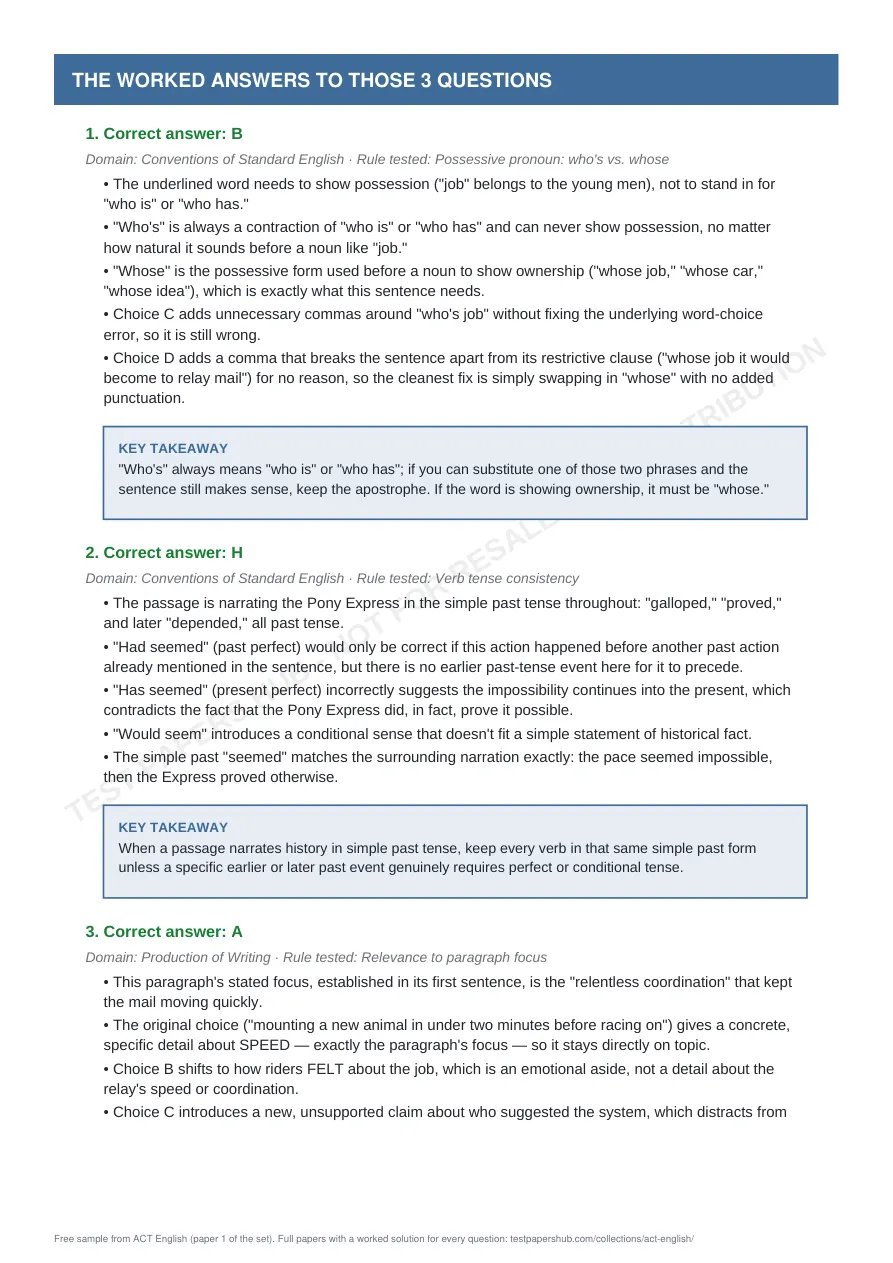
- "Who's" always means "who is" or "who has"; if you can substitute one of those two phrases and the sentence still makes sense, keep the apostrophe. If the word is showing ownership, it must be "whose."
- When a passage narrates history in simple past tense, keep every verb in that same simple past form unless a specific earlier or later past event genuinely requires perfect or conditional tense.
- On "which choice best supports/fits" questions, reread the paragraph's opening sentence first — it usually states the specific focus every other sentence in that paragraph should serve.
Read the text of this sample
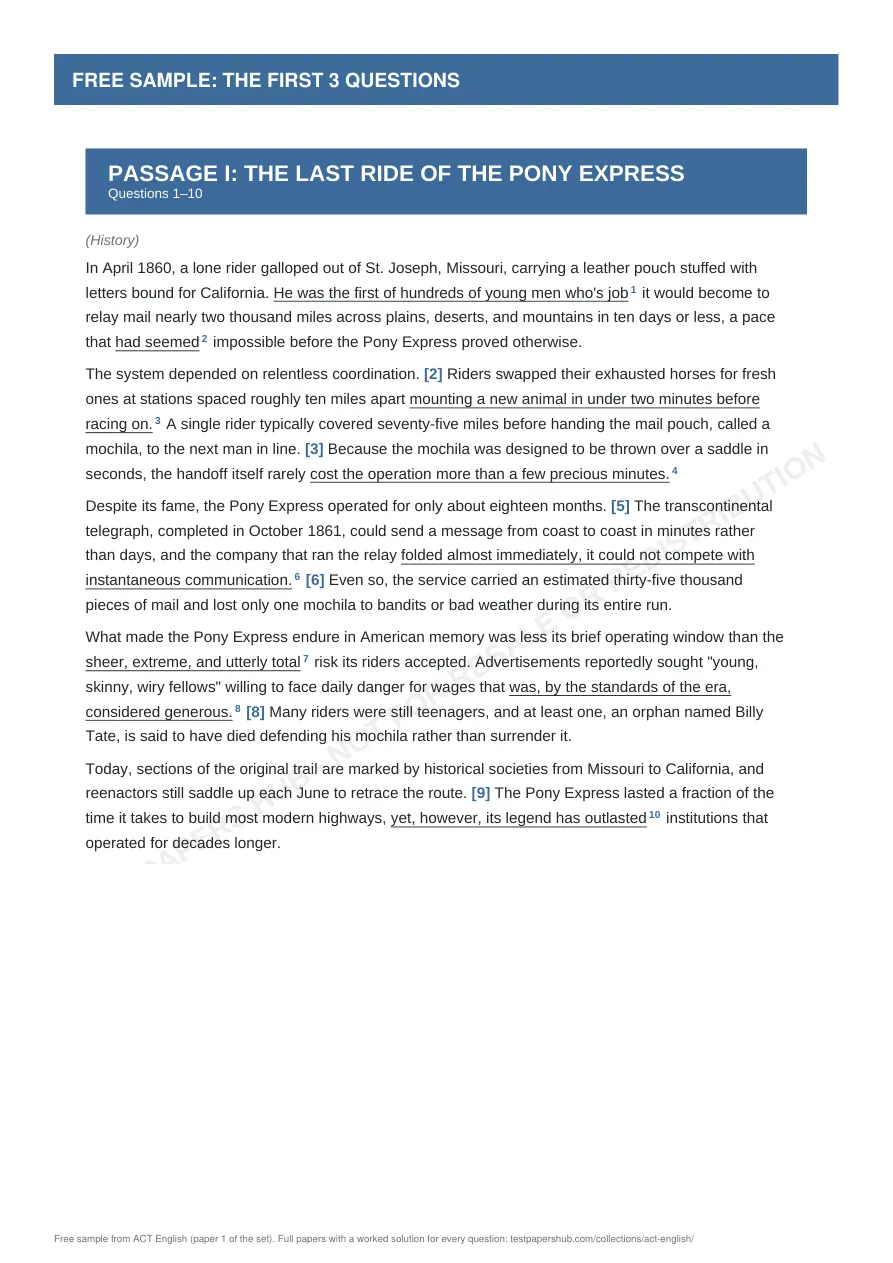
(History) In April 1860, a lone rider galloped out of St. Joseph, Missouri, carrying a leather pouch stuffed with letters bound for California. He was the first of hundreds of young men who's job 1 it would become to relay mail nearly two thousand miles across plains, deserts, and mountains in ten days or less, a pace that had seemed 2 impossible before the Pony Express proved otherwise. The system depended on relentless coordination. [2] Riders swapped their exhausted horses for fresh ones at stations spaced roughly ten miles apart mounting a new animal in under two minutes before racing on. 3 A single rider typically covered seventy-five miles before handing the mail pouch, called a mochila, to the next man in line. [3] Because the mochila was designed to be thrown over a saddle in seconds, the handoff itself rarely cost the operation more than a few precious minutes. 4 Despite its fame, the Pony Express operated for only about eighteen months. [5] The transcontinental telegraph, completed in October 1861, could send a message from coast to coast in minutes rather than days, and the company that ran the relay folded almost immediately, it could not compete with instantaneous communication. 6 [6] Even so, the service carried an estimated thirty-five thousand pieces of mail and lost only one mochila to bandits or bad weather during its entire run. What made the Pony Express endure in American memory was less its brief operating window than the sheer, extreme, and utterly total 7 risk its riders accepted. Advertisements reportedly sought "young, skinny, wiry fellows" willing to face daily danger for wages that was, by the standards of the era, considered generous. 8 [8] Many riders were still teenagers, and at least one, an orphan named Billy Tate, is said to have died defending his mochila rather than surrender it. Today, sections of the original trail are marked by historical societies from Missouri to California, and reenactors still saddle up each June to retrace the route. [9] The Pony Express lasted a fraction of the time it takes to build most modern highways, yet, however, its legend has outlasted 10 institutions that operated for decades longer. PASSAGE I: THE LAST RIDE OF THE PONY EXPRESS Questions 1–10
1. Which choice best corrects the underlined portion?
A. NO CHANGE
B. He was the first of hundreds of young men whose job
C. He was the first of hundreds of young men, who's job,
D. He was the first of hundreds of young men, whose job
2. Which choice most logically completes the sentence and best sets up the information that follows?
F. NO CHANGE
1. Correct answer: B
Domain: Conventions of Standard English · Rule tested: Possessive pronoun: who's vs. whose
• The underlined word needs to show possession ("job" belongs to the young men), not to stand in for "who is" or "who has."
• "Who's" is always a contraction of "who is" or "who has" and can never show possession, no matter how natural it sounds before a noun like "job."
• "Whose" is the possessive form used before a noun to show ownership ("whose job," "whose car," "whose idea"), which is exactly what this sentence needs.
• Choice C adds unnecessary commas around "who's job" without fixing the underlying word-choice error, so it is still wrong.
• Choice D adds a comma that breaks the sentence apart from its restrictive clause ("whose job it would become to relay mail") for no reason, so the cleanest fix is simply swapping in "whose" with no added punctuation.
2. Correct answer: H
Domain: Conventions of Standard English · Rule tested: Verb tense consistency
• The passage is narrating the Pony Express in the simple past tense throughout: "galloped," "proved," and later "depended," all past tense.
• "Had seemed" (past perfect) would only be correct if this action happened before another past action already mentioned in the sentence, but there is no earlier past-tense event here for it to precede.
• "Has seemed" (present perfect) incorrectly suggests the impossibility continues into the present, which contradicts the fact that the Pony Express did, in fact, prove it possible.
• "Would seem" introduces a conditional sense that doesn't fit a simple statement of historical fact.
• The simple past "seemed" matches the surrounding narration exactly: the pace seemed impossible, then the Express proved otherwise.
3. Correct answer: A
Domain: Production of Writing · Rule tested: Relevance to paragraph focus
• This paragraph's stated focus, established in its first sentence, is the "relentless coordination" that kept the mail moving quickly.
• The original choice ("mounting a new animal in under two minutes before racing on") gives a concrete, specific detail about SPEED — exactly the paragraph's focus — so it stays directly on topic.
• Choice B shifts to how riders FELT about the job, which is an emotional aside, not a detail about the relay's speed or coordination.
• Choice C introduces a new, unsupported claim about who suggested the system, which distracts from the paragraph's description of how the handoffs worked.
• Choice D shifts to rider pay, a topic the passage does address later, but not in this sentence about swapping horses — introducing it here would break the paragraph's focus.
Your sample is downloading. Liked it? ACT English Paper 1 is the full paper: 50 questions in 35 minutes across 5 to 6 passages (Enhanced ACT format), with a worked solution for every question.
Get Paper 1 for A$11.99See all 20 papers from A$11.99More free ACT samples
Questions about this sample
What is in the ACT English free sample?
The first 3 questions from paper 1 of the set, in the real exam layout, followed by the step-by-step worked answers. It is a 5-page PDF; this page shows the opening pages.
How many full ACT English papers are there?
20 original papers for students preparing for the ACT. Each is 50 questions in 35 minutes across 5 to 6 passages (Enhanced ACT format), with a worked solution for every question. Papers start at A$11.99 and download instantly as a PDF.
Are these official past papers?
No. The sample is taken from our own original practice paper and is not an official past paper or affiliated with any exam authority.