CFA Level 3 free practice questions with answers
Read the opening questions and their worked answers from paper 1 of our 20-paper CFA Level 3 set, then download the 7-page PDF. These are original practice questions, not official past papers. Page updated 3 November 2026.
Topics: Mean-variance portfolio of equity and bonds (Asset Allocation); Asset-liability management for a pension plan (Asset Allocation); Active management and the fundamental law (Portfolio Construction).
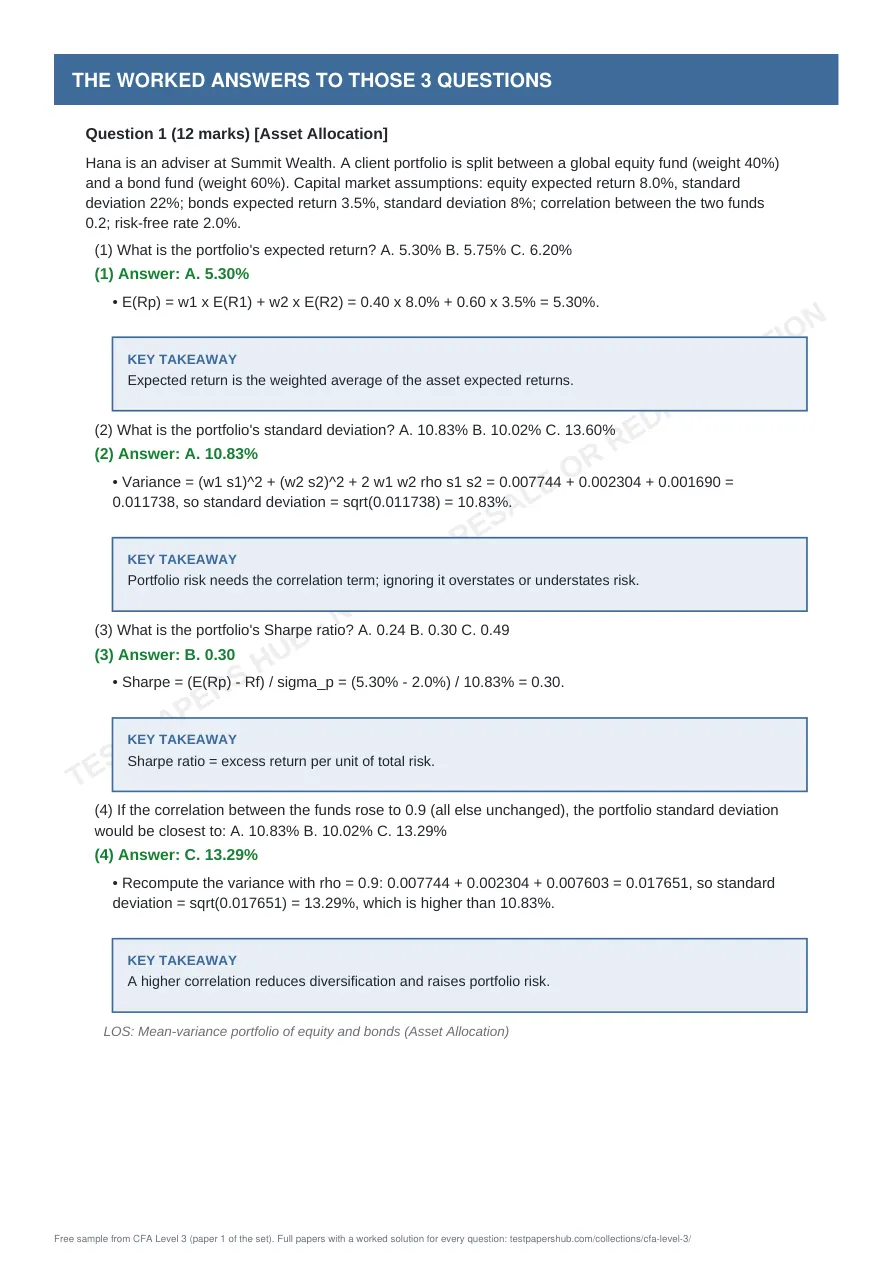
- Expected return is the weighted average of the asset expected returns. (2) What is the portfolio's standard deviation? A. 10.83% B. 10.02% C. 13.60% (2) Answer: A. 10.83%
- Portfolio risk needs the correlation term; ignoring it overstates or understates risk. (3) What is the portfolio's Sharpe ratio? A. 0.24 B. 0.30 C. 0.49 (3) Answer: B. 0.30
- Sharpe ratio = excess return per unit of total risk. (4) If the correlation between the funds rose to 0.9 (all else unchanged), the portfolio standard deviation would be closest to: A. 10.83% B. 10.02% C. 13.29%
- A higher correlation reduces diversification and raises portfolio risk.
Read the text of this sample
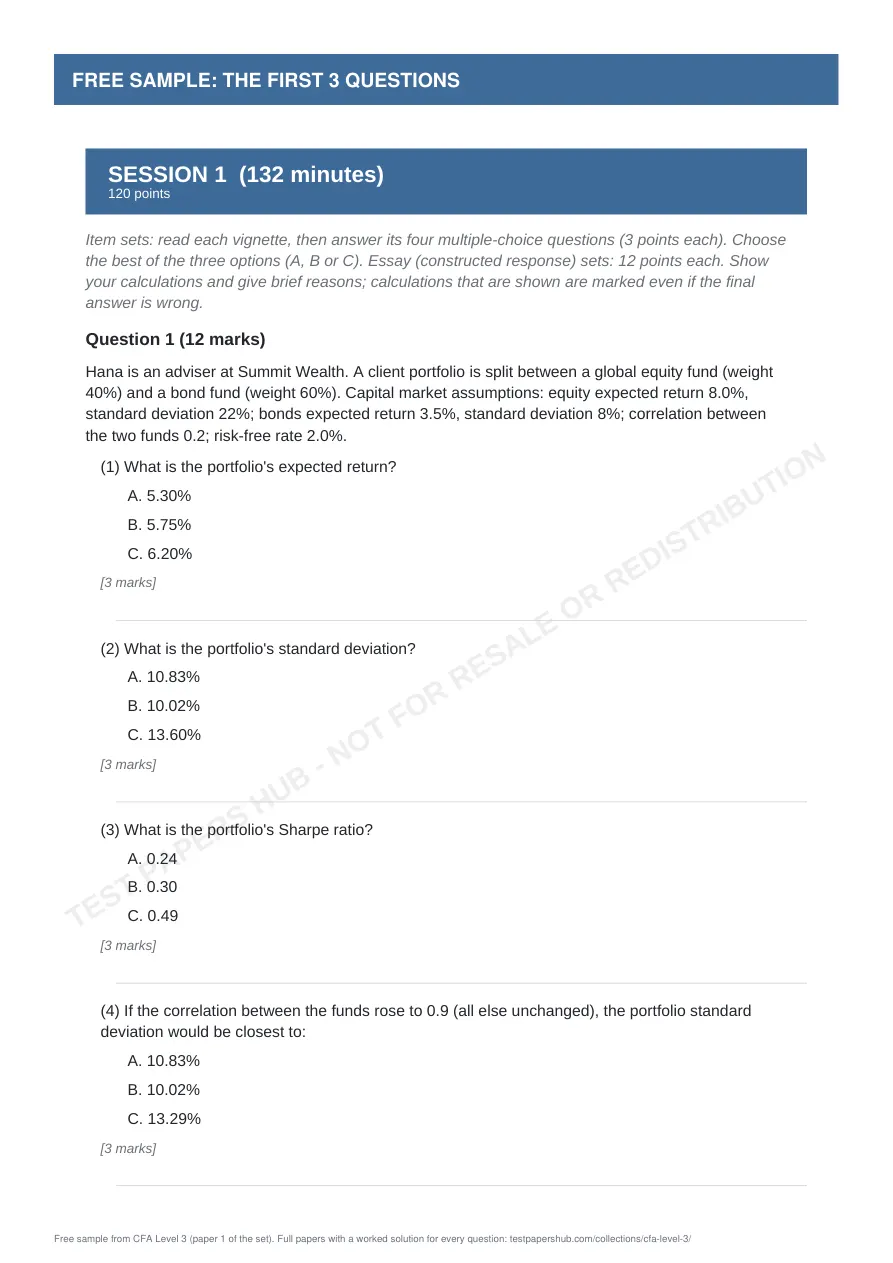
SESSION 1 (132 minutes) 120 points Item sets: read each vignette, then answer its four multiple-choice questions (3 points each). Choose the best of the three options (A, B or C). Essay (constructed response) sets: 12 points each. Show your calculations and give brief reasons; calculations that are shown are marked even if the final answer is wrong. Question 1 (12 marks) Hana is an adviser at Summit Wealth. A client portfolio is split between a global equity fund (weight 40%) and a bond fund (weight 60%). Capital market assumptions: equity expected return 8.0%, standard deviation 22%; bonds expected return 3.5%, standard deviation 8%; correlation between the two funds 0.2; risk-free rate 2.0%.
(1) What is the portfolio's expected return?
A. 5.30%
B. 5.75%
C. 6.20%
[3 marks]
(2) What is the portfolio's standard deviation?
A. 10.83%
B. 10.02%
C. 13.60%
[3 marks]
(3) What is the portfolio's Sharpe ratio?
A. 0.24
B. 0.30
C. 0.49
[3 marks]
(4) If the correlation between the funds rose to 0.9 (all else unchanged), the portfolio standard deviation would be closest to:
A. 10.83%
B. 10.02%
C. 13.29%
[3 marks]
Question 2 (12 marks) Mira manages the Kestrel Pension Plan. Assets are $400m with modified duration 6.5; the present value of liabilities is $421m with modified duration 9.0. Assume duration estimates hold for a parallel shift of 1 percentage point in the discount rate and the yield curve.
(1) The plan's funded ratio is closest to:
A. 95.0%
B. −5.0%
C. 105.2%
[3 marks]
(2) The plan's surplus (deficit) is closest to:
A. −$21m
B. $400m
C. $21m
[3 marks]
(3) If interest rates rise by 1 percentage point, the surplus will change to:
A. −$47.0m
B. −$9.1m
C. $16.9m
[3 marks]
(4) The asset duration needed to immunize the surplus against small parallel rate changes is closest to:
A. 8.55
B. 9.47
C. 9.00
[3 marks]
Question 3 (12 marks) Leila is a portfolio manager at Bluewater Investments running an active equity strategy. Over the past year the portfolio beat its benchmark by 2.0% with tracking error of 4.0%. The manager's information coefficient is 0.08, the strategy makes 64 independent bets a year and the transfer coefficient is 0.7.
(1) The realized information ratio is closest to:
A. 0.33
B. 2.00
C. 0.50
[3 marks]
(2) The expected information ratio from the fundamental law (with transfer coefficient) is closest to:
A. 3.58
B. 0.45
C. 0.64
[3 marks]
(3) To double the expected information ratio by changing breadth only, the number of independent bets must become:
A. 256
B. 128
C. 72
[3 marks]
Question 1 (12 marks) [Asset Allocation]
Hana is an adviser at Summit Wealth. A client portfolio is split between a global equity fund (weight 40%) and a bond fund (weight 60%). Capital market assumptions: equity expected return 8.0%, standard deviation 22%; bonds expected return 3.5%, standard deviation 8%; correlation between the two funds 0.2; risk-free rate 2.0%.
(1) What is the portfolio's expected return? A. 5.30% B. 5.75% C. 6.20%
(1) Answer: A. 5.30%
• E(Rp) = w1 x E(R1) + w2 x E(R2) = 0.40 x 8.0% + 0.60 x 3.5% = 5.30%.
• Variance = (w1 s1)^2 + (w2 s2)^2 + 2 w1 w2 rho s1 s2 = 0.007744 + 0.002304 + 0.001690 = 0.011738, so standard deviation = sqrt(0.011738) = 10.83%.
• Sharpe = (E(Rp) - Rf) / sigmap = (5.30% - 2.0%) / 10.83% = 0.30.
(4) Answer: C. 13.29%
• Recompute the variance with rho = 0.9: 0.007744 + 0.002304 + 0.007603 = 0.017651, so standard deviation = sqrt(0.017651) = 13.29%, which is higher than 10.83%. Question 2 (12 marks) [Asset Allocation]
Mira manages the Kestrel Pension Plan. Assets are $400m with modified duration 6.5; the present value of liabilities is $421m with modified duration 9.0. Assume duration estimates hold for a parallel shift of 1 percentage point in the discount rate and the yield curve.
(1) The plan's funded ratio is closest to: A. 95.0% B. −5.0% C. 105.2%
(1) Answer: A. 95.0%
• Funded ratio = assets / liabilities = 400 / 421 = 95.0%.
• Surplus = assets - liabilities = 400 - 421 = −$21m.
(3) Answer: B. −$9.1m
• Change in assets = −6.5 x 400 x 1% = −$26.0m; change in liabilities = −9.0 x 421 x 1% = −$37.9m; new surplus = −$9.1m.
A. 8.55 B. 9.47 C. 9.00
(4) Answer: B. 9.47
• Match dollar duration: Dassets x A = Dliab x L, so Dassets = 9.0 x 421 / 400 = 9.47. Question 3 (12 marks) [Portfolio Construction]
Leila is a portfolio manager at Bluewater Investments running an active equity strategy. Over the past year the portfolio beat its benchmark by 2.0% with tracking error of 4.0%. The manager's information coefficient is 0.08, the strategy makes 64 independent bets a year and the transfer coefficient is 0.7.
(1) The realized information ratio is closest to: A. 0.33 B. 2.00 C. 0.50
(1) Answer: C. 0.50
• IR = active return / tracking error = 2.0% / 4.0% = 0.50.
(2) Answer: B. 0.45
• IR = TC x IC x sqrt(BR) = 0.7 x 0.08 x sqrt(64) = 0.45.
(3) Answer: A. 256
• IR depends on sqrt(BR), so doubling IR requires 4 times the breadth: 4 x 64 = 256.
(4) Answer: B. 0.51
• IR = 0.8 x 0.08 x sqrt(64) = 0.51.
Your sample is downloading. Liked it? CFA Level 3 Paper 1 is the full paper: 10 item sets (4 multiple-choice questions each, 3 options) and 10 essay sets, 240 points, in 264 minutes in two sessions, with a worked solution for every question.
Get Paper 1 for A$11.99See all 20 papers from A$11.99More free CFA Exams samples
Questions about this sample
What is in the CFA Level 3 free sample?
The first 3 questions from paper 1 of the set, in the real exam layout, followed by the step-by-step worked answers. It is a 7-page PDF; this page shows the opening pages.
How many full CFA Level 3 papers are there?
20 original papers for candidates preparing for the CFA Level 3 exam. Each is 10 item sets (4 multiple-choice questions each, 3 options) and 10 essay sets, 240 points, in 264 minutes in two sessions, with a worked solution for every question. Papers start at A$11.99 and download instantly as a PDF.
Are these official past papers?
No. The sample is taken from our own original practice paper and is not an official past paper or affiliated with any exam authority.