Junior Cycle Maths Higher free practice questions with answers
Read the opening questions and their worked answers from paper 1 of our 20-paper Junior Cycle Maths Higher set, then download the 10-page PDF. These are original practice questions, not official past papers. Page updated 3 November 2026.
Topics: Probability and outcomes (Junior Cycle Mathematics, Higher Level, Statistics and Probability); Statistics: tables, histograms, means and pie charts (Junior Cycle Mathematics, Higher Level, Statistics and; Money, currency and income tax (Junior Cycle Mathematics, Higher Level, Number).
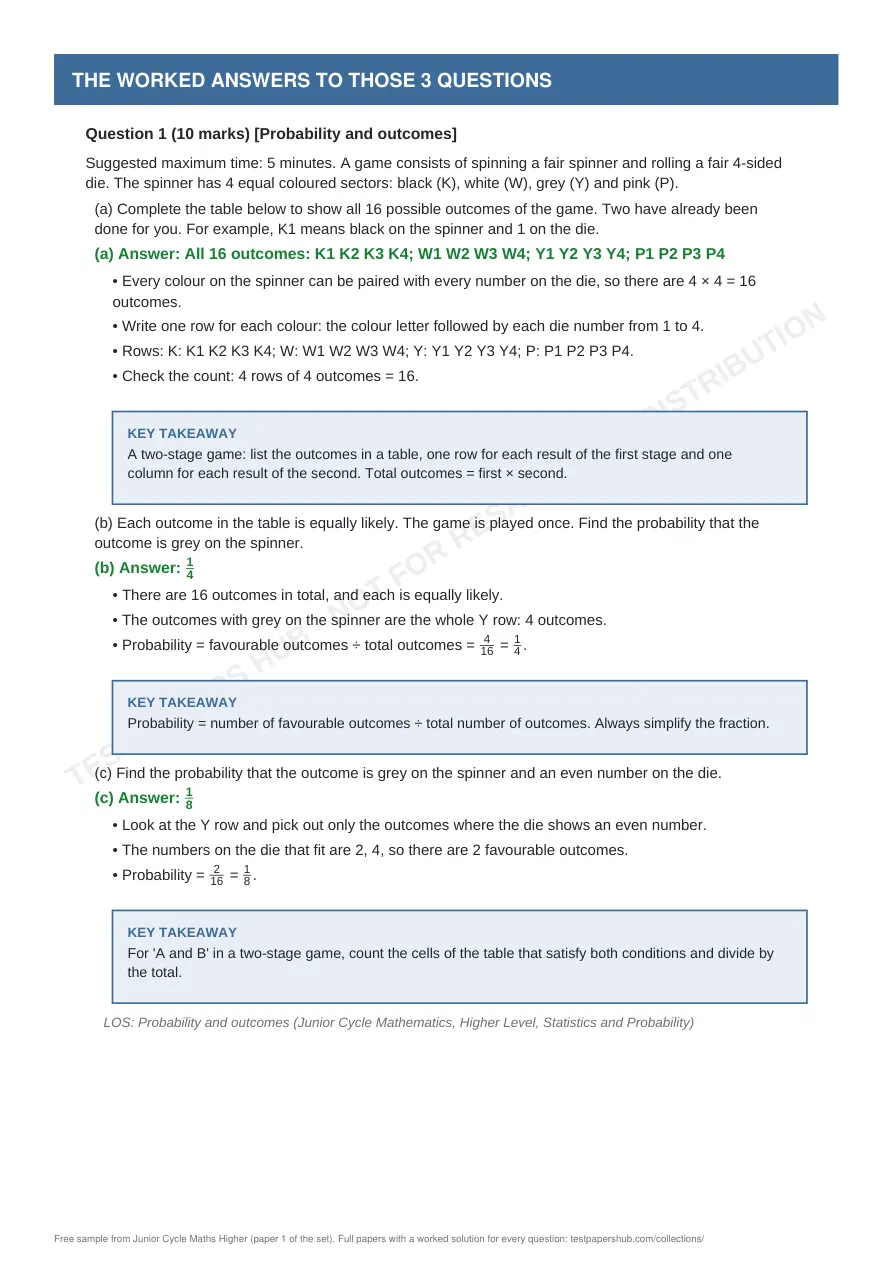
- A two-stage game: list the outcomes in a table, one row for each result of the first stage and one column for each result of the second. Total outcomes = first × second.
- Probability = number of favourable outcomes ÷ total number of outcomes. Always simplify the fraction.
- For 'A and B' in a two-stage game, count the cells of the table that satisfy both conditions and divide by the total.
- A histogram has touching bars; with equal class widths the height of each bar is the frequency of its class.
Read the text of this sample
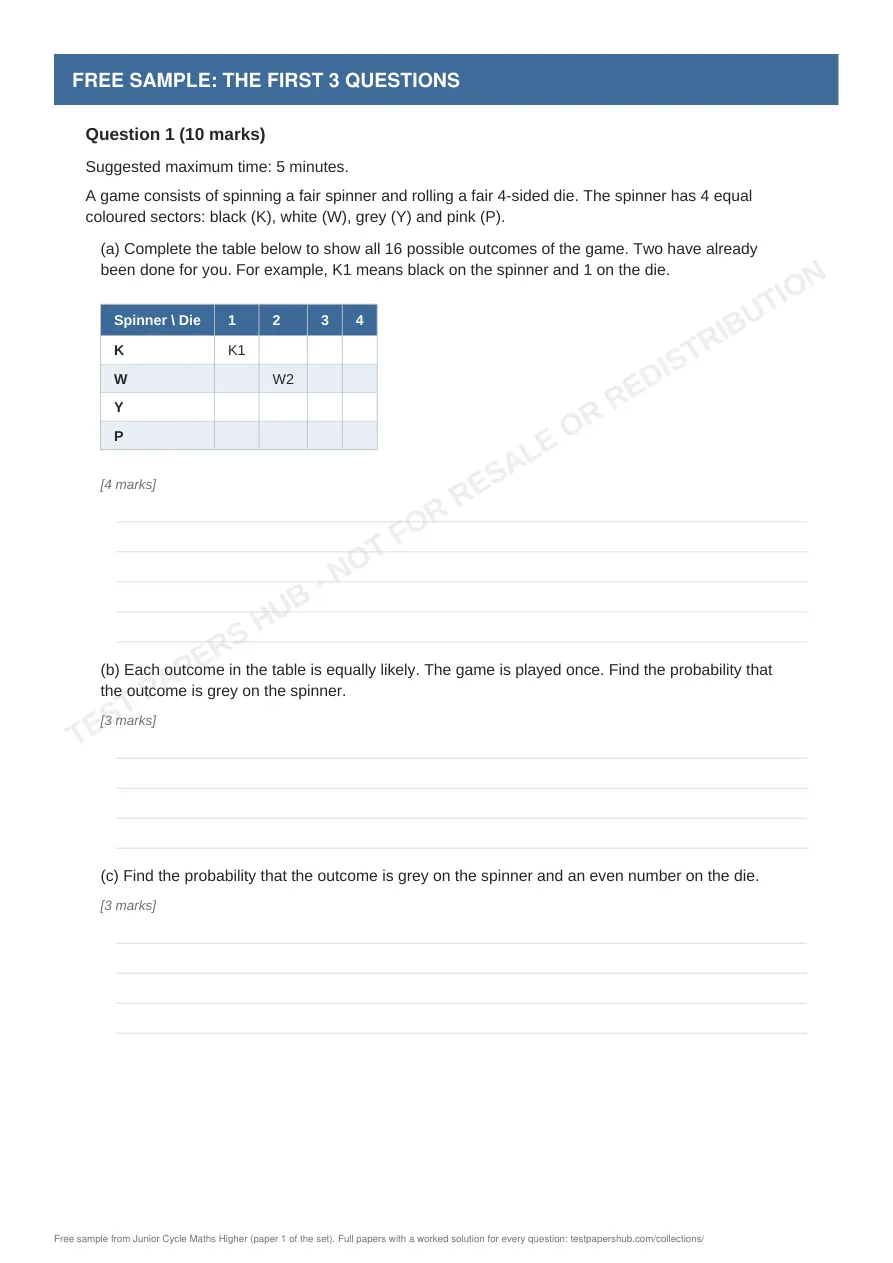
Question 1 (10 marks) Suggested maximum time: 5 minutes.
A game consists of spinning a fair spinner and rolling a fair 4-sided die. The spinner has 4 equal coloured sectors: black (K), white (W), grey (Y) and pink (P).
(a) Complete the table below to show all 16 possible outcomes of the game. Two have already been done for you. For example, K1 means black on the spinner and 1 on the die. Spinner \ Die 1 2 3 4 K K1 W W2 Y P
[4 marks]
(b) Each outcome in the table is equally likely. The game is played once. Find the probability that the outcome is grey on the spinner.
[3 marks]
(c) Find the probability that the outcome is grey on the spinner and an even number on the die.
[3 marks]
Question 2 (25 marks) Suggested maximum time: 10 minutes. 45 students were asked how much time they spent on their phone on a particular day. The results are shown in the frequency table below. [Note: 2 − 4 means 2 hours or more but less than 4 hours hours, and so on.]
(a) Draw a histogram to show the information in the table. Use the axes below. Time (hours) 0 − 2 2 − 4 4 − 6 6 − 8 8 − 10 Number of students 14 14 8 5 4
[6 marks]
0 2 4 6 8 10 0 2 4 6 8 10 12 14 16 18 Time (hours) Number of students
(b) Find the minimum number of students who could have given an answer of less than 7 hours.
[4 marks]
(c) Use mid-interval values to estimate the mean for the 45 students. Give your answer in hours, correct to 1 decimal place.
[6 marks]
(d) The 45 students were also asked about their most common use of their phone. The results are shown in the table. Complete a pie chart to show this information. Label each sector and the size of each angle clearly. Show any workings out. Most common use of their phone Social media Video streaming Gaming Messaging Number of students 2 32 4 7
[9 marks]
Question 3 (25 marks) Suggested maximum time: 10 minutes.
(a) Martina buys a car from abroad. The cost of the car is $22 500 US. The exchange rate is €1 = $1.25 US. Show that the cost of the car in euro is €18 000.
[3 marks]
(b) Martina pays a customs charge of €2430. Write this charge as a percentage of €18 000.
[3 marks]
(c) Martina has a gross annual income of €59 000. Martina pays income tax on this income at the rates given in the table. Work out Martina’s annual income tax at each of these two rates (20% and 40%). Annual income Tax rate First €44 000 20% Balance 40%
[5 marks]
(d) Martina has annual tax credits of €3500. Work out Martina’s net annual income.
[6 marks]
(e) Martina gets a pay rise and Martina’s net annual income increases by €1500. Work out Martina’s new gross annual income.
[8 marks]
Question 1 (10 marks) [Probability and outcomes]
Suggested maximum time: 5 minutes. A game consists of spinning a fair spinner and rolling a fair 4-sided
die. The spinner has 4 equal coloured sectors: black (K), white (W), grey (Y) and pink (P).
(a) Complete the table below to show all 16 possible outcomes of the game. Two have already been done for you. For example, K1 means black on the spinner and 1 on the die.
(a) Answer: All 16 outcomes: K1 K2 K3 K4; W1 W2 W3 W4; Y1 Y2 Y3 Y4; P1 P2 P3 P4
• Every colour on the spinner can be paired with every number on the die, so there are 4 × 4 = 16 outcomes.
• Write one row for each colour: the colour letter followed by each die number from 1 to 4.
• Rows: K: K1 K2 K3 K4; W: W1 W2 W3 W4; Y: Y1 Y2 Y3 Y4; P: P1 P2 P3 P4.
• Check the count: 4 rows of 4 outcomes = 16.
(b) Each outcome in the table is equally likely. The game is played once. Find the probability that the outcome is grey on the spinner.
(b) Answer:
• There are 16 outcomes in total, and each is equally likely.
• The outcomes with grey on the spinner are the whole Y row: 4 outcomes.
• Probability = favourable outcomes ÷ total outcomes =
(c) Find the probability that the outcome is grey on the spinner and an even number on the die.
(c) Answer:
• Look at the Y row and pick out only the outcomes where the die shows an even number.
• The numbers on the die that fit are 2, 4, so there are 2 favourable outcomes.
• Probability = 1 4 4 16 = 1 4 . 1 8 2 16 = 1 8 . Question 2 (25 marks) [Statistics: tables, histograms, means and pie charts]
Suggested maximum time: 10 minutes. 45 students were asked how much time they spent on their phone on a particular day. The results are shown in the frequency table below. [Note: 2 − 4 means 2 hours or more but less than 4 hours hours, and so on.]
(a) Draw a histogram to show the information in the table. Use the axes below. 0 2 4 6 8 10 12 14 16 18 0 2 4 6 8 10 Time (hours) Number of students
(a) Answer: A histogram with bars of equal width and heights (0–2: 14, 2–4: 14, 4–6: 8, 6–8: 5, 8–10: 4).
• The class intervals all have the same width (2 hours), so the height of each bar is simply the frequency.
• Draw one bar for each class, with no gaps, from the lower to the upper class boundary on the horizontal axis.
• Bar heights: 0–2: 14, 2–4: 14, 4–6: 8, 6–8: 5, 8–10: 4.
• Label both axes and check that the total of the heights is 45.
(b) Find the minimum number of students who could have given an answer of less than 7 hours.
(b) Answer: 36
• The value 7 hours lies inside the class 6 − 8, so we do not know exactly how many in that class are below it.
• Everyone in the classes below that one is definitely under 7 hours: 14 + 14 + 8 = 36.
• Minimum: none of the 5 in the class 6 − 8 need be below it, so the answer is 36.
(c) Use mid-interval values to estimate the mean for the 45 students. Give your answer in hours, correct to 1 decimal place.
(c) Answer: 3.7 hours
• Write the mid-interval value of each class: 1, 3, 5, 7, 9.
• Multiply each mid-interval value by its frequency and add: (1 × 14) + (3 × 14) + (5 × 8) + (7 × 5) + (9 × 4).
• Sum = 167.
• Mean = 167 ÷ 45 = 3.7 hours (1 d.p.).
Your sample is downloading. Liked it? Junior Cycle Maths Higher Paper 1 is the full paper: a 270-mark, 2 hour written paper in the 2026 State Examinations Commission layout: 13 compulsory questions across all strands, with a suggested time for each, worked solutions and a key takeaway for every part, with a worked solution for every question.
Get Paper 1 for A$11.99See all 20 papers from A$11.99More free Ireland Junior Cycle samples
Questions about this sample
What is in the Junior Cycle Maths Higher free sample?
The first 3 questions from paper 1 of the set, in the real exam layout, followed by the step-by-step worked answers. It is a 10-page PDF; this page shows the opening pages.
How many full Junior Cycle Maths Higher papers are there?
20 original papers for Irish Junior Cycle students (Second and Third Year) preparing for the Higher Level Mathematics final examination. Each is a 270-mark, 2 hour written paper in the 2026 State Examinations Commission layout: 13 compulsory questions across all strands, with a suggested time for each, worked solutions and a key takeaway for every part, with a worked solution for every question. Papers start at A$11.99 and download instantly as a PDF.
Are these official past papers?
No. The sample is taken from our own original practice paper and is not an official past paper or affiliated with any exam authority.