England KS2 SATs GPS free practice questions with answers
Read the opening questions and their worked answers from paper 1 of our 20-paper England KS2 SATs GPS set, then download the 4-page PDF. These are original practice questions, not official past papers. Page updated 3 November 2026.
- Capitals for names, places, days, months, 'I', and the start of every sentence. 2 Commands (G2.3) Tick the sentence that is a command.
- A command starts with a base verb and has no written subject. 3 Nouns (G1.1) Circle all the nouns in the sentence below. There are four.
- Ask 'can I put the or a in front of it?' If yes, it is probably a noun.
Read the text of this sample
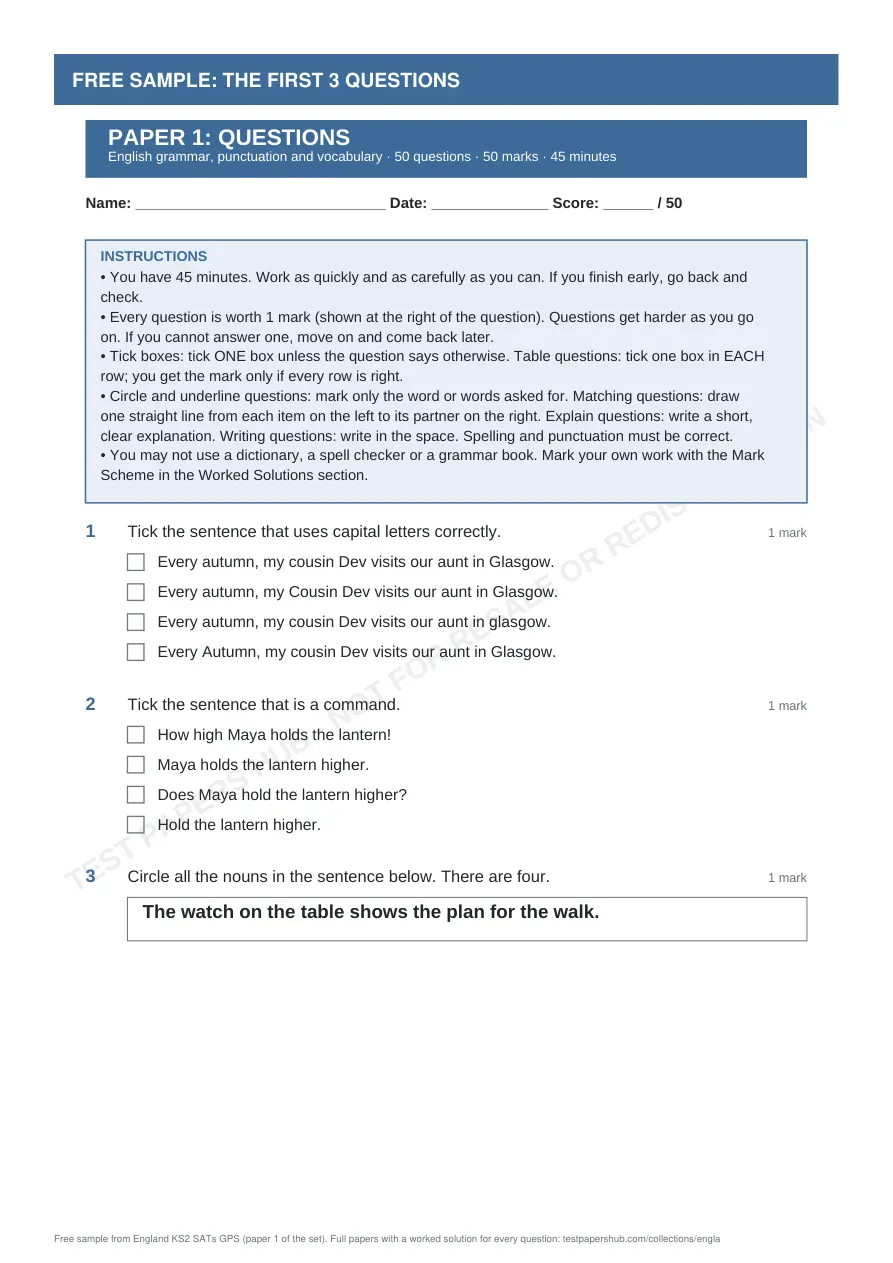
PAPER 1: QUESTIONS English grammar, punctuation and vocabulary · 50 questions · 50 marks · 45 minutes Name: ______________________________ Date: ______________ Score: ______ / 50 INSTRUCTIONS
• You have 45 minutes. Work as quickly and as carefully as you can. If you finish early, go back and check.
• Every question is worth 1 mark (shown at the right of the question). Questions get harder as you go
on. If you cannot answer one, move on and come back later.
• Tick boxes: tick ONE box unless the question says otherwise. Table questions: tick one box in EACH row; you get the mark only if every row is right.
• Circle and underline questions: mark only the word or words asked for. Matching questions: draw one straight line from each item on the left to its partner on the right. Explain questions: write a short, clear explanation. Writing questions: write in the space. Spelling and punctuation must be correct.
• You may not use a dictionary, a spell checker or a grammar book. Mark your own work with the Mark Scheme in the Worked Solutions section. 1 1 mark Tick the sentence that uses capital letters correctly. Every autumn, my cousin Dev visits our aunt in Glasgow. Every autumn, my Cousin Dev visits our aunt in Glasgow. Every autumn, my cousin Dev visits our aunt in glasgow. Every Autumn, my cousin Dev visits our aunt in Glasgow. 2 1 mark Tick the sentence that is a command. How high Maya holds the lantern! Maya holds the lantern higher. Does Maya hold the lantern higher? Hold the lantern higher. 3 1 mark Circle all the nouns in the sentence below. There are four. The watch on the table shows the plan for the walk.
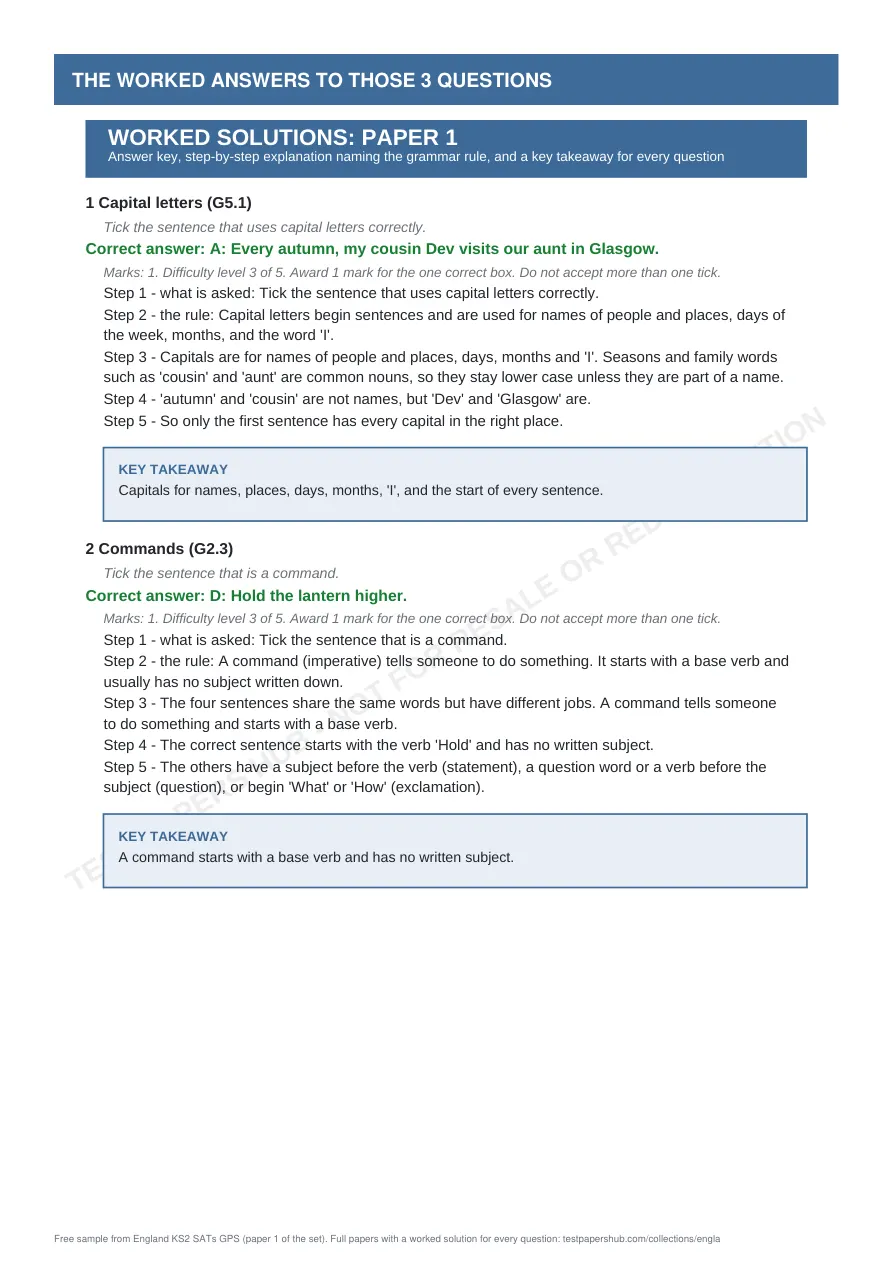
WORKED SOLUTIONS: PAPER 1 Answer key, step-by-step explanation naming the grammar rule, and a key takeaway for every question 1 Capital letters (G5.1) Tick the sentence that uses capital letters correctly.
Correct answer: A: Every autumn, my cousin Dev visits our aunt in Glasgow. Marks: 1. Difficulty level 3 of 5. Award 1 mark for the one correct box. Do not accept more than one tick. Step 1 - what is asked: Tick the sentence that uses capital letters correctly. Step 2 - the rule: Capital letters begin sentences and are used for names of people and places, days of the week, months, and the word 'I'. Step 3 - Capitals are for names of people and places, days, months and 'I'. Seasons and family words such as 'cousin' and 'aunt' are common nouns, so they stay lower case unless they are part of a name. Step 4 - 'autumn' and 'cousin' are not names, but 'Dev' and 'Glasgow' are. Step 5 - So only the first sentence has every capital in the right place.
Correct answer: D: Hold the lantern higher. Marks: 1. Difficulty level 3 of 5. Award 1 mark for the one correct box. Do not accept more than one tick. Step 1 - what is asked: Tick the sentence that is a command. Step 2 - the rule: A command (imperative) tells someone to do something. It starts with a base verb and usually has no subject written down. Step 3 - The four sentences share the same words but have different jobs. A command tells someone to do something and starts with a base verb. Step 4 - The correct sentence starts with the verb 'Hold' and has no written subject. Step 5 - The others have a subject before the verb (statement), a question word or a verb before the subject (question), or begin 'What' or 'How' (exclamation). The watch on the table shows the plan for the walk.
Correct answer: watch, table, plan, walk Marks: 1. Difficulty level 3 of 5. Award 1 mark for circling exactly the correct word(s). Do not accept extra words circled. Step 1 - what is asked: Circle all the nouns in the sentence below. There are four. Step 2 - the rule: A noun names a person, place, thing or idea. Proper nouns name particular people and places and start with a capital letter. Test: a noun can usually follow 'the' or 'a'. Step 3 - Go through the sentence one word at a time and ask 'is this a person, place, thing or idea?' Some words can also be verbs (watch, plan, walk), so test each one: can 'the' or 'a' go before it? Step 4 - The nouns are 'watch', 'table', 'plan', 'walk'. Step 5 - Words such as the, a and some are determiners, and words like and or of are not nouns.
Your sample is downloading. Liked it? England KS2 SATs GPS Paper 1 is the full paper: a 50-mark grammar, punctuation and vocabulary questions paper (45 minutes) plus a 20-word dictated spelling test (about 15 minutes) with a read-aloud script, 70 marks in all, set harder than the real test, with a worked solution for every question.
Get Paper 1 for A$11.99See all 20 papers from A$11.99More free England KS2 SATs (Year 6) samples
Questions about this sample
What is in the England KS2 SATs GPS free sample?
The first 3 questions from paper 1 of the set, in the real exam layout, followed by the step-by-step worked answers. It is a 4-page PDF; this page shows the opening pages.
How many full England KS2 SATs GPS papers are there?
20 original papers for Year 6 pupils in England preparing for the KS2 SATs grammar, punctuation and spelling tests. Each is a 50-mark grammar, punctuation and vocabulary questions paper (45 minutes) plus a 20-word dictated spelling test (about 15 minutes) with a read-aloud script, 70 marks in all, set harder than the real test, with a worked solution for every question. Papers start at A$11.99 and download instantly as a PDF.
Are these official past papers?
No. The sample is taken from our own original practice paper and is not an official past paper or affiliated with any exam authority.