England KS2 SATs Reading free practice questions with answers
Read the opening questions and their worked answers from paper 1 of our 20-paper England KS2 SATs Reading set, then download the 5-page PDF. These are original practice questions, not official past papers. Page updated 3 November 2026.
- Treat each statement on its own. Find the line in the text that proves it true or false, not what feels right.
- Ordering questions test the sequence in the text. Check each event's paragraph number rather than relying on memory or on how likely an order seems.
- Quote the word or phrase, then explain what it suggests and how the reader is meant to feel.
Read the text of this sample
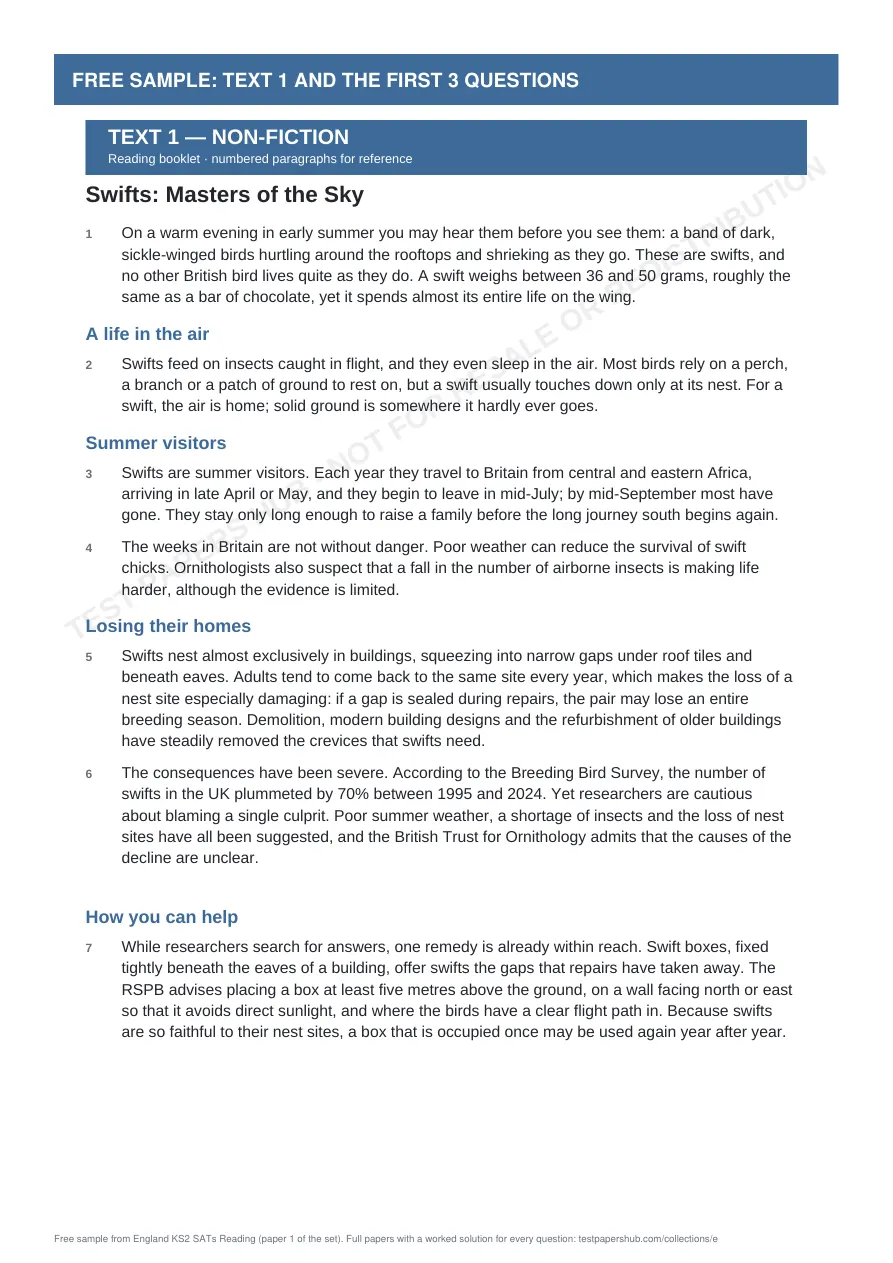
TEXT 1 — NON-FICTION Reading booklet · numbered paragraphs for reference Swifts: Masters of the Sky 1 On a warm evening in early summer you may hear them before you see them: a band of dark, sickle-winged birds hurtling around the rooftops and shrieking as they go. These are swifts, and no other British bird lives quite as they do. A swift weighs between 36 and 50 grams, roughly the same as a bar of chocolate, yet it spends almost its entire life on the wing.
A life in the air 2 Swifts feed on insects caught in flight, and they even sleep in the air. Most birds rely on a perch, a branch or a patch of ground to rest on, but a swift usually touches down only at its nest. For a swift, the air is home; solid ground is somewhere it hardly ever goes. Summer visitors 3 Swifts are summer visitors. Each year they travel to Britain from central and eastern Africa, arriving in late April or May, and they begin to leave in mid-July; by mid-September most have
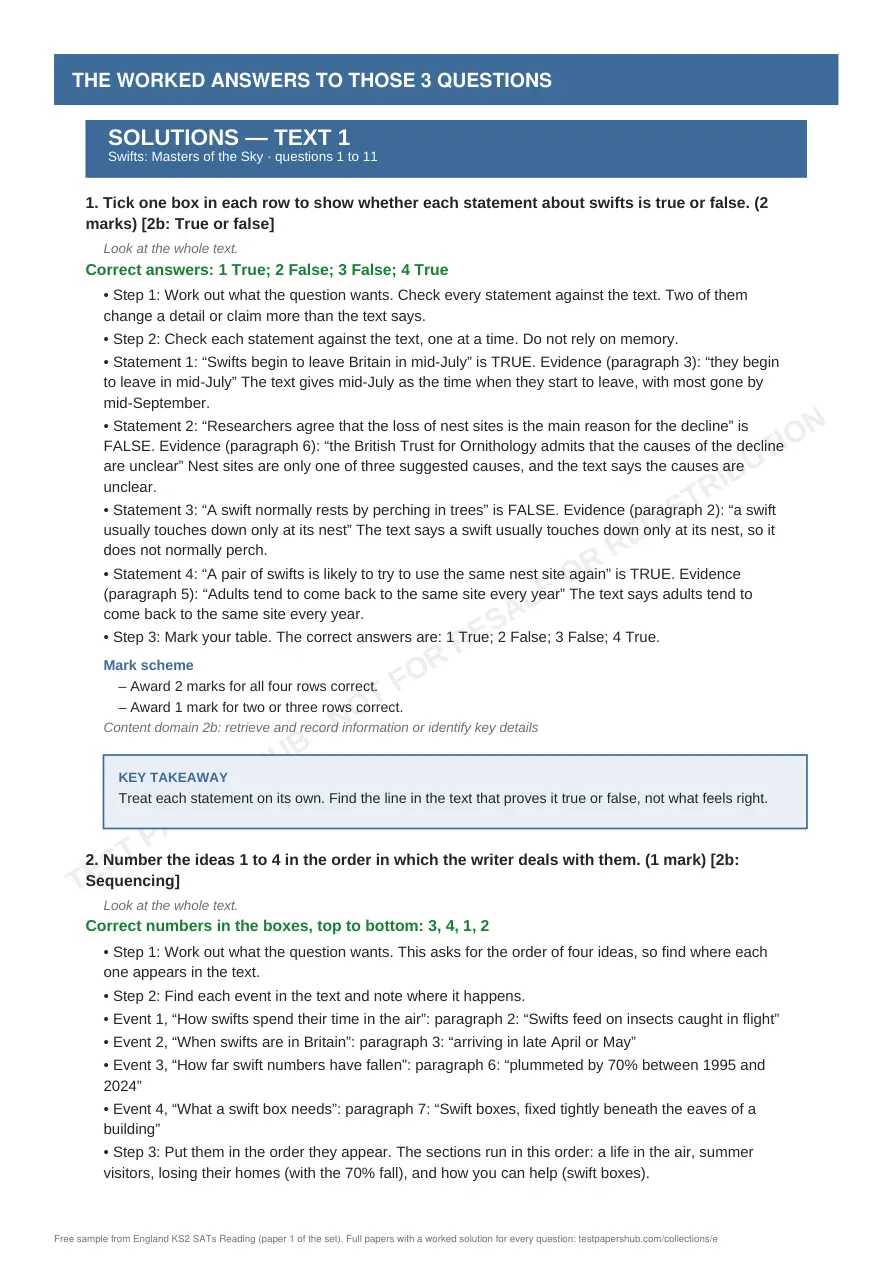
SOLUTIONS — TEXT 1 Swifts: Masters of the Sky · questions 1 to 11
1. Tick one box in each row to show whether each statement about swifts is true or false. (2 marks) [2b: True or false]
Look at the whole text.
Correct answers: 1 True; 2 False; 3 False; 4 True
• Step 1: Work out what the question wants. Check every statement against the text. Two of them change a detail or claim more than the text says.
• Step 2: Check each statement against the text, one at a time. Do not rely on memory.
• Statement 1: “Swifts begin to leave Britain in mid-July” is TRUE. Evidence (paragraph 3): “they begin to leave in mid-July” The text gives mid-July as the time when they start to leave, with most gone by mid-September.
• Statement 2: “Researchers agree that the loss of nest sites is the main reason for the decline” is FALSE. Evidence (paragraph 6): “the British Trust for Ornithology admits that the causes of the decline are unclear” Nest sites are only one of three suggested causes, and the text says the causes are unclear.
• Statement 3: “A swift normally rests by perching in trees” is FALSE. Evidence (paragraph 2): “a swift usually touches down only at its nest” The text says a swift usually touches down only at its nest, so it does not normally perch.
• Statement 4: “A pair of swifts is likely to try to use the same nest site again” is TRUE. Evidence (paragraph 5): “Adults tend to come back to the same site every year” The text says adults tend to come back to the same site every year.
• Step 3: Mark your table. The correct answers are: 1 True; 2 False; 3 False; 4 True. Mark scheme – Award 2 marks for all four rows correct. – Award 1 mark for two or three rows correct. Content domain 2b: retrieve and record information or identify key details
2. Number the ideas 1 to 4 in the order in which the writer deals with them. (1 mark) [2b:
Sequencing]
Look at the whole text. Correct numbers in the boxes, top to bottom: 3, 4, 1, 2
• Step 1: Work out what the question wants. This asks for the order of four ideas, so find where each one appears in the text.
• Step 2: Find each event in the text and note where it happens.
• Event 1, “How swifts spend their time in the air”: paragraph 2: “Swifts feed on insects caught in flight”
• Event 2, “When swifts are in Britain”: paragraph 3: “arriving in late April or May”
• Event 3, “How far swift numbers have fallen”: paragraph 6: “plummeted by 70% between 1995 and 2024”
• Event 4, “What a swift box needs”: paragraph 7: “Swift boxes, fixed tightly beneath the eaves of a building”
• Step 3: Put them in the order they appear. The sections run in this order: a life in the air, summer visitors, losing their homes (with the 70% fall), and how you can help (swift boxes).
• Step 4: The correct order of the boxes as printed is: 3, 4, 1, 2. Mark scheme – Award 1 mark for all four numbers correct: 3, 4, 1, 2. Content domain 2b: retrieve and record information or identify key details
3. Ornithologists ‘suspect’ that falling numbers of airborne insects are making life harder. What does the word ‘suspect’ tell you about what ornithologists know? (1 mark) [2g:
Language choices]
Look at paragraph 4. Model answer: it is only a belief
Your sample is downloading. Liked it? England KS2 SATs Reading Paper 1 is the full paper: a 60-minute, 50-mark reading test in the KS2 SATs layout: a reading booklet of three original texts and an answer booklet of 36 to 40 questions, set harder than the real test, with a worked solution for every question.
Get Paper 1 for A$11.99See all 20 papers from A$11.99More free England KS2 SATs (Year 6) samples
Questions about this sample
What is in the England KS2 SATs Reading free sample?
The first 3 questions from paper 1 of the set, in the real exam layout, followed by the step-by-step worked answers. It is a 5-page PDF; this page shows the opening pages.
How many full England KS2 SATs Reading papers are there?
20 original papers for Year 6 pupils in England preparing for the KS2 SATs English reading test. Each is a 60-minute, 50-mark reading test in the KS2 SATs layout: a reading booklet of three original texts and an answer booklet of 36 to 40 questions, set harder than the real test, with a worked solution for every question. Papers start at A$11.99 and download instantly as a PDF.
Are these official past papers?
No. The sample is taken from our own original practice paper and is not an official past paper or affiliated with any exam authority.