Leaving Cert Biology Higher free practice questions with answers
Read the opening questions and their worked answers from paper 1 of our 20-paper Leaving Cert Biology Higher set, then download the 9-page PDF. These are original practice questions, not official past papers. Page updated 3 November 2026.

Topics: Compulsory question: Organisation of life, structures and processes, interactions (Leaving Certificate Biology,.
- Plant cell: cell wall, large vacuole and chloroplasts distinguish it from an animal cell; mitochondria in every cell carry out aerobic respiration.
- Food tests: iodine for starch, Benedict's (heat) for reducing sugar, biuret for protein, ethanol emulsion for lipid; colour or time against standards makes a test quantitative.
- Osmosis is the net movement of water across a partially permeable membrane from high to low water potential; no mass change marks the isotonic concentration.
- mRNA is complementary to the template strand and read in codons; the genetic code is degenerate, so some mutations are silent.
Read the text of this sample
Question 1 (50 marks)
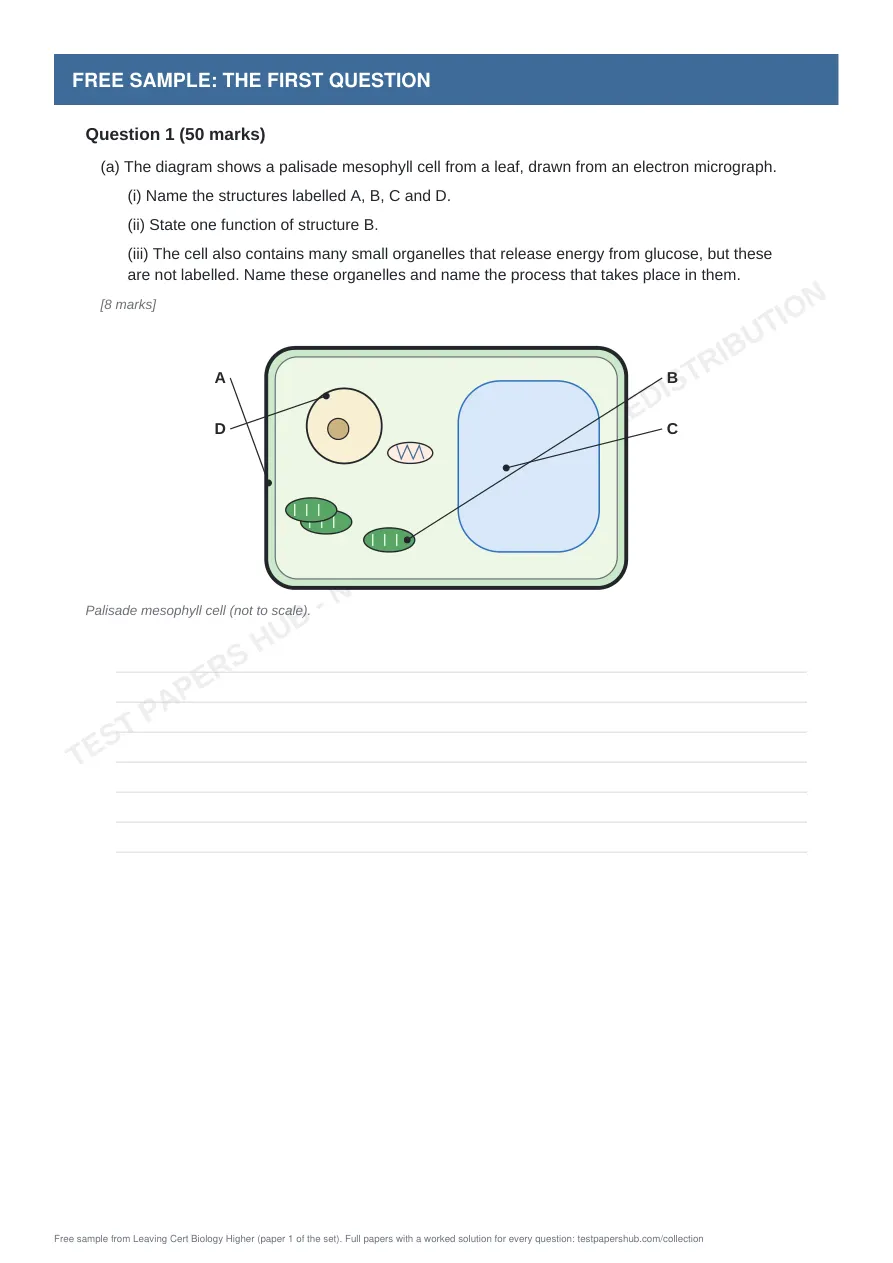
(a) The diagram shows a palisade mesophyll cell from a leaf, drawn from an electron micrograph.
(i) Name the structures labelled A, B, C and D.
(ii) State one function of structure B.
(iii) The cell also contains many small organelles that release energy from glucose, but these are not labelled. Name these organelles and name the process that takes place in them.
[8 marks]
A D B C Palisade mesophyll cell (not to scale).
(b) A student tested three food samples (P, Q and R) for the presence of nutrients. The results are shown in the table.
(i) State which nutrient or nutrients each sample contains. Give a reason for each answer.
(ii) Name the reagent used in the test that gave a purple colour with sample Q.
(iii) The Benedict's test was carried out in a hot water bath. Explain why the mixture was heated.
(iv) The Benedict's test is only qualitative. Describe one way to use it to compare the amounts of reducing sugar in samples. Sample Benedict's test (heated) Iodine solution Biuret reagent Ethanol and water P brick-red blue-black blue stays clear Q blue orange-brown purple stays clear R blue orange-brown blue cloudy white emulsion
[8 marks]
(c) A student investigated osmosis using potato cylinders. Six cylinders, each with an initial mass of 3.00 g, were placed in sucrose solutions of different concentrations for 60 minutes. Each cylinder was blotted dry and reweighed. The results are shown in the table.
(i) Calculate the percentage change in mass of the cylinder in the 0.4 mol L⁻¹ solution.
(ii) State the sucrose concentration that is isotonic to the potato cells. Explain your answer.
(iii) Explain why the cylinder in distilled water (0.0 mol L⁻¹) increased in mass.
(iv) Give one reason why each cylinder was blotted dry before it was reweighed. Sucrose concentration (mol L⁻¹) 0.0 0.1 0.2 0.3 0.4 0.5 Initial mass (g) 3.00 3.00 3.00 3.00 3.00 3.00 Final mass (g) 3.45 3.30 3.15 3.00 2.85 2.70
[8 marks]
(d) The template strand of part of a gene has the base sequence TAC CGA GTT AAA CTG. A portion of the genetic code is given in the table (Met = methionine, Ala = alanine, Gln = glutamine, Phe = phenylalanine, Asp = aspartic acid).
(i) Write the base sequence of the mRNA transcribed from this template strand.
(ii) Use the table to give the sequence of amino acids in the polypeptide.
(iii) State the anticodon on the tRNA that pairs with the second codon of the mRNA.
(iv) Name the organelle where the polypeptide is assembled.
Question 1 (50 marks) [Compulsory question: Organisation of life, structures and processes, interactions]
(a) The diagram shows a palisade mesophyll cell from a leaf, drawn from an electron micrograph. (i) Name the structures labelled A, B, C and D. (ii) State one function of structure B. (iii) The cell also contains many small organelles that release energy from glucose, but these are not labelled. Name these organelles and name the process that takes place in them. A D B C Palisade mesophyll cell (not to scale).
(a) Answer: (i) A cell wall; B chloroplast; C (large) vacuole; D nucleus. (ii) B carries out photosynthesis (traps light and makes glucose). (iii) mitochondria; aerobic respiration.
• Approach: identify each structure from its position and shape, then link structure to function.
• (i) A is the thick outer layer made of cellulose (cell wall). B is the green oval organelle containing stacked membranes (chloroplast). C is the large clear sac occupying much of the cell (vacuole, filled with cell sap). D is the round structure with a nucleolus inside it (nucleus). 1 mark each = 4.
• (ii) Chloroplasts contain chlorophyll, which absorbs light energy; in them light energy is used to make glucose from carbon dioxide and water (photosynthesis). Any one correct function = 2.
• (iii) The organelles that release energy from glucose are mitochondria (1) and the process is aerobic respiration (1).
(b) A student tested three food samples (P, Q and R) for the presence of nutrients. The results are shown in the table. (i) State which nutrient or nutrients each sample contains. Give a reason for each answer. (ii) Name the reagent used in the test that gave a purple colour with sample Q. (iii) The Benedict's test was carried out in a hot water bath. Explain why the mixture was heated. (iv) The Benedict's test is only qualitative. Describe one way to use it to compare the amounts of reducing sugar in samples.
(b) Answer: (i) P: reducing sugar and starch; Q: protein; R: lipid (fat). (ii) biuret reagent. (iii) the reaction between a reducing sugar and Benedict's reagent needs heat. (iv) use a colorimeter, or compare the colour or time taken against known concentrations.
• Approach: match each positive colour change to the test that produces it.
• (i) P gave a brick-red colour with Benedict's (reducing sugar present) and blue-black with iodine (starch present). Q gave purple with biuret (protein). R gave a cloudy white emulsion with ethanol and water (lipid). 3 marks.
• (ii) Biuret reagent (sodium hydroxide and copper sulfate) turns purple when protein is present. 1 mark.
• (iii) The reaction between the reducing sugar and the copper(II) ions in Benedict's reagent is slow at room temperature; heating (about 80 °C) provides the energy needed for the colour change to brick
red. 2 marks.
• (iv) Heat each sample for the same time with the same volume of reagent and compare the final colour with standards made from known concentrations of glucose (a colorimeter makes this measurement objective), or time how long the colour change takes. Any one method described = 2 marks.
Your sample is downloading. Liked it? Leaving Cert Biology Higher Paper 1 is the full paper: a 300-mark, 2 hour 30 minute written paper in the SEC layout: a compulsory Question 1 and six more 50-mark questions (the real exam asks for any five), covering all three strands, with worked solutions and a key takeaway for every part, with a worked solution for every question.
Get Paper 1 for A$11.99See all 20 papers from A$11.99More free Ireland Leaving Certificate samples
Questions about this sample
What is in the Leaving Cert Biology Higher free sample?
The first 3 questions from paper 1 of the set, in the real exam layout, followed by the step-by-step worked answers. It is a 9-page PDF; this page shows the opening pages.
How many full Leaving Cert Biology Higher papers are there?
20 original papers for Irish Leaving Certificate students sitting Higher Level Biology. Each is a 300-mark, 2 hour 30 minute written paper in the SEC layout: a compulsory Question 1 and six more 50-mark questions (the real exam asks for any five), covering all three strands, with worked solutions and a key takeaway for every part, with a worked solution for every question. Papers start at A$11.99 and download instantly as a PDF.
Are these official past papers?
No. The sample is taken from our own original practice paper and is not an official past paper or affiliated with any exam authority.