Leaving Cert Chemistry Higher free practice questions with answers
Read the opening questions and their worked answers from paper 1 of our 20-paper Leaving Cert Chemistry Higher set, then download the 9-page PDF. These are original practice questions, not official past papers. Page updated 3 November 2026.

Topics: Atomic structure, energetics, bonding and a standard solution (Leaving Certificate Chemistry, Higher Level.
- Each emission line is one electron transition: Em − En = hf, so a set of line positions is a fingerprint of the element.
- Hess's law lets you add or subtract measured combustion enthalpies to find a formation enthalpy: ΔH = Σ(combustion of reactants) − Σ(combustion of products).
- Dips in the first ionisation energy across a period come from a new sublevel (Al) or from electron pairing (S); a big jump in successive values shows how many outer electrons there are.
- Hydrogen bonding (O–H···O) explains the higher boiling point of an alcohol than its ether isomer and its solubility in water.
Read the text of this sample
Question 1 (50 marks)
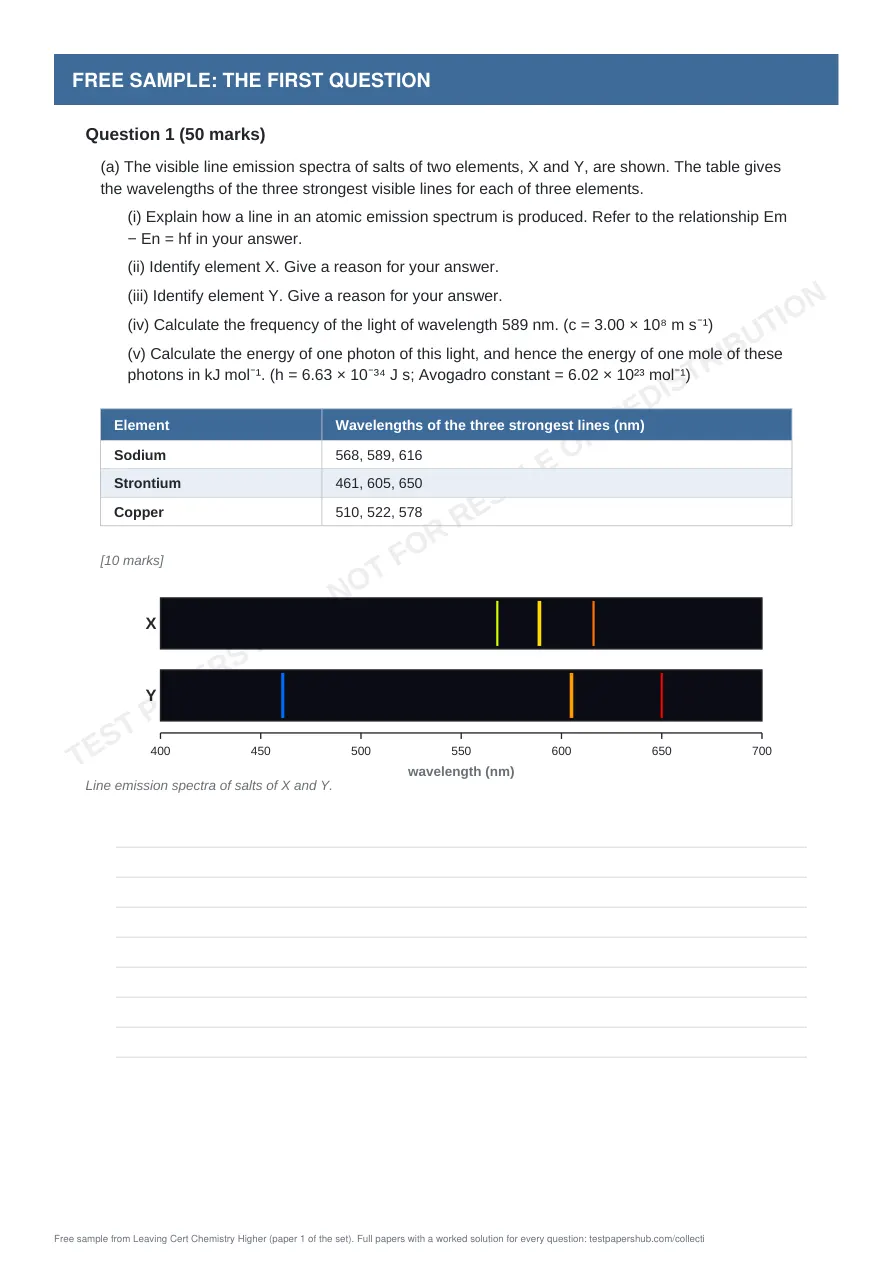
(a) The visible line emission spectra of salts of two elements, X and Y, are shown. The table gives the wavelengths of the three strongest visible lines for each of three elements.
(i) Explain how a line in an atomic emission spectrum is produced. Refer to the relationship Em − En = hf in your answer.
(ii) Identify element X. Give a reason for your answer.
(iii) Identify element Y. Give a reason for your answer.
(iv) Calculate the frequency of the light of wavelength 589 nm. (c = 3.00 × 10⁸ m s⁻¹)
(v) Calculate the energy of one photon of this light, and hence the energy of one mole of these photons in kJ mol⁻¹. (h = 6.63 × 10⁻³⁴ J s; Avogadro constant = 6.02 × 10²³ mol⁻¹) Element Wavelengths of the three strongest lines (nm) Sodium 568, 589, 616 Strontium 461, 605, 650 Copper 510, 522, 578
[10 marks]
X Y 400 450 500 550 600 650 700 wavelength (nm) Line emission spectra of salts of X and Y.
(b) Enthalpy changes of combustion are measured in the laboratory, and Hess's law is used to find enthalpy changes that cannot be measured directly. The standard enthalpy changes of combustion are: carbon, −393.5 kJ mol⁻¹; hydrogen, −285.8 kJ mol⁻¹; ethanol, −1367 kJ mol⁻¹.
(i) State Hess's law.
(ii) Use the data to calculate the enthalpy change of formation of ethanol, C₂H₅OH(l), from its elements: 2C(s) + 3H₂(g) + ½O₂(g) → C₂H₅OH(l)
(iii) A student burned ethanol in a spirit burner under a metal can of water and calculated a heat of combustion that was smaller (less exothermic) than the value above. Give two reasons for this difference.
[10 marks]
(c) The table gives the first ionisation energies (kJ mol⁻¹) of the elements in the third period.
(i) What is meant by the first ionisation energy of an element?
(ii) Identify the two elements in period 3 that do not follow the general increase in first ionisation energy across the period, and explain each exception.
(iii) The first four ionisation energies of an element Z are 738, 1451, 7733 and 10 543 kJ mol⁻¹. In which group of the periodic table is Z? Explain your answer. Na Mg Al Si P S Cl Ar 496 738 578 786 1012 1000 1251 1521
[10 marks]
(d) Ethanol (boiling point 78 °C) and methoxymethane, CH₃OCH₃ (boiling point −24 °C), are structural isomers with the molecular formula C₂H₆O.
(i) Explain, in terms of intermolecular forces, why ethanol has a much higher boiling point than methoxymethane.
(ii) Draw a diagram to show the hydrogen bonding between two molecules of ethanol. Show the dipoles and the position of the hydrogen bond.
Question 1 (50 marks) [Atomic structure, energetics, bonding and a standard solution]
(a) The visible line emission spectra of salts of two elements, X and Y, are shown. The table gives the wavelengths of the three strongest visible lines for each of three elements. (i) Explain how a line in an atomic emission spectrum is produced. Refer to the relationship Em − En = hf in your answer. (ii) Identify element X. Give a reason for your answer. (iii) Identify element Y. Give a reason for your answer. (iv) Calculate the frequency of the light of wavelength 589 nm. (c = 3.00 × 10⁸ m s⁻¹) (v) Calculate the energy of one photon of this light, and hence the energy of one mole of these photons in kJ mol⁻¹. (h = 6.63 × 10⁻³⁴ J s; Avogadro constant = 6.02 × 10²³ mol⁻¹) X Y 400 450 500 550 600 650 700 wavelength (nm) Line emission spectra of salts of X and Y.
(a) Answer: (i) Heat or an electric current excites electrons to higher energy levels; when an electron falls from a higher level (Em) to a lower level (En) it emits a photon of energy hf = Em − En, so each line has one fixed frequency. (ii) X is sodium: its lines are at 568, 589 and 616 nm. (iii) Y is strontium: its lines are at 461, 605 and 650 nm. (iv) f = c/λ = 5.09 × 10¹⁴ Hz. (v) E = hf = 3.38 × 10⁻¹⁹ J per photon; per mole 3.38 × 10⁻¹⁹ × 6.02 × 10²³ = 2.03 × 10⁵ J = 203 kJ mol⁻¹.
• Approach: link each spectral line to one electron transition, then match the line positions to the reference table, then use f = c/λ and E = hf.
• (i) Excited electrons (heat or electricity supplied) occupy higher energy levels. When an electron drops from level m to a lower level n the energy difference is released as one photon, Em − En = hf, where f is the photon's frequency. Only certain energy differences exist, so only certain frequencies, and therefore a few sharp lines, appear. 3 marks.
• (ii) The lines in spectrum X are at 568, 589 and 616 nm, which match the sodium row exactly. (iii) The lines in spectrum Y are at 461, 605 and 650 nm, which match strontium. 1 mark for each element, 1 mark for each reason.
• (iv) λ = 589 nm = 589 × 10⁻⁹ m. f = c/λ = 3.00 × 10⁸ ÷ 5.89 × 10⁻⁷ = 5.09 × 10¹⁴ Hz. 1 mark.
• (v) E = hf = 6.63 × 10⁻³⁴ × 5.09 × 10¹⁴ = 3.38 × 10⁻¹⁹ J per photon (1). For one mole multiply by Avogadro's constant: 3.38 × 10⁻¹⁹ × 6.02 × 10²³ = 2.03 × 10⁵ J mol⁻¹ = 203 kJ mol⁻¹ (1).
(b) Enthalpy changes of combustion are measured in the laboratory, and Hess's law is used to find enthalpy changes that cannot be measured directly. The standard enthalpy changes of combustion are:
carbon, −393.5 kJ mol⁻¹; hydrogen, −285.8 kJ mol⁻¹; ethanol, −1367 kJ mol⁻¹. (i) State Hess's law. (ii) Use the data to calculate the enthalpy change of formation of ethanol, C₂H₅OH(l), from its elements:
2C(s) + 3H₂(g) + ½O₂(g) → C₂H₅OH(l) (iii) A student burned ethanol in a spirit burner under a metal can of water and calculated a heat of combustion that was smaller (less exothermic) than the value above. Give two reasons for this difference.
Your sample is downloading. Liked it? Leaving Cert Chemistry Higher Paper 1 is the full paper: a 300-mark, 2 hour 30 minute written paper in the SEC layout: a compulsory Question 1 and six more 50-mark questions (the real exam asks for any five), covering all four strands, with worked solutions and a key takeaway for every part, with a worked solution for every question.
Get Paper 1 for A$11.99See all 20 papers from A$11.99More free Ireland Leaving Certificate samples
Questions about this sample
What is in the Leaving Cert Chemistry Higher free sample?
The first 3 questions from paper 1 of the set, in the real exam layout, followed by the step-by-step worked answers. It is a 9-page PDF; this page shows the opening pages.
How many full Leaving Cert Chemistry Higher papers are there?
20 original papers for Irish Leaving Certificate students sitting Higher Level Chemistry. Each is a 300-mark, 2 hour 30 minute written paper in the SEC layout: a compulsory Question 1 and six more 50-mark questions (the real exam asks for any five), covering all four strands, with worked solutions and a key takeaway for every part, with a worked solution for every question. Papers start at A$11.99 and download instantly as a PDF.
Are these official past papers?
No. The sample is taken from our own original practice paper and is not an official past paper or affiliated with any exam authority.