Leaving Cert Physics Higher free practice questions with answers
Read the opening questions and their worked answers from paper 1 of our 20-paper Leaving Cert Physics Higher set, then download the 7-page PDF. These are original practice questions, not official past papers. Page updated 3 November 2026.

Topics: Circuits, forces, gravitation, induction and the nucleus (Leaving Certificate Physics, Higher Level written.
- Series: add the resistances; parallel: add the reciprocals; the current splits in a parallel network, and the same p.d. is across each branch.
- Always write F = ma for the direction of acceleration: T = m(g + a) going up, T = m(g − a) going down.
- g = g₀(R/r)², and escape speed v = √(2GM/r) = √(2gr) is independent of the escaping object's mass.
- E = N A ΔB/Δt; the induced current always opposes the change in flux (Lenz's law).
Read the text of this sample
Question 1 (50 marks)
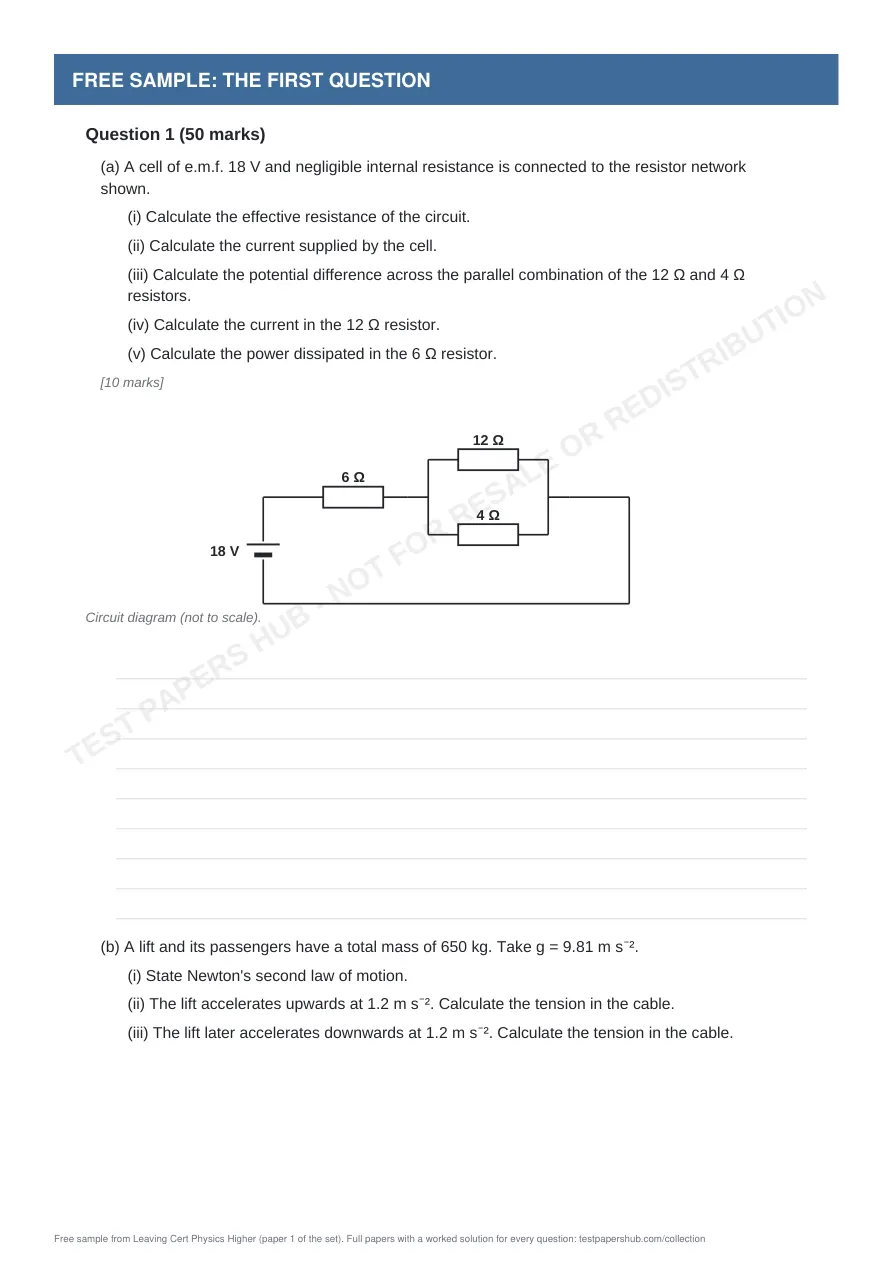
(a) A cell of e.m.f. 18 V and negligible internal resistance is connected to the resistor network shown.
(i) Calculate the effective resistance of the circuit.
(ii) Calculate the current supplied by the cell.
(iii) Calculate the potential difference across the parallel combination of the 12 Ω and 4 Ω resistors.
(iv) Calculate the current in the 12 Ω resistor.
(v) Calculate the power dissipated in the 6 Ω resistor.
[10 marks]
6 Ω 12 Ω 4 Ω 18 V Circuit diagram (not to scale).
(b) A lift and its passengers have a total mass of 650 kg. Take g = 9.81 m s⁻².
(i) State Newton's second law of motion.
(ii) The lift accelerates upwards at 1.2 m s⁻². Calculate the tension in the cable.
(iii) The lift later accelerates downwards at 1.2 m s⁻². Calculate the tension in the cable.
(iv) Explain why a passenger feels heavier when the lift accelerates upwards.
[10 marks]
(c) The gravitational field strength at the surface of the Earth is 9.81 N kg⁻¹ and the radius of the Earth is 6371 km. A satellite orbits 600 km above the surface of the Earth.
(i) Calculate the gravitational field strength at the height of the satellite.
(ii) Calculate the escape velocity at this height.
(iii) Explain why the escape velocity of a rocket does not depend on the mass of the rocket.
[10 marks]
(d) A coil of 500 turns and cross-sectional area 3.0 × 10⁻³ m² is placed with its plane perpendicular to a magnetic field. The magnetic flux density through the coil decreases by 0.40 T in 0.050 s.
(i) State Faraday's law of electromagnetic induction.
(ii) Calculate the average e.m.f. induced in the coil.
(iii) Explain, with reference to Lenz's law, the direction of the induced current.
(iv) State two ways of increasing the induced e.m.f. for the same change in field.
[10 marks]
(e) The mass of a helium-4 nucleus is 6.64466 × 10⁻²⁷ kg. Mass of a proton = 1.67262 × 10⁻²⁷ kg; mass of a neutron = 1.67493 × 10⁻²⁷ kg; c = 3.00 × 10⁸ m s⁻¹; 1 MeV = 1.602 × 10⁻¹³ J.
(i) What is meant by the mass defect of a nucleus?
(ii) Calculate the mass defect of the helium-4 nucleus.
(iii) Calculate the binding energy of the nucleus in joules and in MeV.
(iv) Calculate the binding energy per nucleon.
[10 marks]
QUESTIONS 2 TO 7 50 marks each · in the real paper you answer any FIVE This practice paper prints all six so you can choose your best five, or attempt more than the real paper allows.
Question 1 (50 marks) [Circuits, forces, gravitation, induction and the nucleus]
(a) A cell of e.m.f. 18 V and negligible internal resistance is connected to the resistor network shown. (i) Calculate the effective resistance of the circuit. (ii) Calculate the current supplied by the cell. (iii) Calculate the potential difference across the parallel combination of the 12 Ω and 4 Ω resistors. (iv) Calculate the current in the 12 Ω resistor. (v) Calculate the power dissipated in the 6 Ω resistor. 6 Ω 12 Ω 4 Ω 18 V Circuit diagram (not to scale).
(a) Answer: (i) 1/R = 18 ÷ 9.0 = 2.0 A. (iii) V = IR = 2.0 × 3.0 = 6.0 V. (iv) I = V/R = 6.0 ÷ 12 = 0.50 A. (v) P = I²R = (2.0)² × 6 = 24 W.
• Approach: reduce the parallel part to one resistor, add the series resistor, then work back through the circuit using V = IR.
• (i) For parallel resistors 1/R = 1/R₁ + 1/R₂ = R(total) = 6 + 3.0 = 9.0 Ω. 3 marks.
• (ii) I = V ÷ R = 18 ÷ 9.0 = 2.0 A (the whole current flows through the 6 Ω resistor). 2 marks.
• (iii) The p.d. across the parallel part is V = IR = 2.0 A × 3.0 Ω = 6.0 V. 2 marks.
• (iv) The 12 Ω resistor has 6.0 V across it: I = 6.0 ÷ 12 = 0.50 A (the other 1.5 A goes through the 4 Ω resistor). 2 marks.
• (v) P = I²R = 2.0² × 6 = 24 W. 1 mark.
(b) A lift and its passengers have a total mass of 650 kg. Take g = 9.81 m s⁻². (i) State Newton's second law of motion. (ii) The lift accelerates upwards at 1.2 m s⁻². Calculate the tension in the cable. (iii) The lift later accelerates downwards at 1.2 m s⁻². Calculate the tension in the cable. (iv) Explain why a passenger feels heavier when the lift accelerates upwards.
(b) Answer: (i) The acceleration of an object is directly proportional to the resultant force acting on it and inversely proportional to its mass, in the direction of the force (F = ma). (ii) T − mg = ma, so T = m(g + a) = 650 × (9.81 + 1.2) = 7.16 × 10³ N. (iii) T = m(g − a) = 650 × (9.81 − 1.2) = 5.60 × 10³ N. (iv) The floor must exert a normal reaction greater than the passenger's weight to give an upward resultant force; the reaction force is what the passenger feels as 1 12 + 1 4 = 1 3 , so the parallel part is 3.0 Ω; R = 6 + 3 = 9.0 Ω. (ii) I = V/R = 1 12 + 1 4 = 4 12 , so R = 3.0 Ω. This is in series with 6 Ω:
'weight'.
• Approach: draw the two forces (tension up, weight down), then apply F = ma with the resultant in the direction of acceleration.
• (i) Resultant force = mass × acceleration, F = ma, acting in the direction of the acceleration. 2 marks.
• (ii) Upwards positive: T − mg = ma. T = m(g + a) = 650 × (9.81 + 1.2) = 650 × 11.01 = 7156 N ≈ 7.16 × 10³ N. 3 marks.
• (iii) Downward acceleration: mg − T = ma, so T = m(g − a) = 650 × (9.81 − 1.2) = 650 × 8.61 = 5597 N ≈ 5.60 × 10³ N. 2 marks.
• (iv) For an upward acceleration the resultant force on the passenger is upwards, so the normal reaction N from the floor is greater than the weight mg (N − mg = ma). The sensation of weight is the reaction force, so it feels larger. 3 marks.
Your sample is downloading. Liked it? Leaving Cert Physics Higher Paper 1 is the full paper: a 300-mark, 2 hour 30 minute written paper in the SEC layout: a compulsory Question 1 and six more 50-mark questions (the real exam asks for any five), covering all four strands, with worked solutions and a key takeaway for every part, with a worked solution for every question.
Get Paper 1 for A$11.99See all 20 papers from A$11.99More free Ireland Leaving Certificate samples
Questions about this sample
What is in the Leaving Cert Physics Higher free sample?
The first 3 questions from paper 1 of the set, in the real exam layout, followed by the step-by-step worked answers. It is a 7-page PDF; this page shows the opening pages.
How many full Leaving Cert Physics Higher papers are there?
20 original papers for Irish Leaving Certificate students sitting Higher Level Physics. Each is a 300-mark, 2 hour 30 minute written paper in the SEC layout: a compulsory Question 1 and six more 50-mark questions (the real exam asks for any five), covering all four strands, with worked solutions and a key takeaway for every part, with a worked solution for every question. Papers start at A$11.99 and download instantly as a PDF.
Are these official past papers?
No. The sample is taken from our own original practice paper and is not an official past paper or affiliated with any exam authority.