Leaving Cert Biology Ordinary free practice questions with answers
Read the opening questions and their worked answers from paper 1 of our 20-paper Leaving Cert Biology Ordinary set, then download the 10-page PDF. These are original practice questions, not official past papers. Page updated 3 November 2026.

Topics: Compulsory question: Biological skills, plants, human systems and classification (Leaving Certificate Biology,.
- In an investigation, change one (independent) variable, measure the dependent variable and keep all other factors constant.
- A flower: petals attract insects, the anther makes pollen, the stigma receives it and the ovule becomes the seed.
- Hormones are chemical messengers made by glands and carried in the blood: insulin from the pancreas lowers blood glucose.
- Air passes down the trachea and bronchi to the lungs; the diaphragm and intercostal muscles change the volume of the chest.
Read the text of this sample
Question 1 (50 marks)
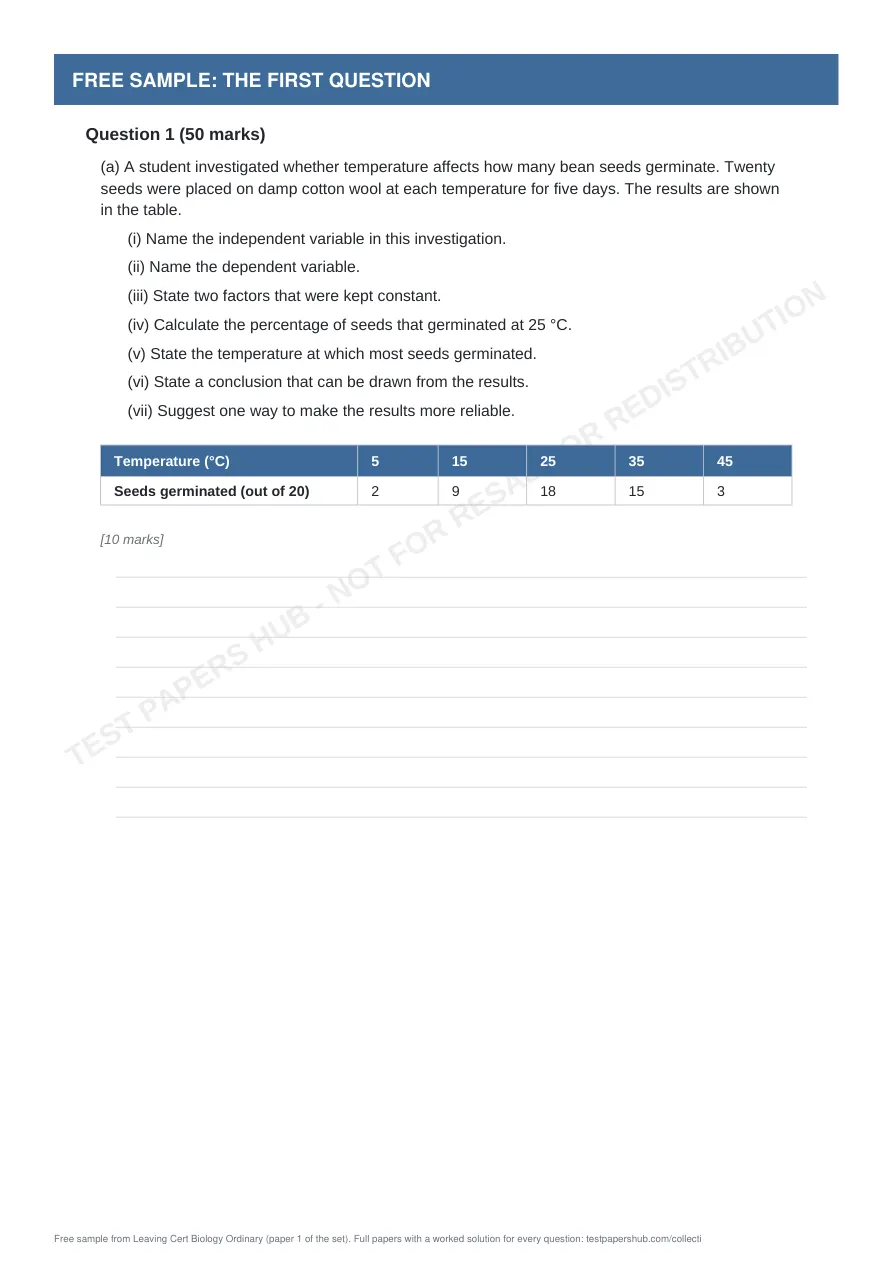
(a) A student investigated whether temperature affects how many bean seeds germinate. Twenty seeds were placed on damp cotton wool at each temperature for five days. The results are shown in the table.
(i) Name the independent variable in this investigation.
(ii) Name the dependent variable.
(iii) State two factors that were kept constant.
(iv) Calculate the percentage of seeds that germinated at 25 °C.
(v) State the temperature at which most seeds germinated.
(vi) State a conclusion that can be drawn from the results.
(vii) Suggest one way to make the results more reliable. Temperature (°C) 5 15 25 35 45 Seeds germinated (out of 20) 2 9 18 15 3
[10 marks]
(b) The diagram shows a flower.
(i) Name the parts labelled A, B, C and D. Choose from this list: petal, anther, stigma, ovary, sepal.
(ii) State the function of the anther.
(iii) What is meant by pollination?
(iv) Is this flower adapted to wind pollination or insect pollination? Give a reason from the diagram.
(v) What does the ovule become after fertilisation?
[10 marks]
A B C D
A flower cut in half (not to scale).
(c) The endocrine system makes hormones. Complete the table by writing the gland that makes each hormone. Choose from this list: pancreas, thyroid, adrenal gland, pituitary gland.
(i) Complete the table: write the gland that makes insulin, thyroxine, adrenaline and FSH.
(ii) State one effect of insulin in the body.
(iii) Hormones are carried around the body in which body fluid?
(iv) State one difference between a nervous response and a hormonal response.
(v) Name the gland in the list that is also part of the digestive system. Hormone Gland that makes it Insulin Thyroxine Adrenaline FSH
[10 marks]
(d) The diagram shows the human chest cavity.
(i) Name the structures labelled A, B, C and D. Choose from this list: trachea, bronchus, lung, diaphragm, ribs.
(ii) The trachea is held open by rings of cartilage. State the function of these rings.
(iii) Name the gas that passes from the alveoli into the blood.
(iv) Name the muscles between the ribs that help us to breathe.
(v) What happens to the diaphragm during inhalation (breathing in)?
[10 marks]
A B C D The human chest cavity (front view, not to scale).
(e) Living things share characteristics, and scientists classify them.
(i) State two characteristics of life.
(ii) Suggest why it is difficult to describe a virus as a living organism.
(iii) Put a tick in the box beside each cell that is a eukaryotic cell (it has a nucleus).
(iv) Name the kingdom to which mushrooms belong.
Question 1 (50 marks) [Compulsory question: Biological skills, plants, human systems and classification]
(a) A student investigated whether temperature affects how many bean seeds germinate. Twenty seeds were placed on damp cotton wool at each temperature for five days. The results are shown in the table.
(i) Name the independent variable in this investigation. (ii) Name the dependent variable. (iii) State two factors that were kept constant. (iv) Calculate the percentage of seeds that germinated at 25 °C. (v) State the temperature at which most seeds germinated. (vi) State a conclusion that can be drawn from the results. (vii) Suggest one way to make the results more reliable.
(a) Answer: (i) Temperature. (ii) The number of seeds that germinated. (iii) Number of seeds, moisture, time, type of seed (any two). (iv) 90%. (v) 25 °C. (vi) Seeds germinate best at about 25 °C; very low or very high temperatures reduce germination. (vii) Repeat the investigation and calculate the mean.
• Approach: name the variables, then read the table.
• (i) The factor the student changed was temperature 1 mark.
• (ii) The factor measured was the number of seeds that germinated 1 mark.
• (iii) Same number of seeds, same moisture and same time at each temperature (any two) 2 marks.
• (iv) 18 ÷ 20 × 100 = 90% 2 marks.
• (v) The highest number (18) germinated at 25 °C 1 mark.
• (vi) Germination rose to 25 °C and then fell as it became too hot 2 marks.
• (vii) A repeat reduces the effect of chance 1 mark.
(b) The diagram shows a flower. (i) Name the parts labelled A, B, C and D. Choose from this list: petal, anther, stigma, ovary, sepal. (ii) State the function of the anther. (iii) What is meant by pollination? (iv) Is this flower adapted to wind pollination or insect pollination? Give a reason from the diagram. (v) What does the ovule become after fertilisation? A B C D
A flower cut in half (not to scale).
(b) Answer: (i) A petal; B anther; C stigma; D ovary. (ii) It makes the pollen. (iii) The transfer of pollen from an anther to a stigma. (iv) Insect pollination; it has large, brightly coloured petals. (v) A seed.
• Approach: identify each part from its shape and position.
• (i) A is the large coloured petal, B the anther on its stalk, C the sticky stigma at the top of the style and D the ovary at the base 4 marks.
• (ii) The anther produces pollen grains (the male gametes) 1 mark.
• (iii) Pollen is carried from the anther to the stigma 2 marks.
• (iv) Large coloured petals attract insects; a wind-pollinated flower has small petals 2 marks.
• (v) The fertilised ovule becomes the seed 1 mark.
(c) The endocrine system makes hormones. Complete the table by writing the gland that makes each hormone. Choose from this list: pancreas, thyroid, adrenal gland, pituitary gland. (i) Complete the table:
write the gland that makes insulin, thyroxine, adrenaline and FSH. (ii) State one effect of insulin in the
body. (iii) Hormones are carried around the body in which body fluid? (iv) State one difference between a nervous response and a hormonal response. (v) Name the gland in the list that is also part of the digestive system.
Your sample is downloading. Liked it? Leaving Cert Biology Ordinary Paper 1 is the full paper: a 300-mark, 2 hour 30 minute written paper in the SEC layout: a compulsory Question 1 and six more 50-mark questions (the real exam asks for any five), covering all three strands, with worked solutions and a key takeaway for every part, with a worked solution for every question.
Get Paper 1 for A$11.99See all 20 papers from A$11.99More free Ireland Leaving Certificate samples
Questions about this sample
What is in the Leaving Cert Biology Ordinary free sample?
The first 3 questions from paper 1 of the set, in the real exam layout, followed by the step-by-step worked answers. It is a 10-page PDF; this page shows the opening pages.
How many full Leaving Cert Biology Ordinary papers are there?
20 original papers for Irish Leaving Certificate students sitting Ordinary Level Biology. Each is a 300-mark, 2 hour 30 minute written paper in the SEC layout: a compulsory Question 1 and six more 50-mark questions (the real exam asks for any five), covering all three strands, with worked solutions and a key takeaway for every part, with a worked solution for every question. Papers start at A$11.99 and download instantly as a PDF.
Are these official past papers?
No. The sample is taken from our own original practice paper and is not an official past paper or affiliated with any exam authority.