Leaving Cert Chemistry Ordinary free practice questions with answers
Read the opening questions and their worked answers from paper 1 of our 20-paper Leaving Cert Chemistry Ordinary set, then download the 8-page PDF. These are original practice questions, not official past papers. Page updated 3 November 2026.

Topics: Matter, solutions, reactivity and polymers (Leaving Certificate Chemistry, Ordinary Level written paper,.
- Moles = mass ÷ molar mass, and concentration (mol per litre) = moles ÷ volume in litres, so always convert cm³ to litres first.
- For isomers, the more branched molecule has less surface contact, weaker forces between molecules and a lower boiling point.
- In a gas the particles are far apart, which is why gases compress; in PV = nRT the temperature must always be in kelvin (°C + 273).
- A more reactive metal displaces a less reactive one from solution; the metal that displaces is oxidised because it loses electrons.
Read the text of this sample
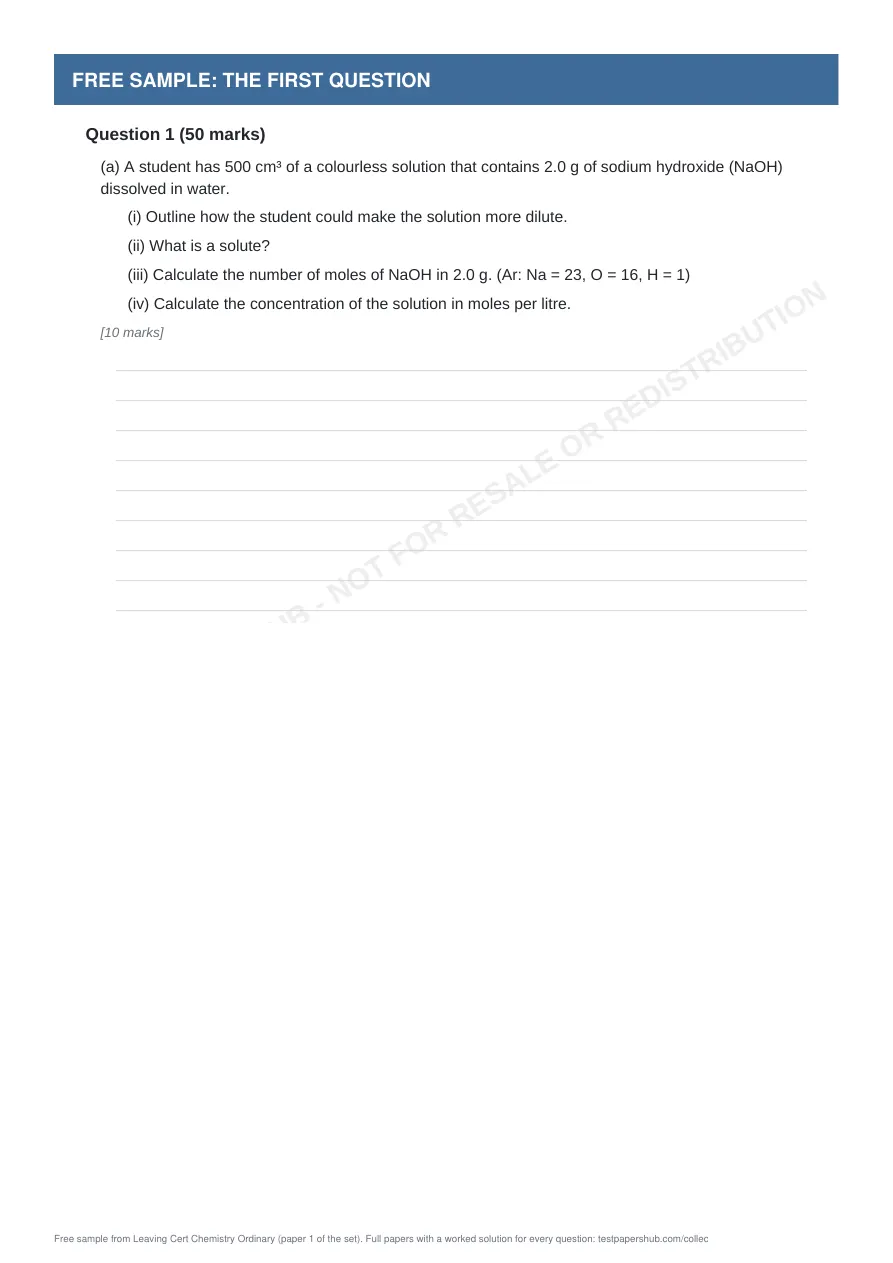
Question 1 (50 marks)
(a) A student has 500 cm³ of a colourless solution that contains 2.0 g of sodium hydroxide (NaOH) dissolved in water.
(i) Outline how the student could make the solution more dilute.
(ii) What is a solute?
(iii) Calculate the number of moles of NaOH in 2.0 g. (Ar: Na = 23, O = 16, H = 1)
(iv) Calculate the concentration of the solution in moles per litre.
[10 marks]
(b) The boiling point of an alkane depends on the size and shape of its molecules. The table gives the boiling points of some straight-chain alkanes. The diagrams show the structures of pentane and 2,2-dimethylpropane, which are isomers (both C₅H₁₂).
(i) Which alkane in the table has the highest boiling point?
(ii) Describe the trend in boiling point as the number of carbon atoms increases.
(iii) The boiling point of pentane is 36 °C and the boiling point of 2,2-dimethylpropane is 10 °C. Which compound has weaker forces between its molecules? Give a reason for your answer. Alkane Methane Ethane Propane Butane Pentane Hexane Boiling point (°C) −162 −89 −42 −1 36 69
[10 marks]
C C C C C H H H H H H H H H H H H pentane C C C C H H H C H H H H H H H H H 2,2-dimethylpropane Pentane and 2,2-dimethylpropane.
(c) Matter exists in three states: solid, liquid and gas.
(i) In the table, write solid, liquid or gas to name the state described.
(ii) Gases can be compressed (squeezed into a smaller volume) but liquids cannot. Explain why.
(iii) The ideal gas equation is PV = nRT. What quantity is represented by the letter n?
(iv) A gas is at a temperature of 27 °C. Convert this temperature to kelvin. Description Solid, liquid or gas? particles are far apart and move quickly in all directions fixed volume, but takes the shape of its container
[10 marks]
(d) A student places a piece of zinc into a beaker of blue copper(II) sulfate solution. After some time the blue colour fades and a brown solid forms on the zinc. Zn + CuSO₄ → ZnSO₄ + Cu The table shows part of the reactivity series of metals, with the most reactive at the top.
(i) Is zinc oxidised or reduced in this reaction? Justify your answer.
(ii) Identify a metal in the table (other than zinc) that would react with copper(II) sulfate in a similar way.
(iii) Identify a metal in the table that would not react with copper(II) sulfate.
(iv) Name the brown solid that formed on the zinc. Reactivity series (most reactive first) magnesium (Mg) aluminium (Al) zinc (Zn) iron (Fe) copper (Cu) silver (Ag)
[10 marks]
(e) Poly(ethene), also known as polythene, is made from many ethene molecules joined together in an addition polymerisation reaction.
Question 1 (50 marks) [Matter, solutions, reactivity and polymers]
(a) A student has 500 cm³ of a colourless solution that contains 2.0 g of sodium hydroxide (NaOH) dissolved in water. (i) Outline how the student could make the solution more dilute. (ii) What is a solute?
(iii) Calculate the number of moles of NaOH in 2.0 g. (Ar: Na = 23, O = 16, H = 1) (iv) Calculate the concentration of the solution in moles per litre.
(a) Answer: (i) Add more water (solvent). (ii) The substance that dissolves in the solvent to make a solution (here NaOH). (iii) Mr(NaOH) = 40; moles = 2.0 ÷ 40 = 0.050 mol. (iv) 500 cm³ = 0.500 L; concentration = 0.050 ÷ 0.500 = 0.10 mol per litre (0.10 M).
• Approach: dilute means more solvent; moles = mass ÷ molar mass; concentration = moles ÷ volume in litres.
• (i) Adding more water spreads the same amount of solute through a larger volume, so the solution is more dilute. 2 marks. (ii) A solute is the substance that dissolves; the water is the solvent. 2 marks.
• (iii) Mr(NaOH) = 23 + 16 + 1 = 40. Moles = mass ÷ Mr = 2.0 ÷ 40 = 0.050 mol. 3 marks.
• (iv) Convert the volume: 500 cm³ ÷ 1000 = 0.500 L. Concentration = moles ÷ litres = 0.050 ÷ 0.500 = 0.10 mol per litre. 3 marks.
(b) The boiling point of an alkane depends on the size and shape of its molecules. The table gives the boiling points of some straight-chain alkanes. The diagrams show the structures of pentane and 2,2-dimethylpropane, which are isomers (both C₅H₁₂). (i) Which alkane in the table has the highest boiling point? (ii) Describe the trend in boiling point as the number of carbon atoms increases. (iii) The boiling point of pentane is 36 °C and the boiling point of 2,2-dimethylpropane is 10 °C. Which compound has weaker forces between its molecules? Give a reason for your answer. C C C C C H H H H H H H H H H H H pentane C C C C H H H C H H H H H H H H H 2,2-dimethylpropane Pentane and 2,2-dimethylpropane.
(b) Answer: (i) Hexane (69 °C). (ii) The boiling point increases as the number of carbon atoms (the chain length) increases. (iii) 2,2-dimethylpropane has the lower boiling point, so its forces are weaker: its molecules are more compact and branched, so they have less surface contact with each other.
• Approach: read the table, describe the pattern, then link boiling point to the strength of the forces between molecules.
• (i) The boiling points are methane −162, ethane −89, propane −42, butane −1, pentane 36 and hexane 69 °C. The highest is hexane. 2 marks.
• (ii) Each extra carbon atom raises the boiling point, so longer chains boil at higher temperatures: the bigger the molecule, the stronger the forces between molecules. 3 marks.
• (iii) A lower boiling point means weaker forces between molecules. Pentane is a long straight chain that touches its neighbours along its whole length, while the compact branched 2,2-dimethylpropane touches them less, so it has weaker forces and boils at 10 °C. 5 marks.
Your sample is downloading. Liked it? Leaving Cert Chemistry Ordinary Paper 1 is the full paper: a 300-mark, 2 hour 30 minute written paper in the SEC layout: a compulsory Question 1 and six more 50-mark questions (the real exam asks for any five), covering all four strands, with worked solutions and a key takeaway for every part, with a worked solution for every question.
Get Paper 1 for A$11.99See all 20 papers from A$11.99More free Ireland Leaving Certificate samples
Questions about this sample
What is in the Leaving Cert Chemistry Ordinary free sample?
The first 3 questions from paper 1 of the set, in the real exam layout, followed by the step-by-step worked answers. It is a 8-page PDF; this page shows the opening pages.
How many full Leaving Cert Chemistry Ordinary papers are there?
20 original papers for Irish Leaving Certificate students sitting Ordinary Level Chemistry. Each is a 300-mark, 2 hour 30 minute written paper in the SEC layout: a compulsory Question 1 and six more 50-mark questions (the real exam asks for any five), covering all four strands, with worked solutions and a key takeaway for every part, with a worked solution for every question. Papers start at A$11.99 and download instantly as a PDF.
Are these official past papers?
No. The sample is taken from our own original practice paper and is not an official past paper or affiliated with any exam authority.