Leaving Cert Physics Ordinary free practice questions with answers
Read the opening questions and their worked answers from paper 1 of our 20-paper Leaving Cert Physics Ordinary set, then download the 8-page PDF. These are original practice questions, not official past papers. Page updated 3 November 2026.

Topics: Waves, motion, circuits, practical and solar energy (Leaving Certificate Physics, Ordinary Level written paper,.
- Wave speed v = fλ, and the period is the reciprocal of the frequency, T =
- The slope of a displacement-time graph is velocity; distance adds up all the movement, but displacement only compares the start and the end.
- In a series circuit the resistances add, one current flows through every component, and V = IR gives the potential difference across each one.
- To test a proportionality, plot the quantities that should give a straight line through the origin, and time many swings to cut the timing error.
Read the text of this sample
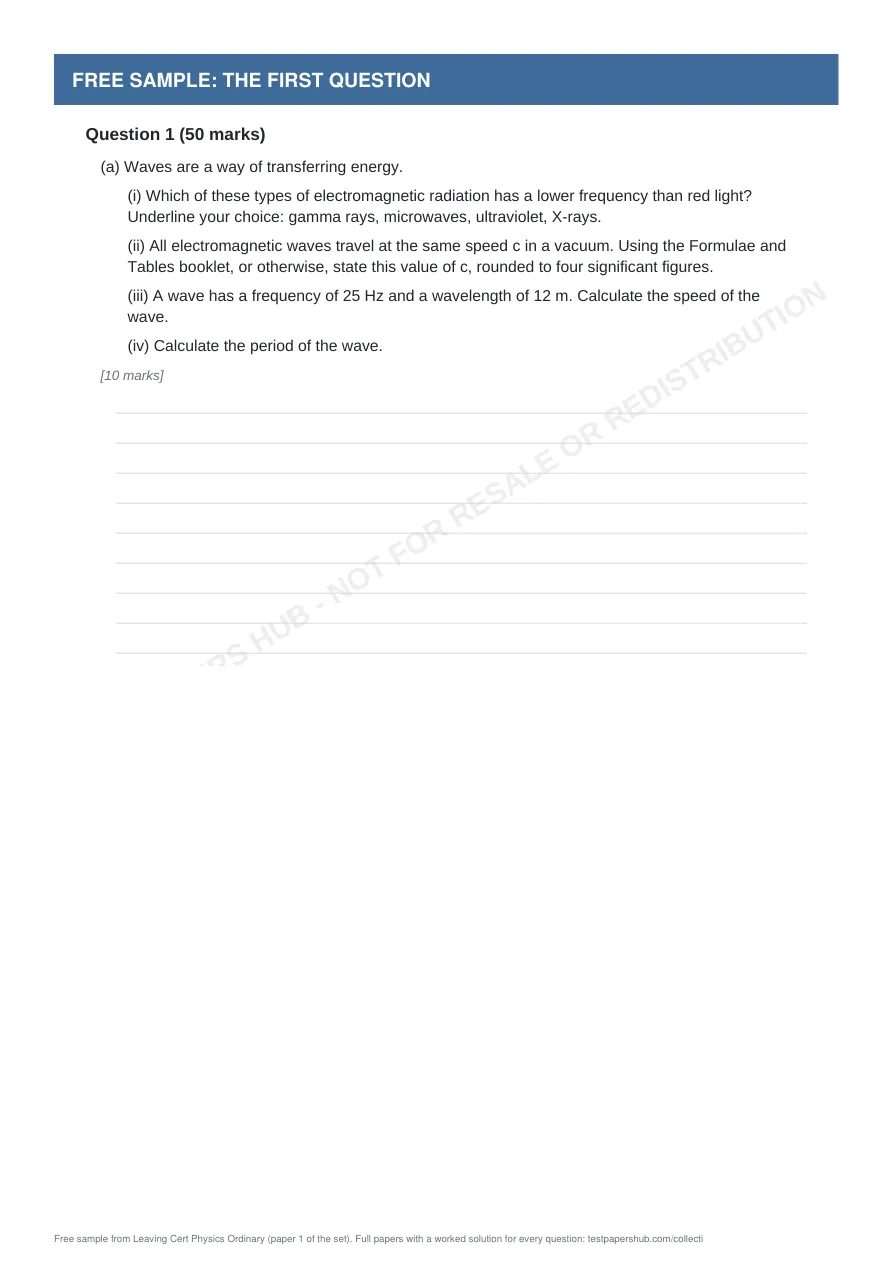
Question 1 (50 marks)
(a) Waves are a way of transferring energy.
(i) Which of these types of electromagnetic radiation has a lower frequency than red light? Underline your choice: gamma rays, microwaves, ultraviolet, X-rays.
(ii) All electromagnetic waves travel at the same speed c in a vacuum. Using the Formulae and Tables booklet, or otherwise, state this value of c, rounded to four significant figures.
(iii) A wave has a frequency of 25 Hz and a wavelength of 12 m. Calculate the speed of the wave.
(iv) Calculate the period of the wave.
[10 marks]
(b) The graph shows how the displacement of a toy car from its starting point changes with time. The car moves in four stages: A, B, C and D.
(i) Is speed a scalar or a vector quantity?
(ii) In which stage is the car stationary?
(iii) In which stage is the car moving fastest? Calculate its velocity in that stage.
(iv) Calculate the velocity of the car in stage A.
(v) Calculate the total distance travelled by the car, and state its displacement after 8 seconds. Stage Time interval (s) A 0 to 2 B 2 to 4 C 4 to 5 D 5 to 8
[10 marks]
0 2 4 6 8 10 12 0 1 2 3 4 5 6 7 8 time (s) displacement (m)
(c) A student connects two resistors in series with a 12 V battery.
(i) Calculate the total resistance of the circuit.
(ii) Calculate the current in the circuit.
(iii) Calculate the potential difference across the 6 Ω resistor.
(iv) Name the instrument used to measure current and state how it is connected in a circuit.
[10 marks]
6 Ω 3 Ω 12 V Circuit diagram (not to scale).
(d) A student investigates how the length l of a simple pendulum affects its period T (the time for one complete swing).
(i) Draw a labelled diagram of the apparatus the student could use.
(ii) Describe how the student should measure the period accurately.
(iii) The student wants to show that T² is proportional to l. Which graph should the student plot:
T against l, or T² against l? Justify your answer.
[10 marks]
(e) A solar panel of area 4.0 m² receives 1600 W of power from the Sun.
(i) Calculate the solar irradiance on the panel.
(ii) The panel is 18% efficient. Calculate the useful electrical power produced.
(iii) Calculate the electrical energy produced in 2 hours.
(iv) State one advantage of generating electricity from solar energy.
[10 marks]
QUESTIONS 2 TO 7 50 marks each · in the real paper you answer any FIVE This practice paper prints all six so you can choose your best five, or attempt more than the real paper allows.
Question 1 (50 marks) [Waves, motion, circuits, practical and solar energy]
(a) Waves are a way of transferring energy. (i) Which of these types of electromagnetic radiation has a lower frequency than red light? Underline your choice: gamma rays, microwaves, ultraviolet, X-rays. (ii) All electromagnetic waves travel at the same speed c in a vacuum. Using the Formulae and Tables booklet, or otherwise, state this value of c, rounded to four significant figures. (iii) A wave has a frequency of 25 Hz and a wavelength of 12 m. Calculate the speed of the wave. (iv) Calculate the period of the wave.
(a) Answer: (i) Microwaves. (ii) c = 2.998 × 10⁸ m s⁻¹. (iii) v = fλ = 25 × 12 = 300 m s⁻¹. (iv) T = 1 ÷ f = 1 ÷ 25 = 0.040 s.
• Approach: red light is in the middle of the spectrum; lower frequency means the radiation sits on the radio-wave side; use v = fλ and T =
• (i) In order of increasing frequency: radio waves, microwaves, infrared, visible, ultraviolet, X-rays, gamma rays. Microwaves are below red light. 2 marks.
• (ii) From the booklet, c = 2.998 × 10⁸ m s⁻¹ (3.00 × 10⁸ to three significant figures). 2 marks.
• (iii) v = fλ = 25 Hz × 12 m = 300 m s⁻¹. 3 marks. (iv) T = 1 ÷ f = 1 ÷ 25 = 0.040 s. 3 marks.
(b) The graph shows how the displacement of a toy car from its starting point changes with time. The car moves in four stages: A, B, C and D. (i) Is speed a scalar or a vector quantity? (ii) In which stage is the car stationary? (iii) In which stage is the car moving fastest? Calculate its velocity in that stage. (iv) Calculate the velocity of the car in stage A. (v) Calculate the total distance travelled by the car, and state its displacement after 8 seconds. 0 2 4 6 8 10 12 0 1 2 3 4 5 6 7 8 time (s) displacement (m)
(b) Answer: (i) Scalar (it has magnitude only). (ii) Stage B (the graph is flat). (iii) Stage C, the steepest section: v = (10 − 4) ÷ (5 − 4) = 6 m s⁻¹. (iv) v = (4 − 0) ÷ (2 − 0) = 2 m s⁻¹. (v) Distance = 4 + 6 + 10 = 20 m; displacement = 0 m (the car is back at the start). 1 f . 1 f .
• Approach: the slope of a displacement-time graph is the velocity; a flat line means no movement.
• (i) Speed has size only, so it is a scalar. 2 marks. (ii) In B the displacement stays at 4 m, so the car is not moving. 2 marks.
• (iii) The steepest slope is in C. Velocity = change in displacement ÷ time = (10 − 4) ÷ (5 − 4) = 6 m s⁻¹. 2 marks. (iv) In A: (4 − 0) ÷ (2 − 0) = 2 m s⁻¹. 2 marks.
• (v) Distance moved: A 4 m, C 6 m, D 10 m (back from 10 m to 0), total 20 m. At 8 s the displacement is 0 − 0 = 0 m. 2 marks.
(c) A student connects two resistors in series with a 12 V battery. (i) Calculate the total resistance of the circuit. (ii) Calculate the current in the circuit. (iii) Calculate the potential difference across the 6 Ω resistor. (iv) Name the instrument used to measure current and state how it is connected in a circuit. 6 Ω 3 Ω 12 V Circuit diagram (not to scale).
(c) Answer: (i) R = 6 + 3 = 9 Ω. (ii) I = V ÷ R = 12 ÷ 9 = 1.33 A. (iii) V = IR = 1.33 × 6 = 8.0 V. (iv) An ammeter, connected in series.
• Approach: in series the resistances add; the same current flows through each part; V = IR.
Your sample is downloading. Liked it? Leaving Cert Physics Ordinary Paper 1 is the full paper: a 300-mark, 2 hour 30 minute written paper in the SEC layout: a compulsory Question 1 and six more 50-mark questions (the real exam asks for any five), covering all four strands, with worked solutions and a key takeaway for every part, with a worked solution for every question.
Get Paper 1 for A$11.99See all 20 papers from A$11.99More free Ireland Leaving Certificate samples
Questions about this sample
What is in the Leaving Cert Physics Ordinary free sample?
The first 3 questions from paper 1 of the set, in the real exam layout, followed by the step-by-step worked answers. It is a 8-page PDF; this page shows the opening pages.
How many full Leaving Cert Physics Ordinary papers are there?
20 original papers for Irish Leaving Certificate students sitting Ordinary Level Physics. Each is a 300-mark, 2 hour 30 minute written paper in the SEC layout: a compulsory Question 1 and six more 50-mark questions (the real exam asks for any five), covering all four strands, with worked solutions and a key takeaway for every part, with a worked solution for every question. Papers start at A$11.99 and download instantly as a PDF.
Are these official past papers?
No. The sample is taken from our own original practice paper and is not an official past paper or affiliated with any exam authority.