NCEA Level 2 Accounting 91174 Concepts free practice questions with answers
Read the opening questions and their worked answers from paper 1 of our 20-paper NCEA Level 2 Accounting 91174 Concepts set, then download the 4-page PDF. These are original practice questions, not official past papers. Page updated 3 November 2026.

Topics: Financial elements and qualitative characteristics (91174).
- To justify an element, name its three characteristics, show each one in the scenario, then use documented evidence to show the amount is faithfully represented.
- Define the characteristic, use the figures from the case to show it, and finish with a limitation and what it means for the decision.
Read the text of this sample
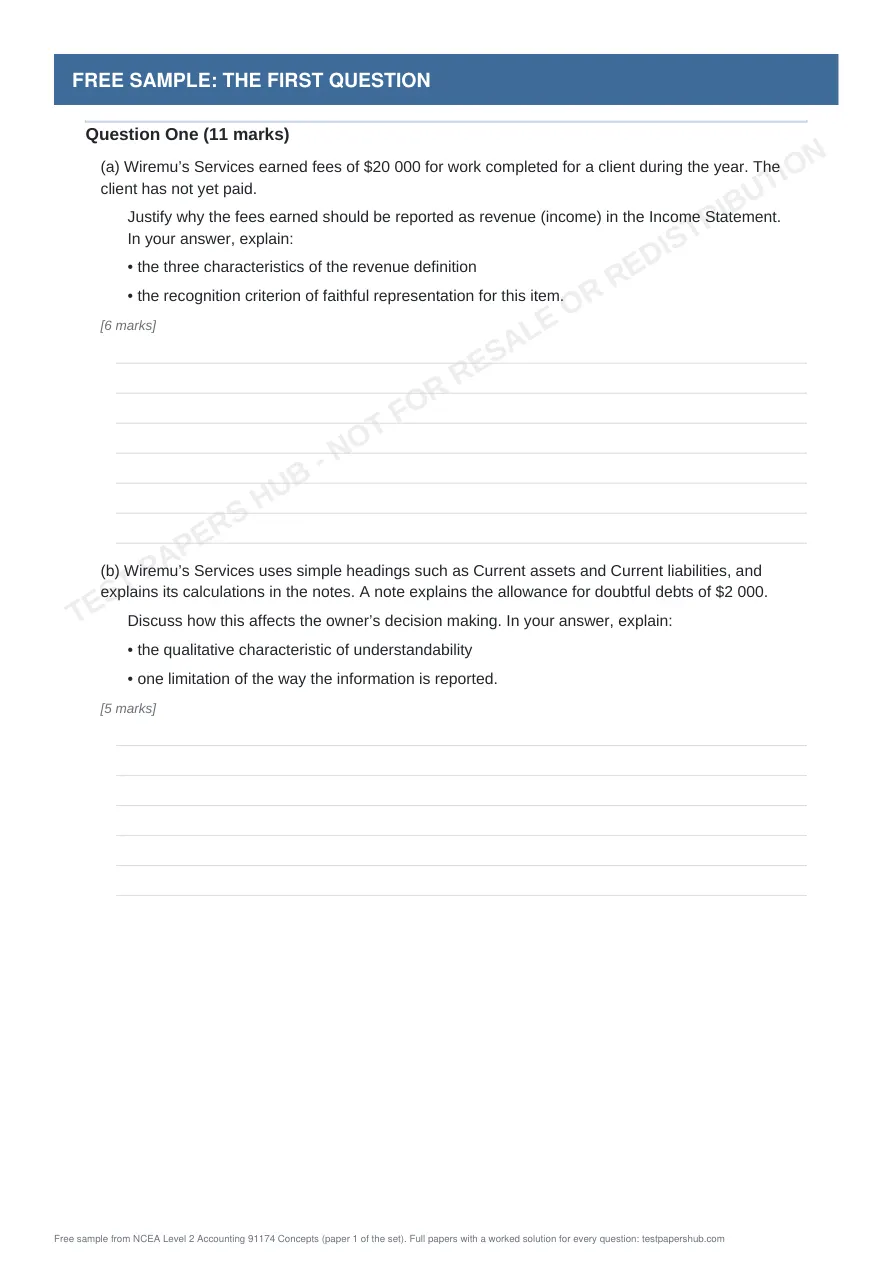
Question One (11 marks)
(a) Wiremu’s Services earned fees of $20 000 for work completed for a client during the year. The client has not yet paid. Justify why the fees earned should be reported as revenue (income) in the Income Statement. In your answer, explain:
• the three characteristics of the revenue definition
• the recognition criterion of faithful representation for this item.
[6 marks]
(b) Wiremu’s Services uses simple headings such as Current assets and Current liabilities, and explains its calculations in the notes. A note explains the allowance for doubtful debts of $2 000. Discuss how this affects the owner’s decision making. In your answer, explain:
• the qualitative characteristic of understandability
• one limitation of the way the information is reported.
[5 marks]
Question 1 (11 marks) [Financial elements and qualitative characteristics]
(a) Wiremu’s Services earned fees of $20 000 for work completed for a client during the year. The client has not yet paid. Justify why the fees earned should be reported as revenue (income) in the Income Statement. In your answer, explain: • the three characteristics of the revenue definition • the recognition criterion of faithful representation for this item.
(a) Answer: The fees earned should be reported as revenue (income): it increases profit and so increases equity; it increases assets or decreases liabilities; it is not capital contributed by the owner
• Evidence level: Excellence (applies all three characteristics to the case and links the recognition criterion to documented evidence).
• Achievement: Revenue (income) has three characteristics: it increases profit and so increases equity; it increases assets or decreases liabilities; and it is not capital contributed by the owner.
• Merit: Revenue (income) has three characteristics: it increases profit and so increases equity; it increases assets or decreases liabilities; and it is not capital contributed by the owner. For the fees earned: the fees increase profit, and so increase equity; the fees increase the asset accounts receivable; and the fees were earned by the business, not capital put in by the owner. So it is revenue in the Income Statement (invoice basis).
• Excellence: Revenue (income) has three characteristics: it increases profit and so increases equity; it increases assets or decreases liabilities; and it is not capital contributed by the owner. For the fees earned: the fees increase profit, and so increase equity; the fees increase the asset accounts receivable; and the fees were earned by the business, not capital put in by the owner. So it is revenue in the Income Statement (invoice basis). Faithful representation: the amount can be reported because there is documented evidence – the invoice sent to the client shows the fees of $20 000 – so the figure is complete, neutral and free from material error. If the owner had put the money in as capital, it would increase equity but it would not be revenue and would not be reported in the Income Statement.
(b) Wiremu’s Services uses simple headings such as Current assets and Current liabilities, and explains its calculations in the notes. A note explains the allowance for doubtful debts of $2 000. Discuss how this affects the owner’s decision making. In your answer, explain: • the qualitative characteristic of understandability • one limitation of the way the information is reported.
(b) Answer: Understandability: Understandability means information is classified, described and presented clearly and concisely so users with reasonable knowledge can understand it
• Evidence level: Excellence (defines the characteristic, applies it with figures, and links a limitation to decision making).
• Achievement: Understandability means information is classified, described and presented clearly and concisely so users with reasonable knowledge can understand it.
Your sample is downloading. Liked it? NCEA Level 2 Accounting 91174 Concepts Paper 1 is the full paper: three questions made of several multi-part problems answered in writing (constructed response, no multiple choice), with a worked solution for every part that shows whether it is aimed at Achieved, Merit or Excellence, with a worked solution for every question.
Get Paper 1 for A$11.99See all 20 papers from A$11.99More free NCEA (New Zealand) samples
Questions about this sample
What is in the NCEA Level 2 Accounting 91174 Concepts free sample?
The first 3 questions from paper 1 of the set, in the real exam layout, followed by the step-by-step worked answers. It is a 4-page PDF; this page shows the opening pages.
How many full NCEA Level 2 Accounting 91174 Concepts papers are there?
20 original papers for New Zealand Level 2 students preparing for NCEA external standard 91174. Each is three questions made of several multi-part problems answered in writing (constructed response, no multiple choice), with a worked solution for every part that shows whether it is aimed at Achieved, Merit or Excellence, with a worked solution for every question. Papers start at A$11.99 and download instantly as a PDF.
Are these official past papers?
No. The sample is taken from our own original practice paper and is not an official past paper or affiliated with any exam authority.