NCEA Level 2 Mathematics 91267 Probability free practice questions with answers
Read the opening questions and their worked answers from paper 1 of our 20-paper NCEA Level 2 Mathematics 91267 Probability set, then download the 5-page PDF. These are original practice questions, not official past papers. Page updated 3 November 2026.

Topics: Trees and conditional probability (91267).
- Screening tests: build the tree in whole numbers (true and false positives); P(condition | positive) = true positives ÷ all positives, which can be small when the condition is rare.
- Without replacement the second probability changes: reduce the total by one, and reduce the count of whatever was removed.
- Independence: events are independent when P(A | B) = P(A); compare the conditional probability with the overall probability from the table totals.
Read the text of this sample
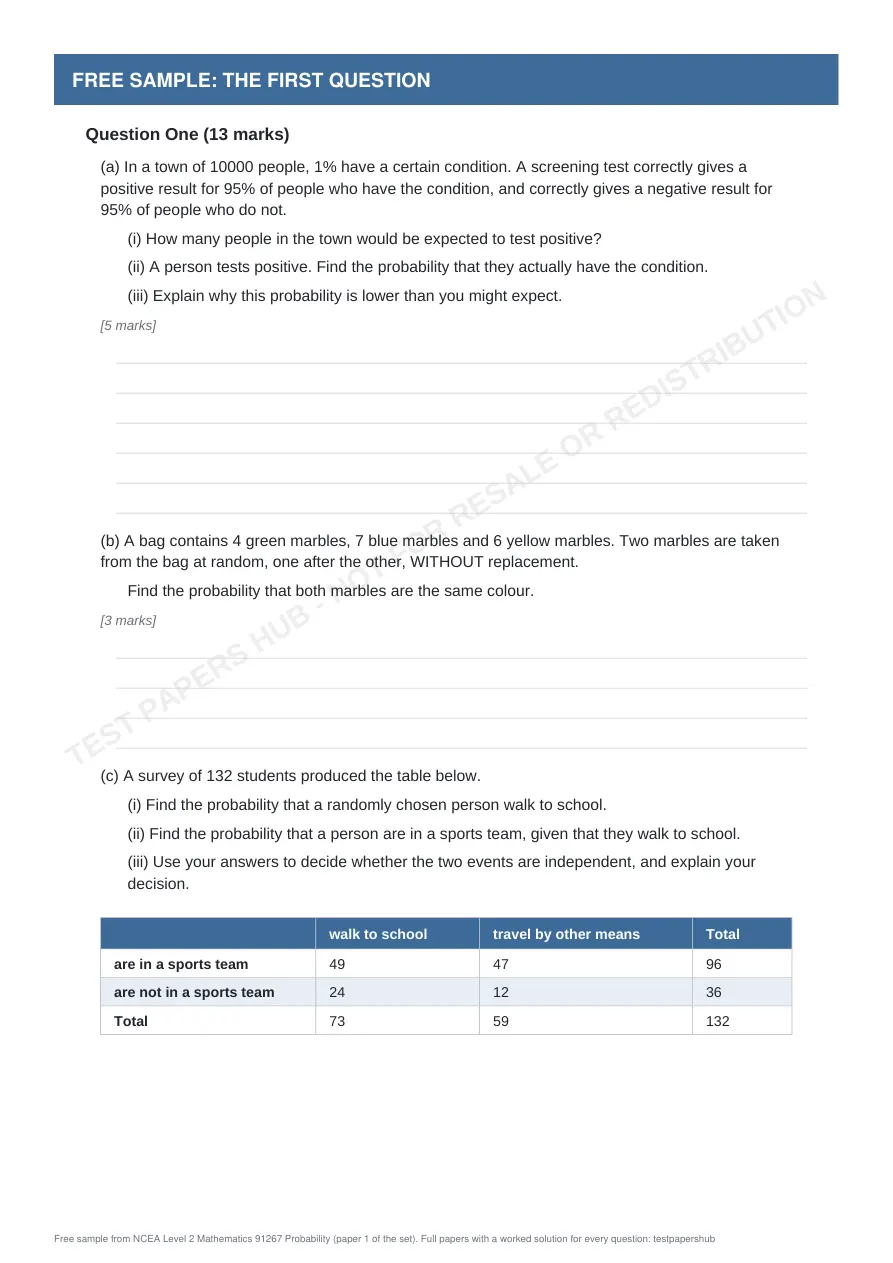
Question One (13 marks)
(a) In a town of 10000 people, 1% have a certain condition. A screening test correctly gives a positive result for 95% of people who have the condition, and correctly gives a negative result for 95% of people who do not.
(i) How many people in the town would be expected to test positive?
(ii) A person tests positive. Find the probability that they actually have the condition.
(iii) Explain why this probability is lower than you might expect.
[5 marks]
(b) A bag contains 4 green marbles, 7 blue marbles and 6 yellow marbles. Two marbles are taken from the bag at random, one after the other, WITHOUT replacement. Find the probability that both marbles are the same colour.
[3 marks]
(c) A survey of 132 students produced the table below.
(i) Find the probability that a randomly chosen person walk to school.
(ii) Find the probability that a person are in a sports team, given that they walk to school.
(iii) Use your answers to decide whether the two events are independent, and explain your decision. walk to school travel by other means Total are in a sports team 49 47 96 are not in a sports team 24 12 36 Total 73 59 132
[5 marks]
Question 1 (13 marks) [Trees and conditional probability]
(a) In a town of 10000 people, 1% have a certain condition. A screening test correctly gives a positive result for 95% of people who have the condition, and correctly gives a negative result for 95% of people who do not. (i) How many people in the town would be expected to test positive? (ii) A person tests positive. Find the probability that they actually have the condition. (iii) Explain why this probability is lower than you might expect.
(a) Answer: (i) 590; (ii) 0.161; (iii) healthy people greatly outnumber those with the condition, so false positives swamp true positives
• Evidence level: Excellence (use a tree or natural frequencies, then interpret a conditional probability).
• People with the condition: 1% of 10000 = 100. Without: 9900.
• (i) True positives: 95% of 100 = 95. False positives: 5% of 9900 = 495. Expected positives = 95 + 495 = 590.
• (ii) P(condition | positive) = 95 ÷ 590 = 0.161.
• (iii) Most people do NOT have the condition, so even a small false-positive rate produces many false positives (495) compared with true positives (95).
(b) A bag contains 4 green marbles, 7 blue marbles and 6 yellow marbles. Two marbles are taken from the bag at random, one after the other, WITHOUT replacement. Find the probability that both marbles are the same colour.
(b) Answer: 0.309
• Evidence level: Merit (use a tree or list of cases without replacement).
• P(both the same) = P(both green) + P(both blue) + P(both yellow).
• = (
• = 0.309.
(c) A survey of 132 students produced the table below. (i) Find the probability that a randomly chosen person walk to school. (ii) Find the probability that a person are in a sports team, given that they walk to school. (iii) Use your answers to decide whether the two events are independent, and explain your decision.
(c) Answer: (i) 0.553; (ii) 0.671; (iii) not independent
• Evidence level: Excellence (compare a conditional probability with the unconditional one to test independence).
• (i) P(walk to school) = 4 17 )( 3 16 ) + ( 7 17 )( 6 16 ) + ( 6 17 )( 5 16 ). 73 132 = 0.553.
• (ii) Of the 73 who walk to school, 49 are in a sports team: P =
• (iii) Overall P(are in a sports team) =
• Here 0.671 ≠ 0.727, so the events are NOT independent (the probability changes when we know about the other event). 49 73 = 0.671. 96 132 = 0.727. Independent events have P(A | B) = P(A).
Your sample is downloading. Liked it? NCEA Level 2 Mathematics 91267 Probability Paper 1 is the full paper: three questions made of several multi-part problems answered in writing (constructed response, no multiple choice), with a worked solution for every part that shows whether it is aimed at Achieved, Merit or Excellence, with a worked solution for every question.
Get Paper 1 for A$11.99See all 20 papers from A$11.99More free NCEA (New Zealand) samples
Questions about this sample
What is in the NCEA Level 2 Mathematics 91267 Probability free sample?
The first 3 questions from paper 1 of the set, in the real exam layout, followed by the step-by-step worked answers. It is a 5-page PDF; this page shows the opening pages.
How many full NCEA Level 2 Mathematics 91267 Probability papers are there?
20 original papers for New Zealand Level 2 students preparing for NCEA external standard 91267. Each is three questions made of several multi-part problems answered in writing (constructed response, no multiple choice), with a worked solution for every part that shows whether it is aimed at Achieved, Merit or Excellence, with a worked solution for every question. Papers start at A$11.99 and download instantly as a PDF.
Are these official past papers?
No. The sample is taken from our own original practice paper and is not an official past paper or affiliated with any exam authority.