NCEA Level 2 Chemistry 91164 Bonding free practice questions with answers
Read the opening questions and their worked answers from paper 1 of our 20-paper NCEA Level 2 Chemistry 91164 Bonding set, then download the 4-page PDF. These are original practice questions, not official past papers. Page updated 3 November 2026.

Topics: Bonding, shape and polarity (91164).
- Shape and polarity: count regions of electron density to get the shape; then ask whether the polar bonds are arranged symmetrically (dipoles cancel, so non-polar) or not (dipoles add, so polar).
- Bond type: |ΔEN| above about 1.7 is ionic, 0.4 to 1.7 polar covalent, and below 0.4 non-polar covalent; in a polar bond the more electronegative atom is δ−.
- Ionic compounds: metals lose electrons to form positive ions, non-metals gain them to form negative ions; the formula balances the charges; the lattice has strong attractions (high melting point) and conducts only when the ions can move.
Read the text of this sample
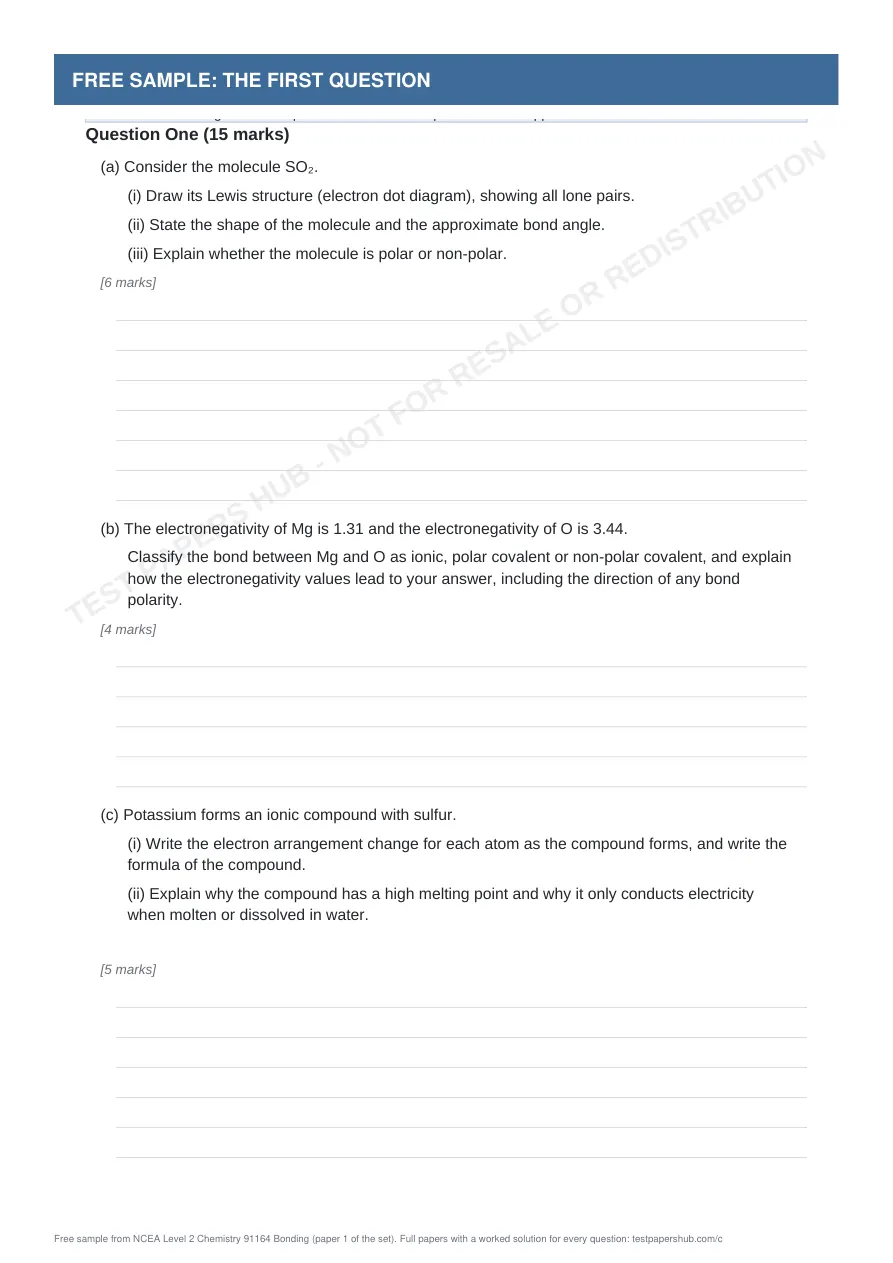
g q p pp Question One (15 marks)
(a) Consider the molecule SO₂.
(i) Draw its Lewis structure (electron dot diagram), showing all lone pairs.
(ii) State the shape of the molecule and the approximate bond angle.
(iii) Explain whether the molecule is polar or non-polar.
[6 marks]
(b) The electronegativity of Mg is 1.31 and the electronegativity of O is 3.44. Classify the bond between Mg and O as ionic, polar covalent or non-polar covalent, and explain how the electronegativity values lead to your answer, including the direction of any bond polarity.
[4 marks]
(c) Potassium forms an ionic compound with sulfur.
(i) Write the electron arrangement change for each atom as the compound forms, and write the formula of the compound.
(ii) Explain why the compound has a high melting point and why it only conducts electricity when molten or dissolved in water.
[5 marks]
Question 1 (15 marks) [Bonding, shape and polarity]
(a) Consider the molecule SO₂. (i) Draw its Lewis structure (electron dot diagram), showing all lone pairs.
(ii) State the shape of the molecule and the approximate bond angle. (iii) Explain whether the molecule is polar or non-polar.
(a) Answer: SO₂ is bent (V-shaped) with a bond angle of about 117°; it is polar
• Evidence level: Excellence (count valence electrons, place bonds and lone pairs, then decide shape and polarity from the symmetry).
• (i) Valence electrons: 6 (S) + 6 (O) + 6 (O) = 18. The central atom is S; it forms 2 bond(s) to O, O (with 2 multiple bond(s)).
• The central atom has 1 lone pair(s) and 3 region(s) of electron density.
• (ii) 3 regions of electron density with 1 lone pair(s): the shape is bent (V-shaped), with a bond angle of about 117°.
• Achievement: (iii) States whether the molecule is polar or non-polar.
• Merit: Gives a reason for the bond polarity: the bonds are polar because of the difference in electronegativity between S and the other atoms.
• Excellence: Full explanation: the bonds are polar and the bent (V-shaped) shape is not symmetrical, so the bond dipoles do not cancel and the molecule is polar.
(b) The electronegativity of Mg is 1.31 and the electronegativity of O is 3.44. Classify the bond between Mg and O as ionic, polar covalent or non-polar covalent, and explain how the electronegativity values lead to your answer, including the direction of any bond polarity.
(b) Answer: ionic bond
• Evidence level: Excellence (use the electronegativity difference to classify the bond and show the direction of polarity).
• Difference = |1.31 − 3.44| = 2.13.
• Achievement: States the bond type (ionic).
• Merit: Links to the difference: a difference of 2.13 is large (above about 1.7), so the bond is ionic.
• Excellence: Full explanation: the electrons are transferred (or almost completely pulled) to O, giving ions held by electrostatic attraction.
(c) Potassium forms an ionic compound with sulfur. (i) Write the electron arrangement change for each atom as the compound forms, and write the formula of the compound. (ii) Explain why the compound has a high melting point and why it only conducts electricity when molten or dissolved in water.
(c) Answer: (i) K loses 1, S gains 2 electron(s); formula K₂S; (ii) strong electrostatic attractions between ions in the lattice give a high melting point; ions are free to move only when molten or dissolved
• Evidence level: Excellence (describe electron transfer, balance the charges, and explain properties from the lattice structure).
• (i) K loses 1 electron(s) to form K⁺; S gains 2 electron(s) to form S²⁻. The charges must balance: 2 ×
(1) = 1 × (−2), so the formula is K₂S (potassium sulfide).
• Achievement: (ii) States that the compound has a lattice of ions with strong attractions between them.
• Merit: Links to the properties: a lot of energy is needed to overcome the strong electrostatic attractions between oppositely charged ions, so the melting point is high; the ions cannot move in the solid.
Your sample is downloading. Liked it? NCEA Level 2 Chemistry 91164 Bonding Paper 1 is the full paper: three questions made of several multi-part problems answered in writing (constructed response, no multiple choice), with a worked solution for every part that shows whether it is aimed at Achieved, Merit or Excellence, with a worked solution for every question.
Get Paper 1 for A$11.99See all 20 papers from A$11.99More free NCEA (New Zealand) samples
Questions about this sample
What is in the NCEA Level 2 Chemistry 91164 Bonding free sample?
The first 3 questions from paper 1 of the set, in the real exam layout, followed by the step-by-step worked answers. It is a 4-page PDF; this page shows the opening pages.
How many full NCEA Level 2 Chemistry 91164 Bonding papers are there?
20 original papers for New Zealand Level 2 students preparing for NCEA external standard 91164. Each is three questions made of several multi-part problems answered in writing (constructed response, no multiple choice), with a worked solution for every part that shows whether it is aimed at Achieved, Merit or Excellence, with a worked solution for every question. Papers start at A$11.99 and download instantly as a PDF.
Are these official past papers?
No. The sample is taken from our own original practice paper and is not an official past paper or affiliated with any exam authority.