NCEA Level 2 Biology 91156 Cells free practice questions with answers
Read the opening questions and their worked answers from paper 1 of our 20-paper NCEA Level 2 Biology 91156 Cells set, then download the 5-page PDF. These are original practice questions, not official past papers. Page updated 3 November 2026.

Topics: Cells and transport (91156).
- SA:V: for a cube SA = 6L², V = L³, SA:V = 6/L, so ratio falls as cells grow; exchange across the surface cannot keep up with the needs of a large volume.
- Osmosis data: percentage change = change ÷ initial × 100; the isotonic concentration is where the percentage change is zero (read or interpolate); water moves to the lower water potential through a partially permeable membrane.
Read the text of this sample
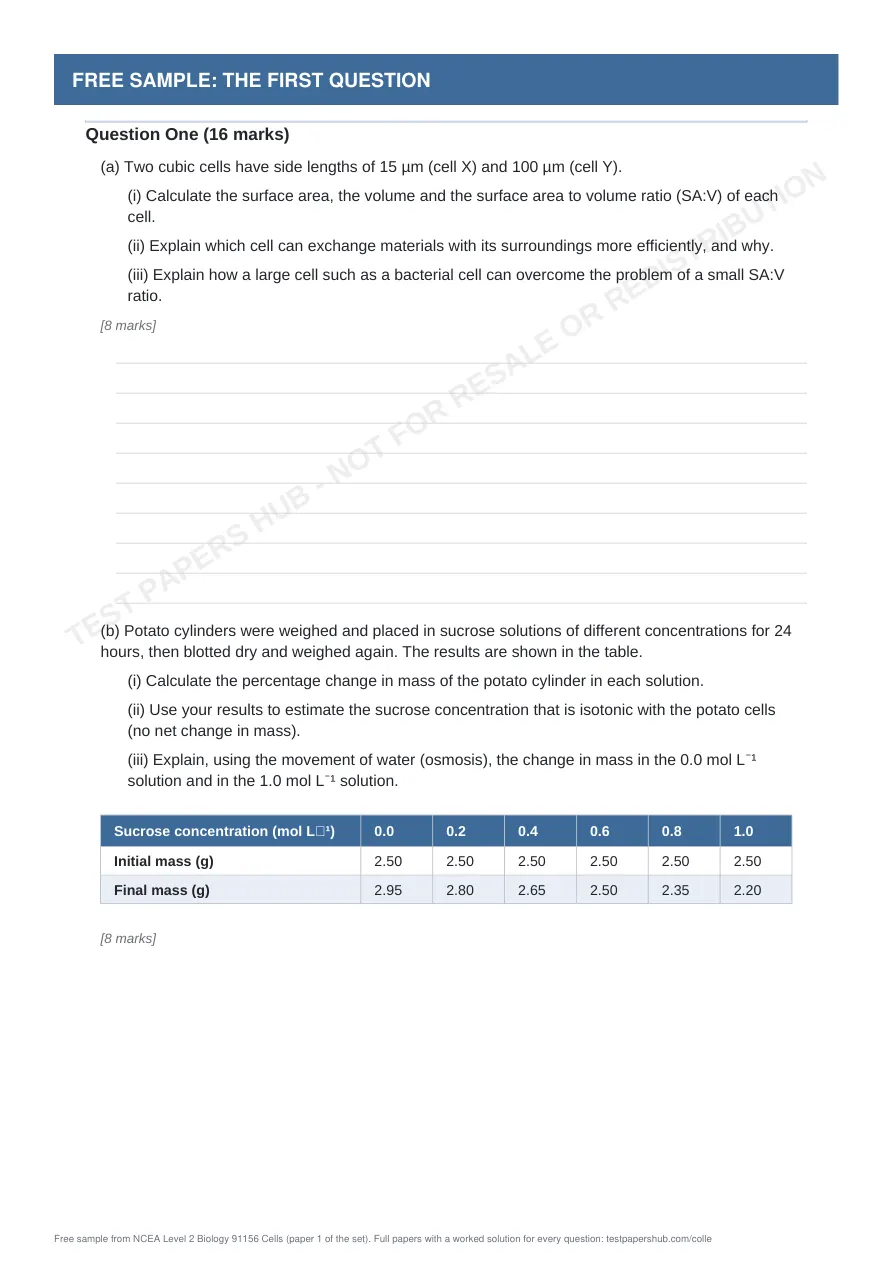
Question One (16 marks)
(a) Two cubic cells have side lengths of 15 µm (cell X) and 100 µm (cell Y).
(i) Calculate the surface area, the volume and the surface area to volume ratio (SA:V) of each cell.
(ii) Explain which cell can exchange materials with its surroundings more efficiently, and why.
(iii) Explain how a large cell such as a bacterial cell can overcome the problem of a small SA:V ratio.
[8 marks]
(b) Potato cylinders were weighed and placed in sucrose solutions of different concentrations for 24 hours, then blotted dry and weighed again. The results are shown in the table.
(i) Calculate the percentage change in mass of the potato cylinder in each solution.
(ii) Use your results to estimate the sucrose concentration that is isotonic with the potato cells (no net change in mass).
(iii) Explain, using the movement of water (osmosis), the change in mass in the 0.0 mol L⁻¹ solution and in the 1.0 mol L⁻¹ solution. 0.0 0.2 0.4 0.6 0.8 1.0 Initial mass (g) 2.50 2.50 2.50 2.50 2.50 2.50 Final mass (g) 2.95 2.80 2.65 2.50 2.35 2.20
[8 marks]
Question 1 (16 marks) [Cells and transport]
(a) Two cubic cells have side lengths of 15 µm (cell X) and 100 µm (cell Y). (i) Calculate the surface area, the volume and the surface area to volume ratio (SA:V) of each cell. (ii) Explain which cell can exchange materials with its surroundings more efficiently, and why. (iii) Explain how a large cell such as a bacterial cell can overcome the problem of a small SA:V ratio.
(a) Answer: (i) X: SA:V = 0.400, Y: SA:V = 0.0600; (ii) the smaller cell X exchanges materials faster
• Evidence level: Excellence (surface area = 6 × side² for a cube; volume = side³; ratio = SA ÷ V).
• (i) Cell X: SA = 6 × 15² = 1350 µm²; V = 15³ = 3375 µm³; SA:V = 1350 : 3375 = 0.400 : 1. Cell Y: SA = 6 × 100² = 60000 µm²; V = 100³ = 1000000 µm³; SA:V = 0.0600 : 1.
• Achievement: (ii) States that cell X has the greater SA:V ratio.
• Merit: Links to diffusion: materials enter and leave through the surface, so a larger surface for each unit of volume exchanges materials faster.
• Excellence: Full explanation: the SA:V of cell X (0.400 : 1) is greater than that of cell Y (0.0600 : 1); as a cell gets bigger its volume (and need for oxygen and nutrients, and its waste production) increases faster than its surface area, so in the larger cell the distance for diffusion is greater and the membrane surface per unit volume is smaller, and diffusion is too slow to supply the whole cell.
• Achievement: (iii) States that the cell can have folds or microvilli.
• Merit: Links to surface: folding the membrane increases the surface area without increasing volume.
• Excellence: Full explanation: a large cell can increase its SA:V by flattening or elongating its shape, folding its membrane into microvilli or invaginations to increase the surface area, and by having transport systems (cytoplasmic streaming, a transport network) or by dividing into smaller cells, so exchange keeps pace with the needs of the whole volume.
(b) Potato cylinders were weighed and placed in sucrose solutions of different concentrations for 24 hours, then blotted dry and weighed again. The results are shown in the table. (i) Calculate the percentage change in mass of the potato cylinder in each solution. (ii) Use your results to estimate the sucrose concentration that is isotonic with the potato cells (no net change in mass). (iii) Explain, using the movement of water (osmosis), the change in mass in the 0.0 mol L⁻¹ solution and in the 1.0 mol L⁻¹ solution.
(b) Answer: (i) 0.0: 18.0%; 0.2: 12.0%; 0.4: 6.00%; 0.6: 0%; 0.8: −6.00%; 1.0: −12.0%; (ii) about 0.60 mol L⁻¹; (iii) water in at 0.0, out at 1.0
• Evidence level: Excellence (percentage change = (final − initial) ÷ initial × 100; the isotonic concentration is where the change is zero).
• (i) 0.0 mol L⁻¹: 18.0%; 0.2 mol L⁻¹: 12.0%; 0.4 mol L⁻¹: 6.00%; 0.6 mol L⁻¹: 0%; 0.8 mol L⁻¹: −6.00%; 1.0 mol L⁻¹: −12.0%.
• (ii) The percentage change crosses zero between 0.6 and 0.8 mol L⁻¹; by linear interpolation the isotonic concentration ≈ 0.6 + (0 ÷ (0 − (−6.00))) × 0.2 = 0.60 mol L⁻¹.
• Achievement: (iii) States that water entered the cells in pure water and left in 1.0 mol L⁻¹ sucrose.
Your sample is downloading. Liked it? NCEA Level 2 Biology 91156 Cells Paper 1 is the full paper: three questions made of several multi-part problems answered in writing (constructed response, no multiple choice), with a worked solution for every part that shows whether it is aimed at Achieved, Merit or Excellence, with a worked solution for every question.
Get Paper 1 for A$11.99See all 20 papers from A$11.99More free NCEA (New Zealand) samples
Questions about this sample
What is in the NCEA Level 2 Biology 91156 Cells free sample?
The first 3 questions from paper 1 of the set, in the real exam layout, followed by the step-by-step worked answers. It is a 5-page PDF; this page shows the opening pages.
How many full NCEA Level 2 Biology 91156 Cells papers are there?
20 original papers for New Zealand Level 2 students preparing for NCEA external standard 91156. Each is three questions made of several multi-part problems answered in writing (constructed response, no multiple choice), with a worked solution for every part that shows whether it is aimed at Achieved, Merit or Excellence, with a worked solution for every question. Papers start at A$11.99 and download instantly as a PDF.
Are these official past papers?
No. The sample is taken from our own original practice paper and is not an official past paper or affiliated with any exam authority.