NCEA Level 2 Accounting 91177 Interpret free practice questions with answers
Read the opening questions and their worked answers from paper 1 of our 20-paper NCEA Level 2 Accounting 91177 Interpret set, then download the 5-page PDF. These are original practice questions, not official past papers. Page updated 3 November 2026.
Topics: Liquidity and financial stability (91177).
- Liquidity: the liquid ratio leaves inventory and prepayments out of current assets and the secured overdraft out of current liabilities; compare both ratios with 1:1 and explain the change using what the business did.
- Stability = how much of the assets the owner pays for (equity ratio); returns use average equity or assets over the year; compare profit growth with the growth in equity and in assets to explain each return.
- Management effectiveness: a lower age of accounts receivable means faster collection; a higher inventory turnover means inventory sells faster; explain each measure separately using the figures and what the business did.
Read the text of this sample
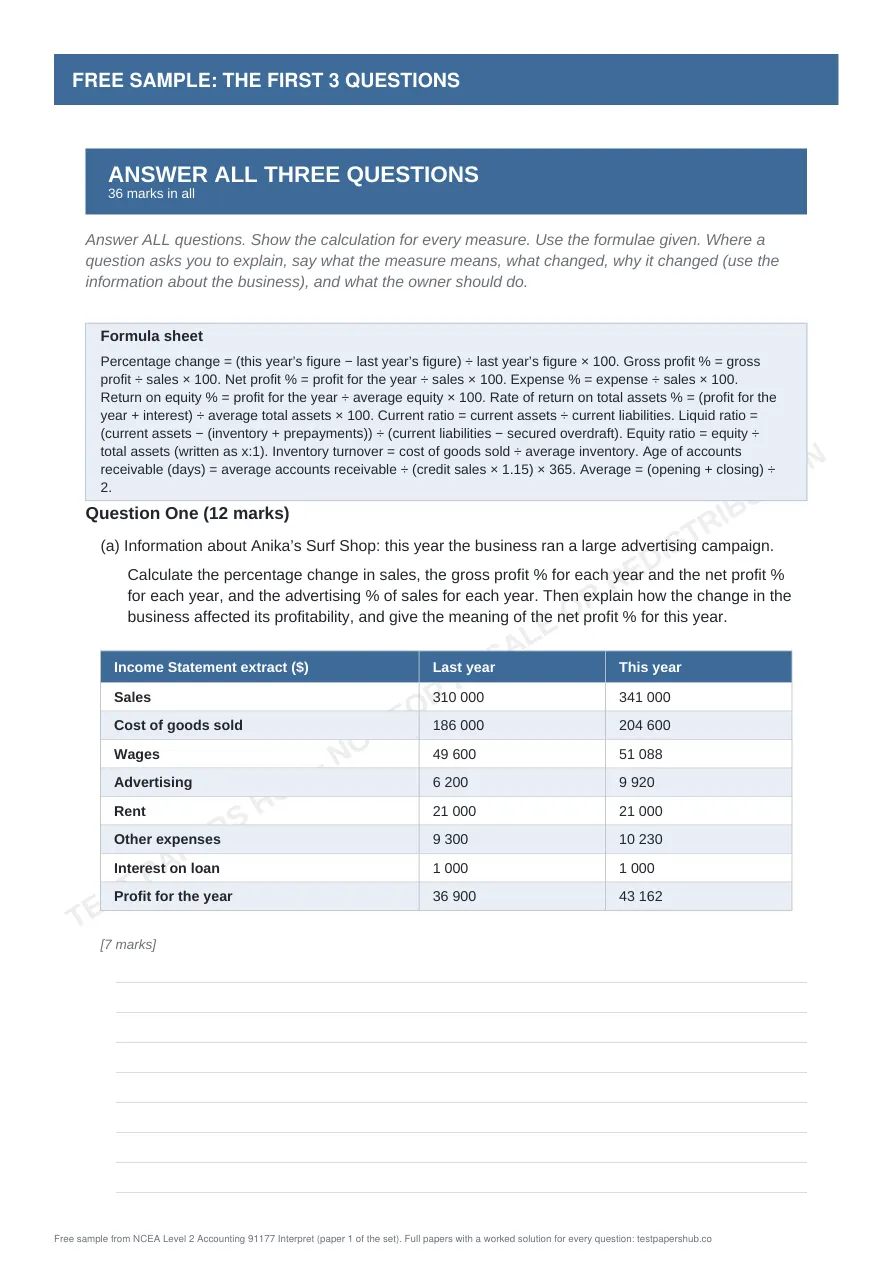
ANSWER ALL THREE QUESTIONS 36 marks in all Answer ALL questions. Show the calculation for every measure. Use the formulae given. Where a question asks you to explain, say what the measure means, what changed, why it changed (use the information about the business), and what the owner should do. Formula sheet Percentage change = (this year’s figure − last year’s figure) ÷ last year’s figure × 100. Gross profit % = gross profit ÷ sales × 100. Net profit % = profit for the year ÷ sales × 100. Expense % = expense ÷ sales × 100. Return on equity % = profit for the year ÷ average equity × 100. Rate of return on total assets % = (profit for the year + interest) ÷ average total assets × 100. Current ratio = current assets ÷ current liabilities. Liquid ratio = (current assets − (inventory + prepayments)) ÷ (current liabilities − secured overdraft). Equity ratio = equity ÷ total assets (written as x:1). Inventory turnover = cost of goods sold ÷ average inventory. Age of accounts receivable (days) = average accounts receivable ÷ (credit sales × 1.15) × 365. Average = (opening + closing) ÷ 2. Question One (12 marks)
(a) Information about Anika’s Surf Shop: this year the business ran a large advertising campaign. Calculate the percentage change in sales, the gross profit % for each year and the net profit % for each year, and the advertising % of sales for each year. Then explain how the change in the business affected its profitability, and give the meaning of the net profit % for this year. Income Statement extract ($) Last year This year Sales 310 000 341 000 Cost of goods sold 186 000 204 600 Wages 49 600 51 088 Advertising 6 200 9 920 Rent 21 000 21 000 Other expenses 9 300 10 230 Interest on loan 1 000 1 000 Profit for the year 36 900 43 162
[7 marks]
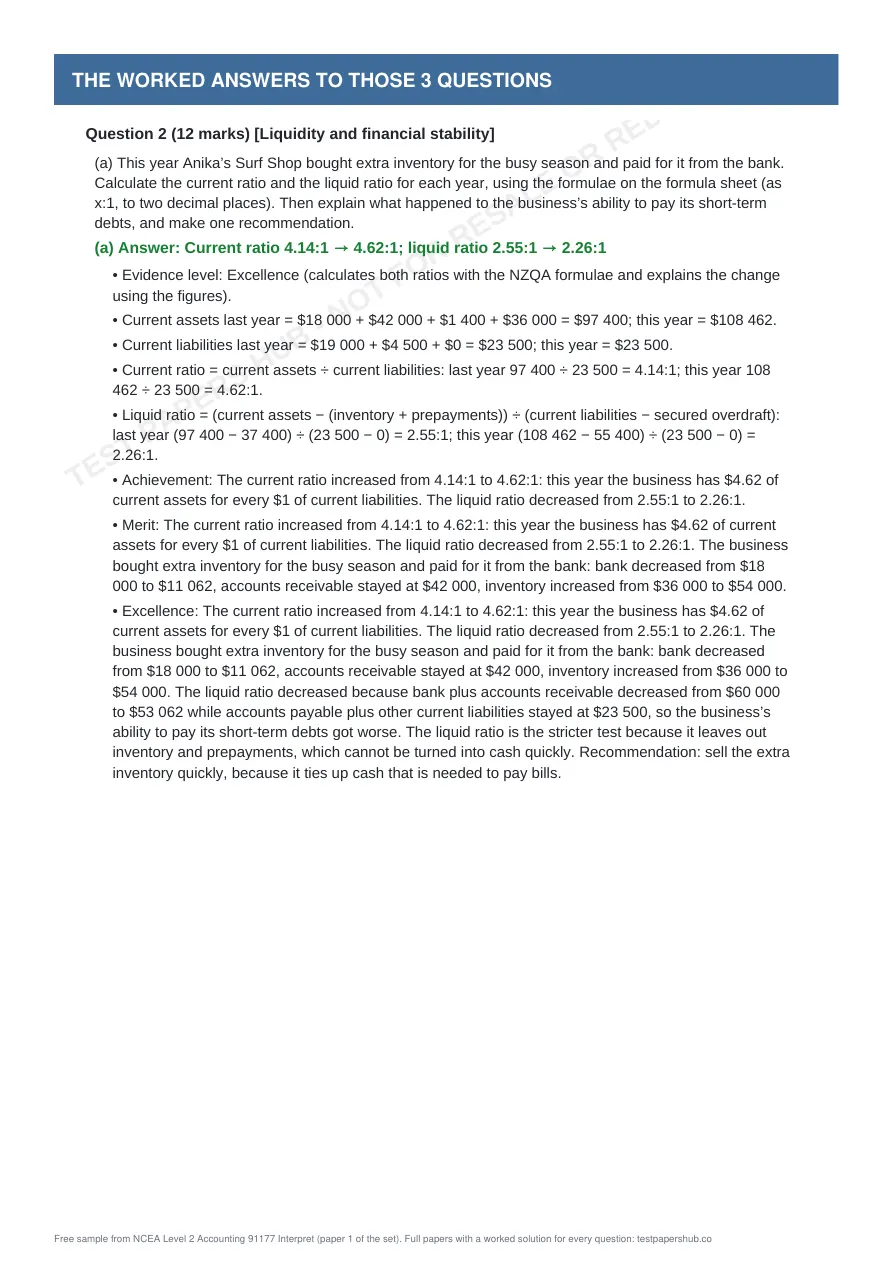
Question 2 (12 marks) [Liquidity and financial stability]
(a) This year Anika’s Surf Shop bought extra inventory for the busy season and paid for it from the bank. Calculate the current ratio and the liquid ratio for each year, using the formulae on the formula sheet (as x:1, to two decimal places). Then explain what happened to the business’s ability to pay its short-term debts, and make one recommendation.
(a) Answer: Current ratio 4.14:1 → 4.62:1; liquid ratio 2.55:1 → 2.26:1
• Evidence level: Excellence (calculates both ratios with the NZQA formulae and explains the change using the figures).
• Current assets last year = $18 000 + $42 000 + $1 400 + $36 000 = $97 400; this year = $108 462.
• Current liabilities last year = $19 000 + $4 500 + $0 = $23 500; this year = $23 500.
• Current ratio = current assets ÷ current liabilities: last year 97 400 ÷ 23 500 = 4.14:1; this year 108 462 ÷ 23 500 = 4.62:1.
• Liquid ratio = (current assets − (inventory + prepayments)) ÷ (current liabilities − secured overdraft):
last year (97 400 − 37 400) ÷ (23 500 − 0) = 2.55:1; this year (108 462 − 55 400) ÷ (23 500 − 0) = 2.26:1.
• Achievement: The current ratio increased from 4.14:1 to 4.62:1: this year the business has $4.62 of current assets for every $1 of current liabilities. The liquid ratio decreased from 2.55:1 to 2.26:1.
• Merit: The current ratio increased from 4.14:1 to 4.62:1: this year the business has $4.62 of current assets for every $1 of current liabilities. The liquid ratio decreased from 2.55:1 to 2.26:1. The business bought extra inventory for the busy season and paid for it from the bank: bank decreased from $18 000 to $11 062, accounts receivable stayed at $42 000, inventory increased from $36 000 to $54 000.
• Excellence: The current ratio increased from 4.14:1 to 4.62:1: this year the business has $4.62 of current assets for every $1 of current liabilities. The liquid ratio decreased from 2.55:1 to 2.26:1. The business bought extra inventory for the busy season and paid for it from the bank: bank decreased from $18 000 to $11 062, accounts receivable stayed at $42 000, inventory increased from $36 000 to $54 000. The liquid ratio decreased because bank plus accounts receivable decreased from $60 000 to $53 062 while accounts payable plus other current liabilities stayed at $23 500, so the business’s ability to pay its short-term debts got worse. The liquid ratio is the stricter test because it leaves out inventory and prepayments, which cannot be turned into cash quickly. Recommendation: sell the extra inventory quickly, because it ties up cash that is needed to pay bills.
(b) Information about Anika’s Surf Shop: this year the business had larger drawings taken by the owner. Using the formulae on the formula sheet, calculate the equity ratio (as x:1, to two decimal places), the return on equity % and the rate of return on total assets % for each year. Explain the change in financial stability and in the returns, and make one recommendation.
(b) Answer: Equity ratio 0.70:1 → 0.72:1; ROE 34.6% → 36.1%; return on total assets 24.5% → 26.3%
Your sample is downloading. Liked it? NCEA Level 2 Accounting 91177 Interpret Paper 1 is the full paper: three questions made of several multi-part problems answered in writing (constructed response, no multiple choice), with a worked solution for every part that shows whether it is aimed at Achieved, Merit or Excellence, with a worked solution for every question.
Get Paper 1 for A$11.99See all 20 papers from A$11.99More free NCEA (New Zealand) samples
Questions about this sample
What is in the NCEA Level 2 Accounting 91177 Interpret free sample?
The first 3 questions from paper 1 of the set, in the real exam layout, followed by the step-by-step worked answers. It is a 5-page PDF; this page shows the opening pages.
How many full NCEA Level 2 Accounting 91177 Interpret papers are there?
20 original papers for New Zealand Level 2 students preparing for NCEA external standard 91177. Each is three questions made of several multi-part problems answered in writing (constructed response, no multiple choice), with a worked solution for every part that shows whether it is aimed at Achieved, Merit or Excellence, with a worked solution for every question. Papers start at A$11.99 and download instantly as a PDF.
Are these official past papers?
No. The sample is taken from our own original practice paper and is not an official past paper or affiliated with any exam authority.