NCEA Level 2 Business Studies 90843 free practice questions with answers
Read the opening questions and their worked answers from paper 1 of our 20-paper NCEA Level 2 Business Studies 90843 set, then download the 3-page PDF. These are original practice questions, not official past papers. Page updated 3 November 2026.
- A policy says WHAT the business will do; a procedure says HOW, step by step; link both to a business result.
Read the text of this sample
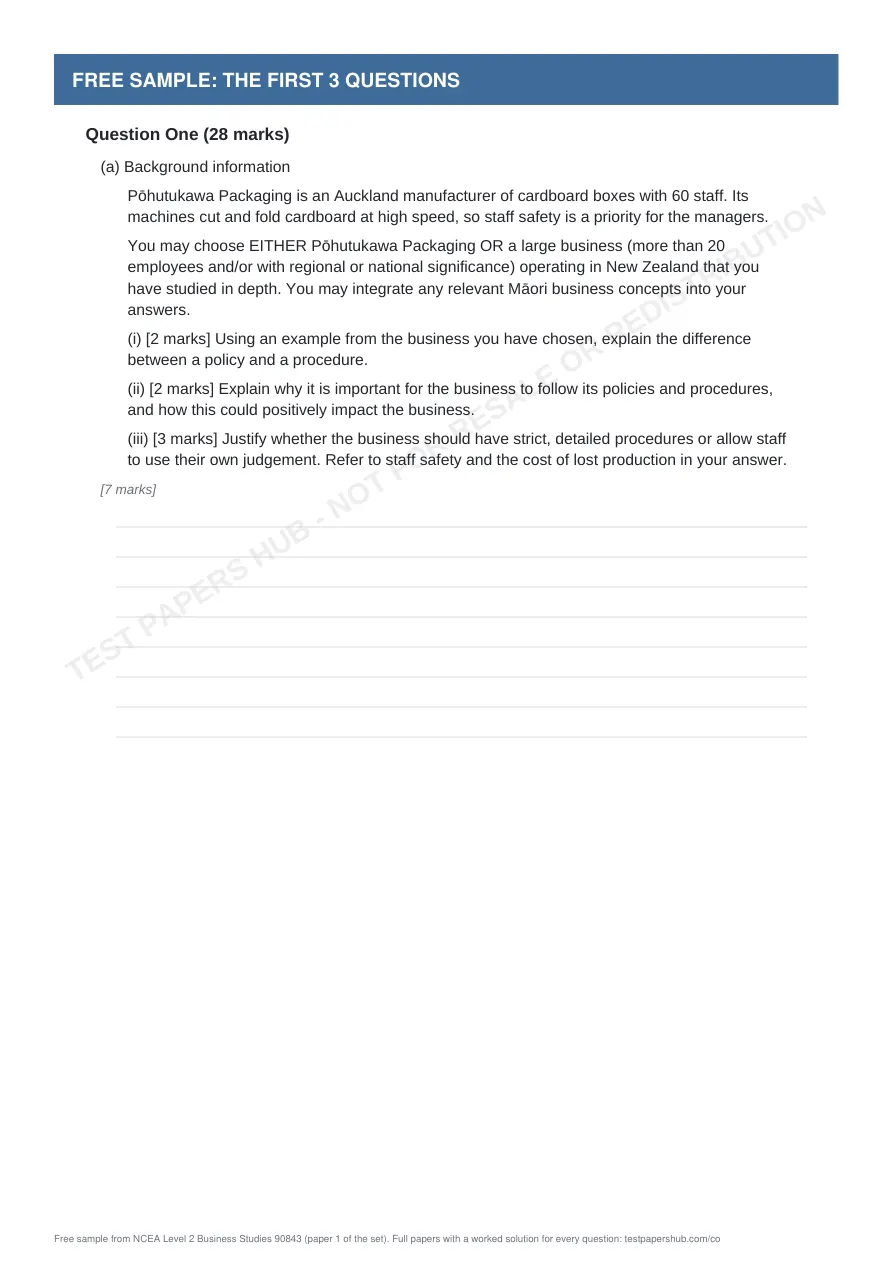
Question One (28 marks)
(a) Background information Pōhutukawa Packaging is an Auckland manufacturer of cardboard boxes with 60 staff. Its machines cut and fold cardboard at high speed, so staff safety is a priority for the managers. You may choose EITHER Pōhutukawa Packaging OR a large business (more than 20 employees and/or with regional or national significance) operating in New Zealand that you have studied in depth. You may integrate any relevant Māori business concepts into your answers.
(i) [2 marks] Using an example from the business you have chosen, explain the difference between a policy and a procedure.
(ii) [2 marks] Explain why it is important for the business to follow its policies and procedures, and how this could positively impact the business.
(iii) [3 marks] Justify whether the business should have strict, detailed procedures or allow staff to use their own judgement. Refer to staff safety and the cost of lost production in your answer.
[7 marks]
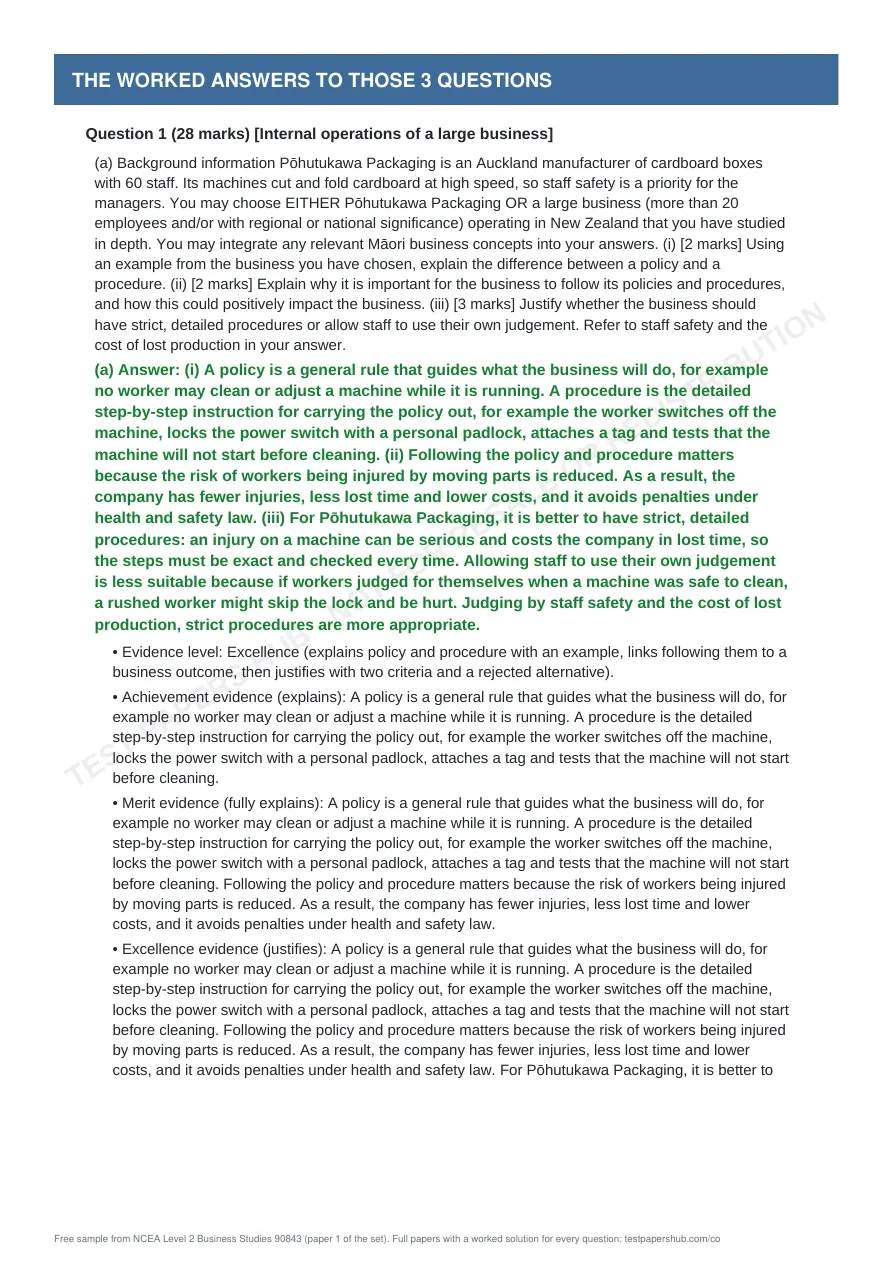
Question 1 (28 marks) [Internal operations of a large business]
(a) Background information Pōhutukawa Packaging is an Auckland manufacturer of cardboard boxes with 60 staff. Its machines cut and fold cardboard at high speed, so staff safety is a priority for the managers. You may choose EITHER Pōhutukawa Packaging OR a large business (more than 20 employees and/or with regional or national significance) operating in New Zealand that you have studied in depth. You may integrate any relevant Māori business concepts into your answers. (i) [2 marks] Using an example from the business you have chosen, explain the difference between a policy and a procedure. (ii) [2 marks] Explain why it is important for the business to follow its policies and procedures, and how this could positively impact the business. (iii) [3 marks] Justify whether the business should have strict, detailed procedures or allow staff to use their own judgement. Refer to staff safety and the cost of lost production in your answer.
(a) Answer: (i) A policy is a general rule that guides what the business will do, for example no worker may clean or adjust a machine while it is running. A procedure is the detailed step-by-step instruction for carrying the policy out, for example the worker switches off the machine, locks the power switch with a personal padlock, attaches a tag and tests that the machine will not start before cleaning. (ii) Following the policy and procedure matters because the risk of workers being injured by moving parts is reduced. As a result, the company has fewer injuries, less lost time and lower costs, and it avoids penalties under health and safety law. (iii) For Pōhutukawa Packaging, it is better to have strict, detailed procedures: an injury on a machine can be serious and costs the company in lost time, so the steps must be exact and checked every time. Allowing staff to use their own judgement is less suitable because if workers judged for themselves when a machine was safe to clean, a rushed worker might skip the lock and be hurt. Judging by staff safety and the cost of lost production, strict procedures are more appropriate.
• Evidence level: Excellence (explains policy and procedure with an example, links following them to a business outcome, then justifies with two criteria and a rejected alternative).
• Achievement evidence (explains): A policy is a general rule that guides what the business will do, for example no worker may clean or adjust a machine while it is running. A procedure is the detailed step-by-step instruction for carrying the policy out, for example the worker switches off the machine, locks the power switch with a personal padlock, attaches a tag and tests that the machine will not start before cleaning.
Your sample is downloading. Liked it? NCEA Level 2 Business Studies 90843 Paper 1 is the full paper: one question in four parts on the internal operations of a large business (policies and procedures, leadership styles, budget variances, capacity and efficiency), each with a supplied business, with worked Achieved, Merit and Excellence answers, with a worked solution for every question.
Get Paper 1 for A$11.99See all 20 papers from A$11.99More free NCEA (New Zealand) samples
Questions about this sample
What is in the NCEA Level 2 Business Studies 90843 free sample?
The first 3 questions from paper 1 of the set, in the real exam layout, followed by the step-by-step worked answers. It is a 3-page PDF; this page shows the opening pages.
How many full NCEA Level 2 Business Studies 90843 papers are there?
20 original papers for New Zealand Level 2 students preparing for NCEA external standard 90843. Each is one question in four parts on the internal operations of a large business (policies and procedures, leadership styles, budget variances, capacity and efficiency), each with a supplied business, with worked Achieved, Merit and Excellence answers, with a worked solution for every question. Papers start at A$11.99 and download instantly as a PDF.
Are these official past papers?
No. The sample is taken from our own original practice paper and is not an official past paper or affiliated with any exam authority.