NCEA Level 2 Chemistry 91166 Reactivity free practice questions with answers
Read the opening questions and their worked answers from paper 1 of our 20-paper NCEA Level 2 Chemistry 91166 Reactivity set, then download the 3-page PDF. These are original practice questions, not official past papers. Page updated 3 November 2026.

Topics: Rates of reaction (91166).
- Collision theory: a rate increase means more successful collisions per second; concentration and surface area raise the collision frequency, temperature raises both frequency and the fraction above the activation energy, and a catalyst lowers the activation energy.
- Rate from a graph or table: change in quantity ÷ change in time; it falls as the reactant concentration falls, which gives a curve that flattens when the reaction is complete.
Read the text of this sample
Question One (9 marks)
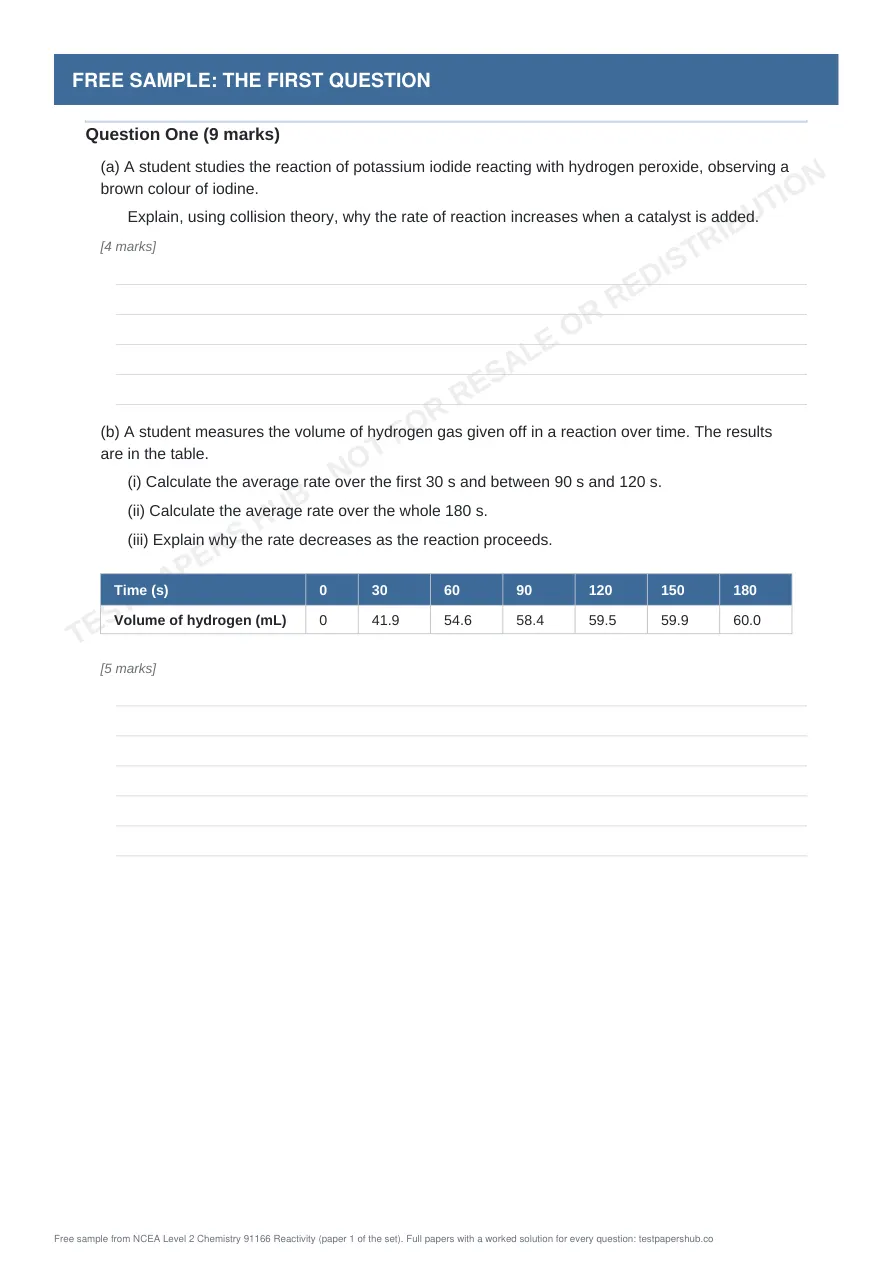
(a) A student studies the reaction of potassium iodide reacting with hydrogen peroxide, observing a brown colour of iodine. Explain, using collision theory, why the rate of reaction increases when a catalyst is added.
[4 marks]
(b) A student measures the volume of hydrogen gas given off in a reaction over time. The results are in the table.
(i) Calculate the average rate over the first 30 s and between 90 s and 120 s.
(ii) Calculate the average rate over the whole 180 s.
(iii) Explain why the rate decreases as the reaction proceeds. Time (s) 0 30 60 90 120 150 180 Volume of hydrogen (mL) 0 41.9 54.6 58.4 59.5 59.9 60.0
[5 marks]
Question 1 (9 marks) [Rates of reaction]
(a) A student studies the reaction of potassium iodide reacting with hydrogen peroxide, observing a brown colour of iodine. Explain, using collision theory, why the rate of reaction increases when a catalyst is added.
(a) Answer: The rate increases because the catalyst provides an alternative pathway with a lower activation energy, so a greater proportion of collisions have enough energy to react, and the frequency of successful collisions increases while the catalyst is not used up
• Evidence level: Excellence (use collision theory: frequency of collisions and the proportion with enough energy (activation energy)).
• Achievement: States that there are more (or more frequent) collisions.
• Merit: Links the factor to the collisions: the catalyst provides an alternative pathway with a lower activation energy.
• Excellence: Full explanation: the catalyst provides an alternative pathway with a lower activation energy, so a greater proportion of collisions have enough energy to react, and the frequency of successful collisions increases while the catalyst is not used up. Reaction only occurs when particles collide with at least the activation energy and the correct orientation, so more successful collisions per second means a faster rate.
(b) A student measures the volume of hydrogen gas given off in a reaction over time. The results are in the table. (i) Calculate the average rate over the first 30 s and between 90 s and 120 s. (ii) Calculate the average rate over the whole 180 s. (iii) Explain why the rate decreases as the reaction proceeds.
(b) Answer: (i) 1.40 mL s⁻¹ and 0.0367 mL s⁻¹; (ii) 0.333 mL s⁻¹; (iii) concentration of reactants falls, so fewer successful collisions per second
• Evidence level: Excellence (calculate average rates from the data and explain the change using concentration).
• (i) Rate = change in volume ÷ change in time. First 30 s: (41.9 − 0) ÷ 30 = 1.40 mL s⁻¹. From 90 s to 120 s: (59.5 − 58.4) ÷ 30 = 0.0367 mL s⁻¹.
• (ii) Whole reaction: 60.0 ÷ 180 = 0.333 mL s⁻¹.
• Achievement: (iii) States that the rate decreases because the reactants are used up.
• Merit: Links to concentration: as the reactant particles are used up their concentration falls, so there are fewer collisions.
• Excellence: Full explanation: as the reaction proceeds the concentration of the reactant(s) decreases, so there are fewer particles per unit volume, collisions between reactant particles are less frequent, and the frequency of successful collisions (with at least the activation energy) falls, so the rate decreases until the reactant is used up and the curve flattens.
Your sample is downloading. Liked it? NCEA Level 2 Chemistry 91166 Reactivity Paper 1 is the full paper: three questions made of several multi-part problems answered in writing (constructed response, no multiple choice), with a worked solution for every part that shows whether it is aimed at Achieved, Merit or Excellence, with a worked solution for every question.
Get Paper 1 for A$11.99See all 20 papers from A$11.99More free NCEA (New Zealand) samples
Questions about this sample
What is in the NCEA Level 2 Chemistry 91166 Reactivity free sample?
The first 3 questions from paper 1 of the set, in the real exam layout, followed by the step-by-step worked answers. It is a 3-page PDF; this page shows the opening pages.
How many full NCEA Level 2 Chemistry 91166 Reactivity papers are there?
20 original papers for New Zealand Level 2 students preparing for NCEA external standard 91166. Each is three questions made of several multi-part problems answered in writing (constructed response, no multiple choice), with a worked solution for every part that shows whether it is aimed at Achieved, Merit or Excellence, with a worked solution for every question. Papers start at A$11.99 and download instantly as a PDF.
Are these official past papers?
No. The sample is taken from our own original practice paper and is not an official past paper or affiliated with any exam authority.