NCEA Level 2 History 91231 91233 91234 free practice questions with answers
Read the opening questions and their worked answers from paper 1 of our 20-paper NCEA Level 2 History 91231 91233 91234 set, then download the 4-page PDF. These are original practice questions, not official past papers. Page updated 3 November 2026.
- Name the cause, back it with two sources and link them with because or so.
- Say what changed, what stayed the same, and point to two sources.
Read the text of this sample
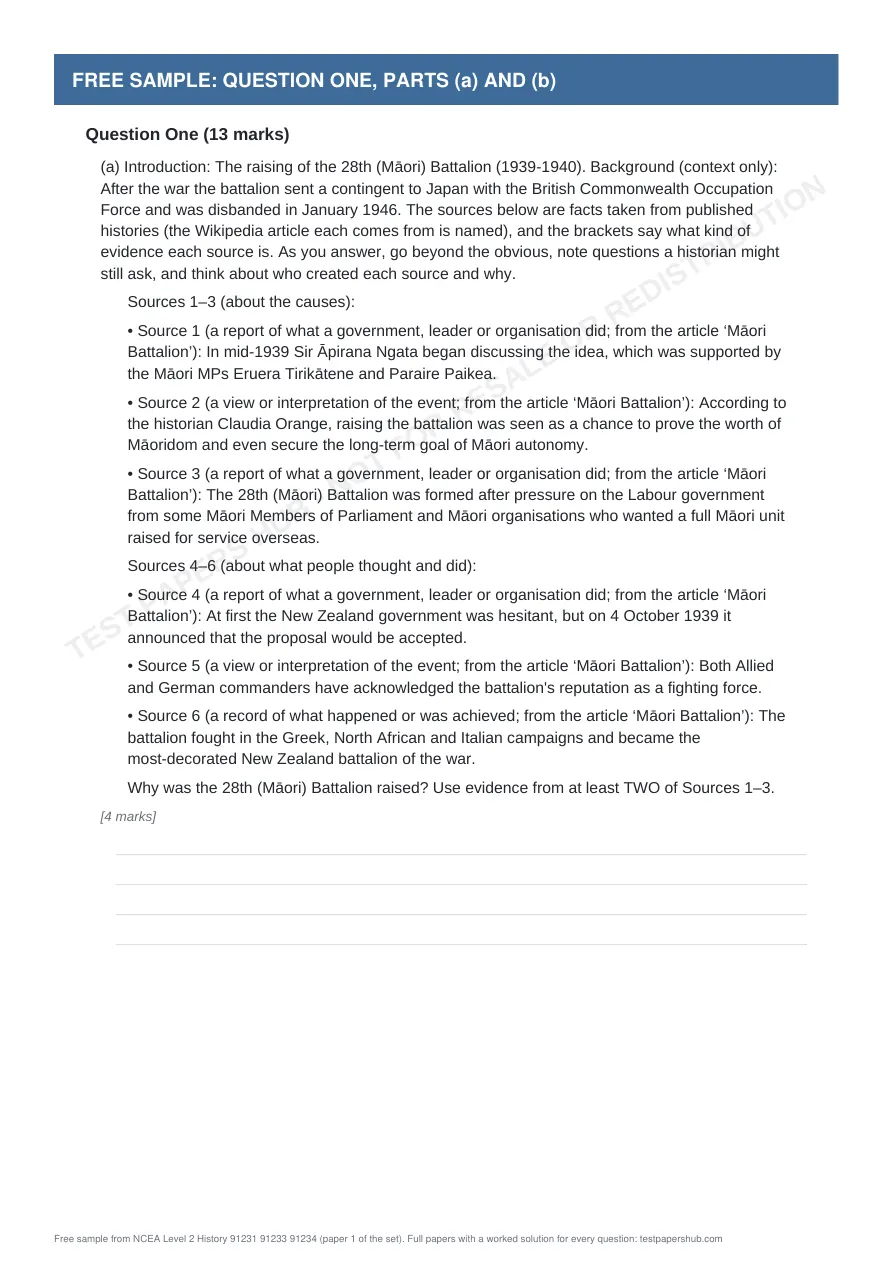
Question One (13 marks)
(a) Introduction: The raising of the 28th (Māori) Battalion (1939-1940). Background (context only):
After the war the battalion sent a contingent to Japan with the British Commonwealth Occupation Force and was disbanded in January 1946. The sources below are facts taken from published histories (the Wikipedia article each comes from is named), and the brackets say what kind of evidence each source is. As you answer, go beyond the obvious, note questions a historian might still ask, and think about who created each source and why. Sources 1–3 (about the causes):
• Source 1 (a report of what a government, leader or organisation did; from the article ‘Māori Battalion’): In mid-1939 Sir Āpirana Ngata began discussing the idea, which was supported by the Māori MPs Eruera Tirikātene and Paraire Paikea.
• Source 2 (a view or interpretation of the event; from the article ‘Māori Battalion’): According to the historian Claudia Orange, raising the battalion was seen as a chance to prove the worth of Māoridom and even secure the long-term goal of Māori autonomy.
• Source 3 (a report of what a government, leader or organisation did; from the article ‘Māori Battalion’): The 28th (Māori) Battalion was formed after pressure on the Labour government from some Māori Members of Parliament and Māori organisations who wanted a full Māori unit raised for service overseas. Sources 4–6 (about what people thought and did):
• Source 4 (a report of what a government, leader or organisation did; from the article ‘Māori Battalion’): At first the New Zealand government was hesitant, but on 4 October 1939 it announced that the proposal would be accepted.
• Source 5 (a view or interpretation of the event; from the article ‘Māori Battalion’): Both Allied and German commanders have acknowledged the battalion's reputation as a fighting force.
• Source 6 (a record of what happened or was achieved; from the article ‘Māori Battalion’): The battalion fought in the Greek, North African and Italian campaigns and became the most-decorated New Zealand battalion of the war. Why was the 28th (Māori) Battalion raised? Use evidence from at least TWO of Sources 1–3.
[4 marks]
(b) How did perspectives on the Māori Battalion change or continue over time? Use evidence from at least TWO of Sources 4–6.
[4 marks]
Question 1 (13 marks) [Examine sources of an historical event of significance to New Zealanders]
(a) Introduction: The raising of the 28th (Māori) Battalion (1939-1940). Background (context only): After the war the battalion sent a contingent to Japan with the British Commonwealth Occupation Force and was disbanded in January 1946. The sources below are facts taken from published histories (the Wikipedia article each comes from is named), and the brackets say what kind of evidence each source
is. As you answer, go beyond the obvious, note questions a historian might still ask, and think about who created each source and why. Sources 1–3 (about the causes): • Source 1 (a report of what a government, leader or organisation did; from the article ‘Māori Battalion’): In mid-1939 Sir Āpirana Ngata began discussing the idea, which was supported by the Māori MPs Eruera Tirikātene and Paraire Paikea.
• Source 2 (a view or interpretation of the event; from the article ‘Māori Battalion’): According to the historian Claudia Orange, raising the battalion was seen as a chance to prove the worth of Māoridom and even secure the long-term goal of Māori autonomy. • Source 3 (a report of what a government, leader or organisation did; from the article ‘Māori Battalion’): The 28th (Māori) Battalion was formed after pressure on the Labour government from some Māori Members of Parliament and Māori organisations who wanted a full Māori unit raised for service overseas. Sources 4–6 (about what people thought and did): • Source 4 (a report of what a government, leader or organisation did; from the article ‘Māori Battalion’): At first the New Zealand government was hesitant, but on 4 October 1939 it announced that the proposal would be accepted. • Source 5 (a view or interpretation of the event; from the article ‘Māori Battalion’):
Both Allied and German commanders have acknowledged the battalion's reputation as a fighting force. • Source 6 (a record of what happened or was achieved; from the article ‘Māori Battalion’): The battalion fought in the Greek, North African and Italian campaigns and became the most-decorated New Zealand battalion of the war. Why was the 28th (Māori) Battalion raised? Use evidence from at least TWO of Sources 1–3.
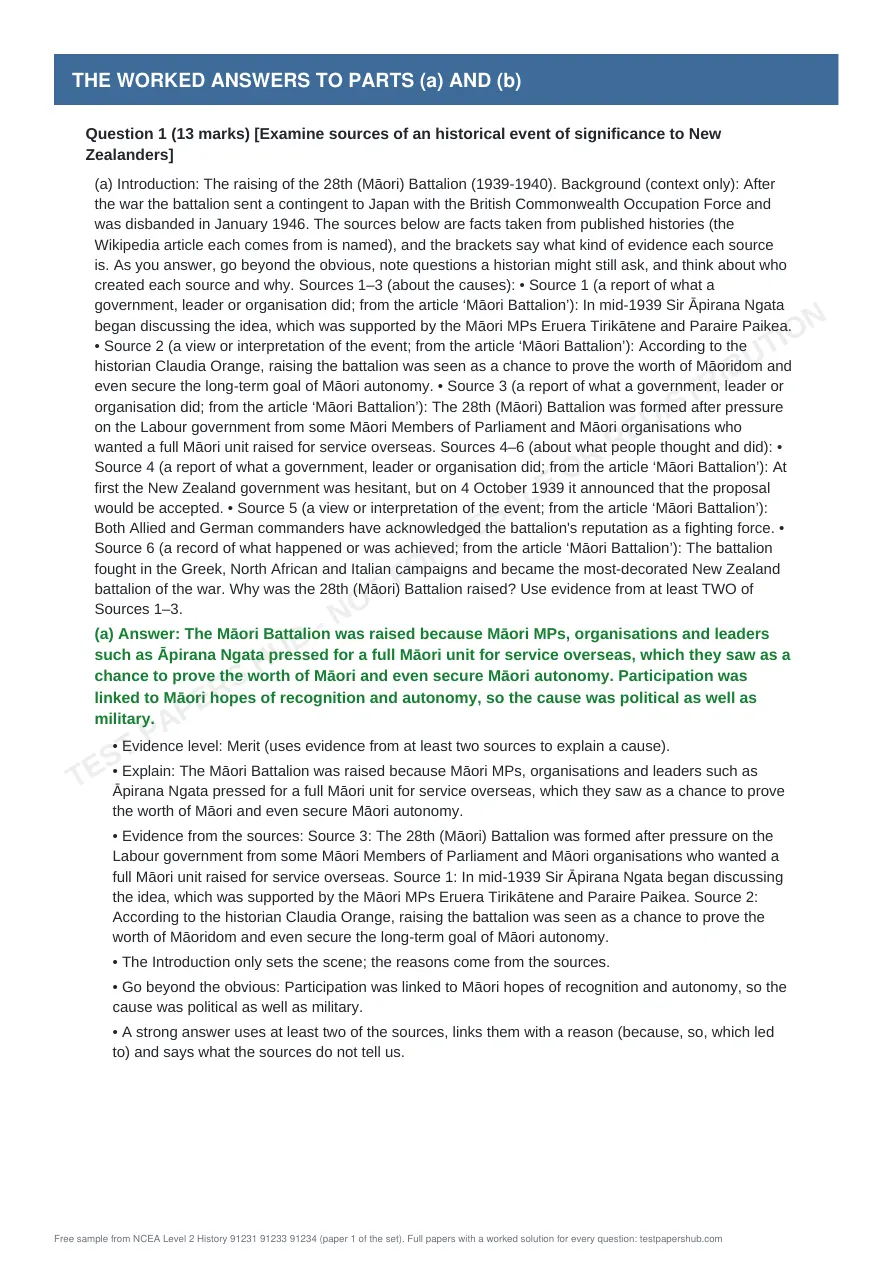
(a) Answer: The Māori Battalion was raised because Māori MPs, organisations and leaders such as Āpirana Ngata pressed for a full Māori unit for service overseas, which they saw as a chance to prove the worth of Māori and even secure Māori autonomy. Participation was linked to Māori hopes of recognition and autonomy, so the cause was political as well as military.
• Evidence level: Merit (uses evidence from at least two sources to explain a cause).
• Explain: The Māori Battalion was raised because Māori MPs, organisations and leaders such as Āpirana Ngata pressed for a full Māori unit for service overseas, which they saw as a chance to prove the worth of Māori and even secure Māori autonomy.
Your sample is downloading. Liked it? NCEA Level 2 History 91231 91233 91234 Paper 1 is the full paper: three questions made of several multi-part problems answered in writing (constructed response, no multiple choice), with a worked solution for every part that shows whether it is aimed at Achieved, Merit or Excellence, with a worked solution for every question.
Get Paper 1 for A$11.99See all 20 papers from A$11.99More free NCEA (New Zealand) samples
Questions about this sample
What is in the NCEA Level 2 History 91231 91233 91234 free sample?
The first 3 questions from paper 1 of the set, in the real exam layout, followed by the step-by-step worked answers. It is a 4-page PDF; this page shows the opening pages.
How many full NCEA Level 2 History 91231 91233 91234 papers are there?
20 original papers for New Zealand Level 2 students preparing for NCEA external standard 91231 and 91233 and 91234. Each is three questions made of several multi-part problems answered in writing (constructed response, no multiple choice), with a worked solution for every part that shows whether it is aimed at Achieved, Merit or Excellence, with a worked solution for every question. Papers start at A$11.99 and download instantly as a PDF.
Are these official past papers?
No. The sample is taken from our own original practice paper and is not an official past paper or affiliated with any exam authority.