NCEA Level 2 Physics 91170 Waves free practice questions with answers
Read the opening questions and their worked answers from paper 1 of our 20-paper NCEA Level 2 Physics 91170 Waves set, then download the 4-page PDF. These are original practice questions, not official past papers. Page updated 3 November 2026.

Topics: Light and images (91170).
- Curved mirrors: a negative m means inverted, and |m| > 1 means enlarged.
- Convex lenses: the same equations as mirrors, but a positive di now means the image is on the far side of the lens (real); an object inside the focal length gives an upright, enlarged, virtual image.
- Total internal reflection needs two things: light moving from a higher to a lower refractive index and an angle of incidence greater than the critical angle sin⁻¹(n₂/n₁).
Read the text of this sample
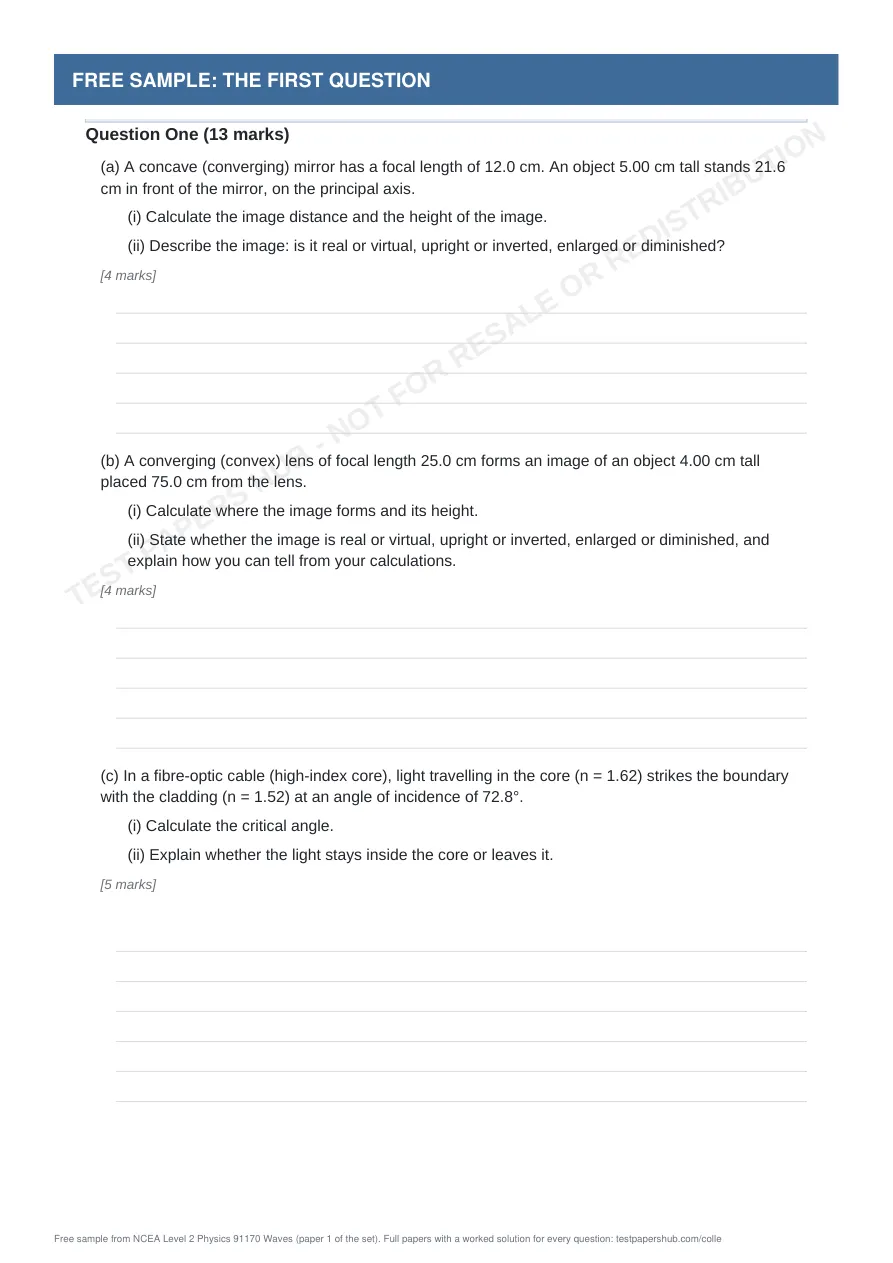
Question One (13 marks)
(a) A concave (converging) mirror has a focal length of 12.0 cm. An object 5.00 cm tall stands 21.6 cm in front of the mirror, on the principal axis.
(i) Calculate the image distance and the height of the image.
(ii) Describe the image: is it real or virtual, upright or inverted, enlarged or diminished?
[4 marks]
(b) A converging (convex) lens of focal length 25.0 cm forms an image of an object 4.00 cm tall placed 75.0 cm from the lens.
(i) Calculate where the image forms and its height.
(ii) State whether the image is real or virtual, upright or inverted, enlarged or diminished, and explain how you can tell from your calculations.
[4 marks]
(c) In a fibre-optic cable (high-index core), light travelling in the core (n = 1.62) strikes the boundary with the cladding (n = 1.52) at an angle of incidence of 72.8°.
(i) Calculate the critical angle.
(ii) Explain whether the light stays inside the core or leaves it.
[5 marks]
Question 1 (13 marks) [Light and images]
(a) A concave (converging) mirror has a focal length of 12.0 cm. An object 5.00 cm tall stands 21.6 cm in front of the mirror, on the principal axis. (i) Calculate the image distance and the height of the image. (ii) Describe the image: is it real or virtual, upright or inverted, enlarged or diminished?
(a) Answer: (i) di = 27.0 cm, hi = −6.25 cm; (ii) real, inverted, enlarged
• Evidence level: Merit (use the mirror equation and magnification, then describe the image from the signs).
• (i) real).
• Magnification m = −di/do = −1.25, so the image height hi = m × ho = −1.25 × 5.00 = −6.25 cm.
• (ii) The image is real, inverted and enlarged.
(b) A converging (convex) lens of focal length 25.0 cm forms an image of an object 4.00 cm tall placed 75.0 cm from the lens. (i) Calculate where the image forms and its height. (ii) State whether the image is real or virtual, upright or inverted, enlarged or diminished, and explain how you can tell from your calculations.
(b) Answer: (i) di = 37.5 cm, hi = −2.00 cm; (ii) real, inverted, diminished
• Evidence level: Merit (use the lens equation and magnification and interpret the signs).
• (i)
• m = −di/do = −0.500, so hi = −0.500 × 4.00 = −2.00 cm.
• (ii) di is positive so the image is real; m is negative so it is inverted; |m| is less than 1 so it is diminished.
(c) In a fibre-optic cable (high-index core), light travelling in the core (n = 1.62) strikes the boundary with the cladding (n = 1.52) at an angle of incidence of 72.8°. (i) Calculate the critical angle. (ii) Explain whether the light stays inside the core or leaves it.
(c) Answer: (i) θc = 69.8°; (ii) the light is totally internally reflected and stays inside
• Evidence level: Excellence (find the critical angle and apply the conditions for total internal reflection).
• (i) sin θc = n₂/n₁ = 1.52 ÷ 1.62 = 0.938, so θc = 69.8°.
• Achievement: (ii) States whether the angle of incidence is bigger or smaller than the critical angle.
• Merit: Links to the outcome: 72.8° is greater than the critical angle, so the light is totally internally reflected. 1 f = 1/do + 1/di gives 1/di = 1/12.0 − 1/21.6, so di = 27.0 cm (positive: in front of the mirror, so 1 f = 1/do + 1/di and m = −di/do; a positive di means a real image on the object's side, 1 f = 1/do + 1/di so di = 37.5 cm.
• Excellence: Full explanation: total internal reflection needs light going from the higher refractive index
(core) to the lower (cladding) AND an angle of incidence above θc. Both conditions are met, so the light stays inside the core, reflecting at the boundary with no loss through it.
Your sample is downloading. Liked it? NCEA Level 2 Physics 91170 Waves Paper 1 is the full paper: three questions made of several multi-part problems answered in writing (constructed response, no multiple choice), with a worked solution for every part that shows whether it is aimed at Achieved, Merit or Excellence, with a worked solution for every question.
Get Paper 1 for A$11.99See all 20 papers from A$11.99More free NCEA (New Zealand) samples
Questions about this sample
What is in the NCEA Level 2 Physics 91170 Waves free sample?
The first 3 questions from paper 1 of the set, in the real exam layout, followed by the step-by-step worked answers. It is a 4-page PDF; this page shows the opening pages.
How many full NCEA Level 2 Physics 91170 Waves papers are there?
20 original papers for New Zealand Level 2 students preparing for NCEA external standard 91170. Each is three questions made of several multi-part problems answered in writing (constructed response, no multiple choice), with a worked solution for every part that shows whether it is aimed at Achieved, Merit or Excellence, with a worked solution for every question. Papers start at A$11.99 and download instantly as a PDF.
Are these official past papers?
No. The sample is taken from our own original practice paper and is not an official past paper or affiliated with any exam authority.