NCEA Level 2 Physics 91171 Mechanics free practice questions with answers
Read the opening questions and their worked answers from paper 1 of our 20-paper NCEA Level 2 Physics 91171 Mechanics set, then download the 5-page PDF. These are original practice questions, not official past papers. Page updated 3 November 2026.

Topics: Motion (91171).
- Constant acceleration: list vi, vf, a, d and t, pick the equation with exactly one unknown, and give the answer with a unit and sensible significant figures.
- Projectiles: split the launch speed into horizontal (constant) and vertical (a = −9.8) parts, use the horizontal part to find the time, then find the height at that time and compare it, writing a conclusion.
- Compare projectile kicks by comparing the components: the vertical part sets the time in the air, the horizontal part is constant, and the range is horizontal speed times time.
- Unbalanced force: add the forces with signs to find the net force, then a = F/m; use that acceleration in the equations of motion.
Read the text of this sample
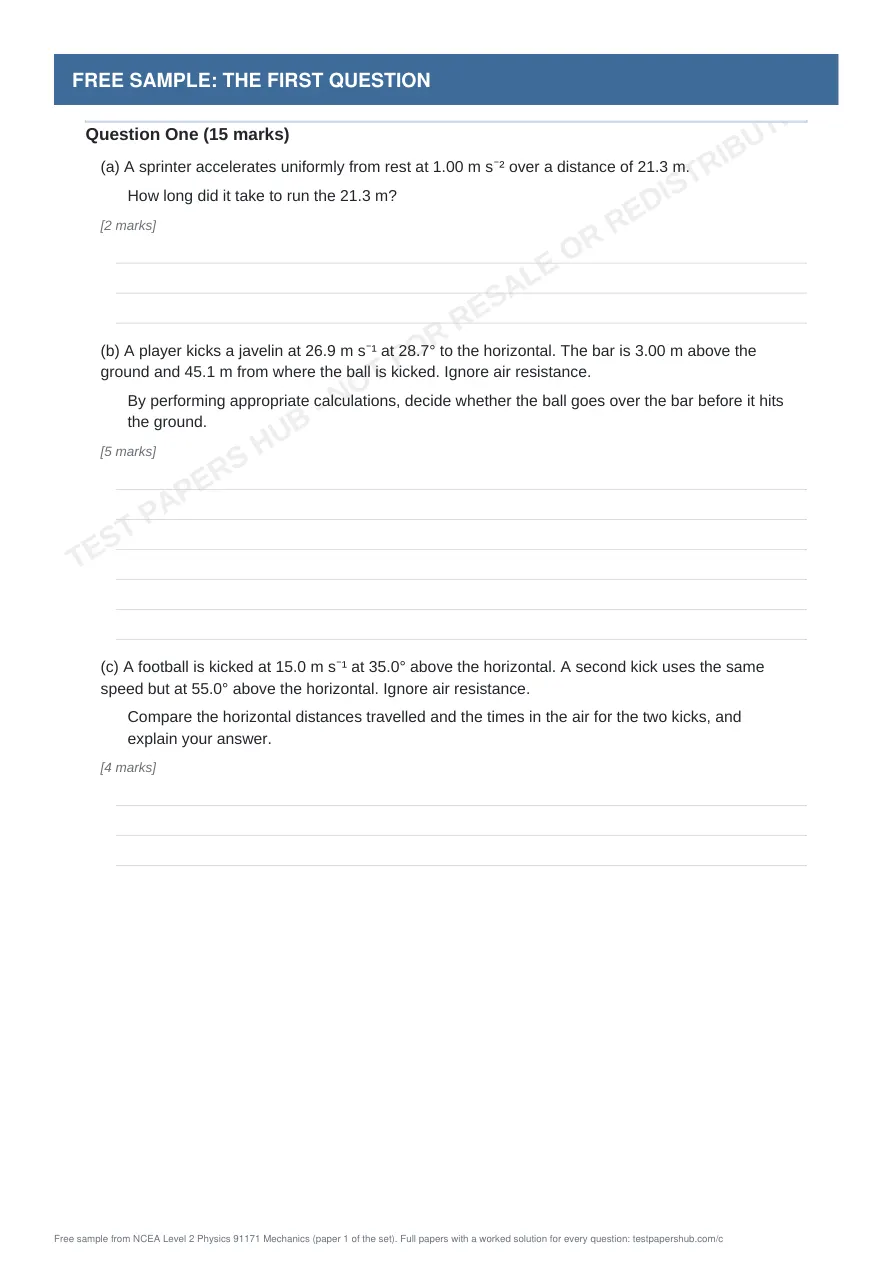
Question One (15 marks)
(a) A sprinter accelerates uniformly from rest at 1.00 m s⁻² over a distance of 21.3 m. How long did it take to run the 21.3 m?
[2 marks]
(b) A player kicks a javelin at 26.9 m s⁻¹ at 28.7° to the horizontal. The bar is 3.00 m above the ground and 45.1 m from where the ball is kicked. Ignore air resistance. By performing appropriate calculations, decide whether the ball goes over the bar before it hits the ground.
[5 marks]
(c) A football is kicked at 15.0 m s⁻¹ at 35.0° above the horizontal. A second kick uses the same speed but at 55.0° above the horizontal. Ignore air resistance. Compare the horizontal distances travelled and the times in the air for the two kicks, and explain your answer.
[4 marks]
(d) A 15.0 kg sled is pulled across level snow by a horizontal force of 60.0 N. Friction opposes the motion with a constant force of 30.0 N. The sled starts at rest.
(i) Calculate the acceleration of the sled.
(ii) How far does it travel, and how fast is it moving, after 6.00 s?
[4 marks]
Question 1 (15 marks) [Motion]
(a) A sprinter accelerates uniformly from rest at 1.00 m s⁻² over a distance of 21.3 m. How long did it take to run the 21.3 m?
(a) Answer: 6.53 s
• Evidence level: Achieved (choose and use one equation of motion with consistent units).
• Use d = vit + ½at² with vi = 0, a = 1.00 m s⁻², d = 21.3 m.
• 21.3 = ½ × 1.00 × t², so t = √(2 × 21.3 ÷ 1.00) = 6.53 s.
(b) A player kicks a javelin at 26.9 m s⁻¹ at 28.7° to the horizontal. The bar is 3.00 m above the ground and 45.1 m from where the ball is kicked. Ignore air resistance. By performing appropriate calculations, decide whether the ball goes over the bar before it hits the ground.
(b) Answer: At the bar the ball is 6.79 m high: it clears the bar
• Evidence level: Excellence (resolve the velocity, find the time to the bar, and compare the height with a clear conclusion).
• Components: vx = 26.9 cos 28.7° = 23.6 m s⁻¹ and vy = 26.9 sin 28.7° = 12.9 m s⁻¹.
• Time to travel 45.1 m horizontally: t = d ÷ vx = 45.1 ÷ 23.6 = 1.91 s.
• Height at that time: d = vyt + ½at² = 12.9 × 1.91 − ½ × 9.8 × 1.91² = 6.79 m.
• The ball is still in the air (it would stay up for 2.64 s), and 6.79 m is higher than 3.00 m, so the ball goes over the bar.
(c) A football is kicked at 15.0 m s⁻¹ at 35.0° above the horizontal. A second kick uses the same speed but at 55.0° above the horizontal. Ignore air resistance. Compare the horizontal distances travelled and the times in the air for the two kicks, and explain your answer.
(c) Answer: The two kicks land at the same horizontal distance (complementary angles), but the steeper kick (55.0°) stays in the air longer.
• Evidence level: Excellence (explain a comparison using the independence of horizontal and vertical motion).
• Achievement: States that the steeper kick has the larger vertical speed and so is in the air longer.
• Merit: Links cause and effect: sin and cos swap when the angle is replaced by 90° minus the angle, so the range vx × t is the same.
• Excellence: Full explanation: the horizontal speed of one kick equals the vertical speed component of the other, so the product vx × (2vy/g) = 2v²sinθcosθ/g is the same for both, but the larger vertical speed gives the longer time.
• Model answer: The two kicks land at the same horizontal distance (complementary angles), but the steeper kick (55.0°) stays in the air longer.
(d) A 15.0 kg sled is pulled across level snow by a horizontal force of 60.0 N. Friction opposes the motion with a constant force of 30.0 N. The sled starts at rest. (i) Calculate the acceleration of the sled. (ii) How far does it travel, and how fast is it moving, after 6.00 s?
(d) Answer: (i) 2.00 m s⁻²; (ii) 36.0 m and 12.0 m s⁻¹
• Evidence level: Merit (find the net force first, then use F = ma and the equations of motion).
• (i) Net force = 60.0 − 30.0 = 30.0 N. a = Fnet ÷ m = 30.0 ÷ 15.0 = 2.00 m s⁻².
• (ii) d = ½at² = ½ × 2.00 × 6.00² = 36.0 m, and v = at = 2.00 × 6.00 = 12.0 m s⁻¹.
Your sample is downloading. Liked it? NCEA Level 2 Physics 91171 Mechanics Paper 1 is the full paper: three questions made of several multi-part problems answered in writing (constructed response, no multiple choice), with a worked solution for every part that shows whether it is aimed at Achieved, Merit or Excellence, with a worked solution for every question.
Get Paper 1 for A$11.99See all 20 papers from A$11.99More free NCEA (New Zealand) samples
Questions about this sample
What is in the NCEA Level 2 Physics 91171 Mechanics free sample?
The first 3 questions from paper 1 of the set, in the real exam layout, followed by the step-by-step worked answers. It is a 5-page PDF; this page shows the opening pages.
How many full NCEA Level 2 Physics 91171 Mechanics papers are there?
20 original papers for New Zealand Level 2 students preparing for NCEA external standard 91171. Each is three questions made of several multi-part problems answered in writing (constructed response, no multiple choice), with a worked solution for every part that shows whether it is aimed at Achieved, Merit or Excellence, with a worked solution for every question. Papers start at A$11.99 and download instantly as a PDF.
Are these official past papers?
No. The sample is taken from our own original practice paper and is not an official past paper or affiliated with any exam authority.