NCEA Level 1 Chem and Bio 92022 Genetics free practice questions with answers
Read the opening questions and their worked answers from paper 1 of our 20-paper NCEA Level 1 Chem and Bio 92022 Genetics set, then download the 3-page PDF. These are original practice questions, not official past papers. Page updated 3 November 2026.

Topics: Inheriting a characteristic (92022).
- Crosses: list the gametes, complete the Punnett square, and count the offspring; probability = number of squares ÷ 4; two carriers have a 1 in 4 chance of an affected child.
- Pedigree reasoning: an affected child of unaffected parents shows that both parents are carriers; the probability of another affected child is
Read the text of this sample
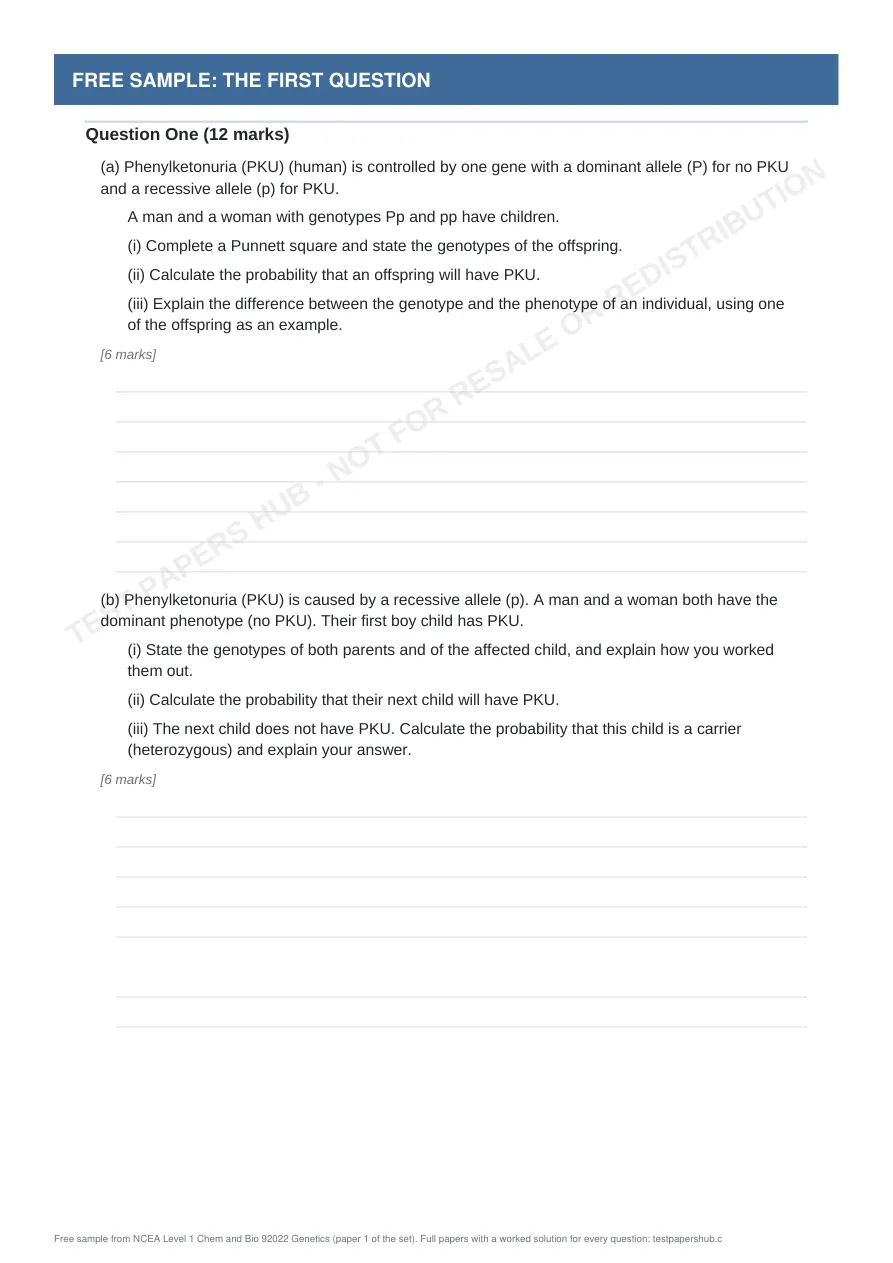
Question One (12 marks)
(a) Phenylketonuria (PKU) (human) is controlled by one gene with a dominant allele (P) for no PKU and a recessive allele (p) for PKU.
A man and a woman with genotypes Pp and pp have children.
(i) Complete a Punnett square and state the genotypes of the offspring.
(ii) Calculate the probability that an offspring will have PKU.
(iii) Explain the difference between the genotype and the phenotype of an individual, using one of the offspring as an example.
[6 marks]
(b) Phenylketonuria (PKU) is caused by a recessive allele (p). A man and a woman both have the dominant phenotype (no PKU). Their first boy child has PKU.
(i) State the genotypes of both parents and of the affected child, and explain how you worked them out.
(ii) Calculate the probability that their next child will have PKU.
(iii) The next child does not have PKU. Calculate the probability that this child is a carrier (heterozygous) and explain your answer.
[6 marks]
Question 1 (12 marks) [Inheriting a characteristic]
(a) Phenylketonuria (PKU) (human) is controlled by one gene with a dominant allele (P) for no PKU and a recessive allele (p) for PKU. A man and a woman with genotypes Pp and pp have children. (i) Complete a Punnett square and state the genotypes of the offspring. (ii) Calculate the probability that an offspring will have PKU. (iii) Explain the difference between the genotype and the phenotype of an individual, using one of the offspring as an example.
(a) Answer: (i) Pp × 2, pp × 2; (ii)
• Evidence level: Achieved (gametes from each parent, Punnett square, then count).
• (i) Gametes: P and p from the first parent and p and p from the second parent. Offspring: Pp × 2, pp × 2.
• (ii) P(PKU) =
• Achievement: (iii) States that genotype is the alleles and phenotype is the appearance.
• Merit: Links to an example: an offspring Pp has the dominant phenotype (no PKU) but carries a recessive allele.
• Excellence: Full explanation: the genotype is the combination of alleles an individual has (for example Pp); the phenotype is the observable characteristic that results from the genotype and the environment (no PKU); because P is dominant, the genotypes PP and Pp both give the phenotype no PKU, while only pp shows PKU.
(b) Phenylketonuria (PKU) is caused by a recessive allele (p). A man and a woman both have the dominant phenotype (no PKU). Their first boy child has PKU. (i) State the genotypes of both parents and of the affected child, and explain how you worked them out. (ii) Calculate the probability that their next child will have PKU. (iii) The next child does not have PKU. Calculate the probability that this child is a carrier (heterozygous) and explain your answer.
(b) Answer: (i) both parents Pp, child pp; (ii)
• Evidence level: Merit (an affected child must have two recessive alleles, one from each parent).
• (i) The child has pp (two recessive alleles, one from each parent). The parents have the dominant phenotype, so each has at least one P, and both must carry p, so both are heterozygous: Pp.
• (ii) Cross Pp × Pp gives PP, Pp, Pp and pp in equal numbers, so P(PKU) =
• Achievement: (iii) States that the probability is
• Merit: Links to the Punnett square: the child is one of the three offspring types with the dominant phenotype (PP, Pp, Pp).
• Excellence: Full explanation: since the child does not have PKU, the child cannot be pp; of the three remaining equally likely outcomes (PP, Pp, Pp) two are heterozygous, so P(carrier) = 1 2 ; (iii) explained 1 2 (the offspring that are pp). 1 4 ; (iii) 2 3 1 4 . 2 3 . 2 3 . 1 4 , and an unaffected child is a carrier with probability 2 3 .
Your sample is downloading. Liked it? NCEA Level 1 Chem and Bio 92022 Genetics Paper 1 is the full paper: three questions made of several multi-part problems answered in writing (constructed response, no multiple choice), with a worked solution for every part that shows whether it is aimed at Achieved, Merit or Excellence, with a worked solution for every question.
Get Paper 1 for A$11.99See all 20 papers from A$11.99More free NCEA (New Zealand) samples
Questions about this sample
What is in the NCEA Level 1 Chem and Bio 92022 Genetics free sample?
The first 3 questions from paper 1 of the set, in the real exam layout, followed by the step-by-step worked answers. It is a 3-page PDF; this page shows the opening pages.
How many full NCEA Level 1 Chem and Bio 92022 Genetics papers are there?
20 original papers for New Zealand Level 1 students preparing for NCEA external standard 92022. Each is three questions made of several multi-part problems answered in writing (constructed response, no multiple choice), with a worked solution for every part that shows whether it is aimed at Achieved, Merit or Excellence, with a worked solution for every question. Papers start at A$11.99 and download instantly as a PDF.
Are these official past papers?
No. The sample is taken from our own original practice paper and is not an official past paper or affiliated with any exam authority.