NCEA Level 1 Chem and Bio 92023 Materials free practice questions with answers
Read the opening questions and their worked answers from paper 1 of our 20-paper NCEA Level 1 Chem and Bio 92023 Materials set, then download the 5-page PDF. These are original practice questions, not official past papers. Page updated 3 November 2026.

Topics: Properties and uses of materials (92023).
- Classifying materials: conducts as a solid → metal; conducts only when molten or dissolved → ionic; no conductivity and low melting point → simple molecular; no conductivity and very high melting point → covalent network.
- Choosing materials: list the properties the use needs, check each material's data against them, then explain the property from the particles and bonding.
Read the text of this sample
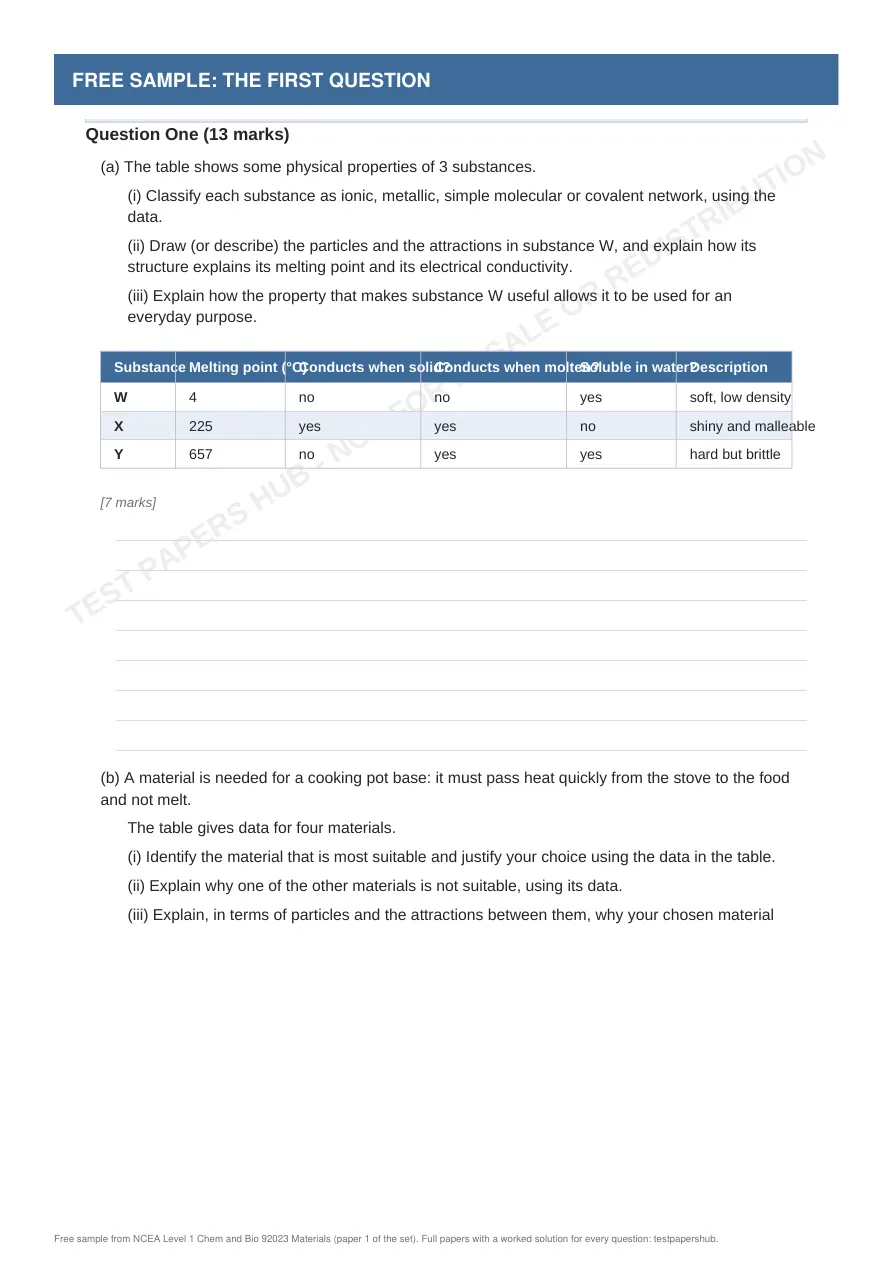
Question One (13 marks)
(a) The table shows some physical properties of 3 substances.
(i) Classify each substance as ionic, metallic, simple molecular or covalent network, using the data.
(ii) Draw (or describe) the particles and the attractions in substance W, and explain how its structure explains its melting point and its electrical conductivity.
(iii) Explain how the property that makes substance W useful allows it to be used for an everyday purpose. Substance Melting point (°C)Conducts when solid? Conducts when molten? Soluble in water?Description W 4 no no yes soft, low density X 225 yes yes no shiny and malleable Y 657 no yes yes hard but brittle
[7 marks]
(b) A material is needed for a cooking pot base: it must pass heat quickly from the stove to the food and not melt. The table gives data for four materials.
(i) Identify the material that is most suitable and justify your choice using the data in the table.
(ii) Explain why one of the other materials is not suitable, using its data.
(iii) Explain, in terms of particles and the attractions between them, why your chosen material has the properties you identified. Material Melting point (°C) Electrical conductivity (relative) Hardness (Mohs, 1–10) Flexible? wood 300 0.15 0 0.6 2 no stainless steel1450 16 1.4 8.0 5 no copper 1085 400 60 8.9 3 yes sodium chloride (salt) 801 6.5 0 2.2 2 no
[6 marks]
Question 1 (13 marks) [Properties and uses of materials]
(a) The table shows some physical properties of 3 substances. (i) Classify each substance as ionic, metallic, simple molecular or covalent network, using the data. (ii) Draw (or describe) the particles and the attractions in substance W, and explain how its structure explains its melting point and its electrical conductivity. (iii) Explain how the property that makes substance W useful allows it to be used for an everyday purpose.
(a) Answer: (i) W molecular; X metallic; Y ionic; (ii) small separate molecules held to each other by weak forces b
• Evidence level: Merit (decide from conductivity first, then melting point).
• (i) W is molecular; X is metallic; Y is ionic.
• (ii) Substance W is a simple molecular substance: its structure is small separate molecules held to each other by weak forces between the molecules (while the atoms in each molecule are joined by strong covalent bonds); it has low melting and boiling points because only weak forces between the molecules need to be overcome (the covalent bonds do not break); does not conduct electricity because there are no free charged particles.
• Achievement: (iii) Names a use and links it to a property.
• Merit: Links the use to the particle structure.
• Excellence: Full explanation: a simple molecular substance such as wax or ethanol melts or evaporates easily because the forces between molecules are weak, so it is used as a fuel or a solvent, and it is a good electrical insulator because it has no free charged particles
(b) A material is needed for a cooking pot base: it must pass heat quickly from the stove to the food and not melt. The table gives data for four materials. (i) Identify the material that is most suitable and justify your choice using the data in the table. (ii) Explain why one of the other materials is not suitable, using its
data. (iii) Explain, in terms of particles and the attractions between them, why your chosen material has the properties you identified.
(b) Answer: (i) copper; (ii) wood fails thermal conductivity, melting point above 500°C
• Evidence level: Merit (match each requirement to the data).
• (i) copper is the only material that meets both requirements: thermal conductivity (high); melting point above 500°C (high).
• (ii) wood is not suitable because it does not meet thermal conductivity or melting point above 500°C.
• Achievement: (iii) States the structure of copper.
• Merit: Links the structure to the property.
• Excellence: Full explanation: copper is a metal: a lattice of positive ions in a sea of delocalised electrons; the free electrons carry electric charge and heat energy, so it conducts well; the lattice of strong attractions gives a high melting point
Your sample is downloading. Liked it? NCEA Level 1 Chem and Bio 92023 Materials Paper 1 is the full paper: three questions made of several multi-part problems answered in writing (constructed response, no multiple choice), with a worked solution for every part that shows whether it is aimed at Achieved, Merit or Excellence, with a worked solution for every question.
Get Paper 1 for A$11.99See all 20 papers from A$11.99More free NCEA (New Zealand) samples
Questions about this sample
What is in the NCEA Level 1 Chem and Bio 92023 Materials free sample?
The first 3 questions from paper 1 of the set, in the real exam layout, followed by the step-by-step worked answers. It is a 5-page PDF; this page shows the opening pages.
How many full NCEA Level 1 Chem and Bio 92023 Materials papers are there?
20 original papers for New Zealand Level 1 students preparing for NCEA external standard 92023. Each is three questions made of several multi-part problems answered in writing (constructed response, no multiple choice), with a worked solution for every part that shows whether it is aimed at Achieved, Merit or Excellence, with a worked solution for every question. Papers start at A$11.99 and download instantly as a PDF.
Are these official past papers?
No. The sample is taken from our own original practice paper and is not an official past paper or affiliated with any exam authority.