NCEA Level 3 Accounting 91406 Statements free practice questions with answers
Read the opening questions and their worked answers from paper 1 of our 20-paper NCEA Level 3 Accounting 91406 Statements set, then download the 6-page PDF. These are original practice questions, not official past papers. Page updated 3 November 2026.
Topics: General journal entries (91406); Statement of Comprehensive Income and Statement of Financial Position (91406).
- Income tax expense is based on taxable profit (accounting profit adjusted for non-deductible items), not on accounting profit.
- A liability is only what is still owed at balance date: tax payable = tax expense less tax already paid.
- Each journal entry balances: total debits equal total credits; use the account that matches what changed in each transaction.
- Tax is charged on taxable profit; dividends are a distribution of profit, not an expense, and revaluation gains on land go to other comprehensive income.
Read the text of this sample
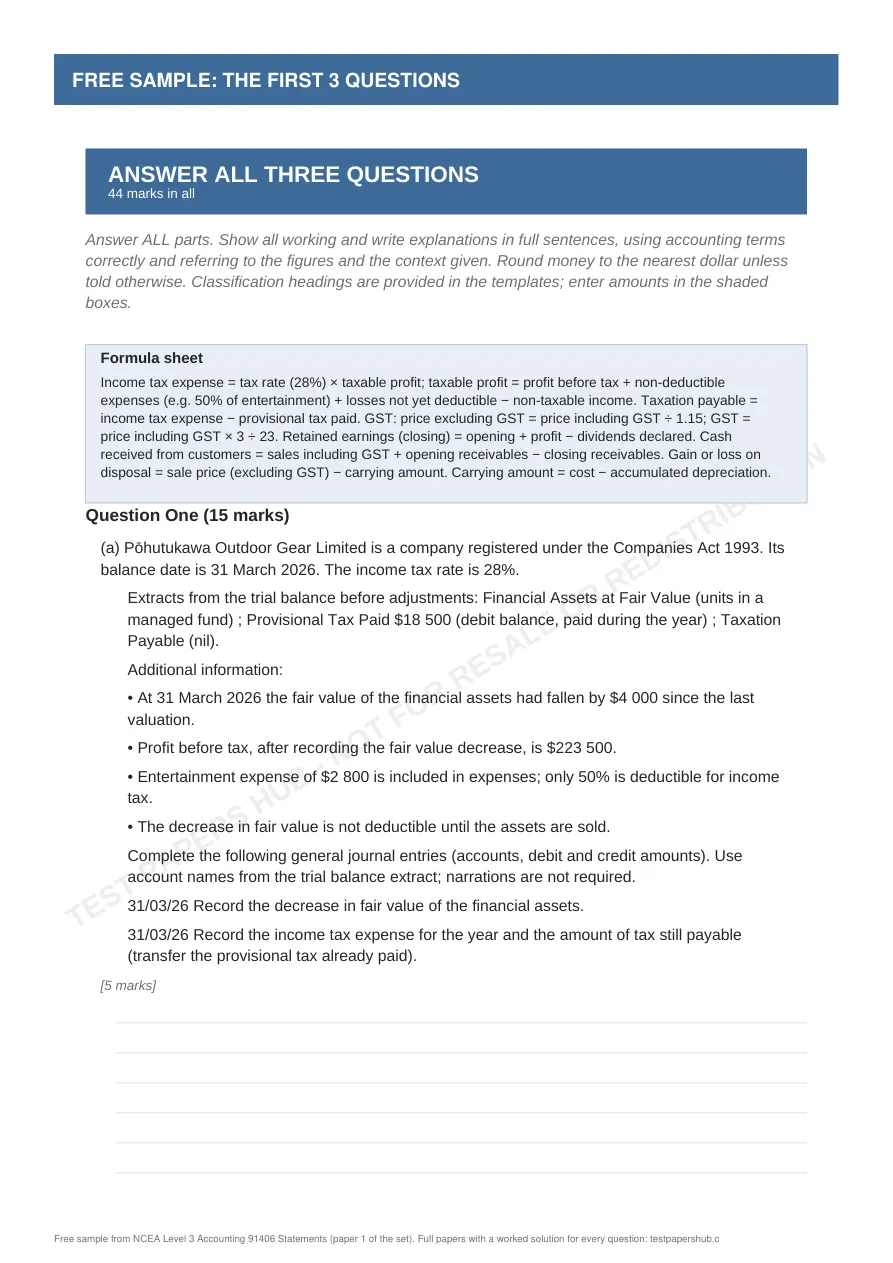
ANSWER ALL THREE QUESTIONS 44 marks in all Answer ALL parts. Show all working and write explanations in full sentences, using accounting terms correctly and referring to the figures and the context given. Round money to the nearest dollar unless told otherwise. Classification headings are provided in the templates; enter amounts in the shaded boxes. Formula sheet Income tax expense = tax rate (28%) × taxable profit; taxable profit = profit before tax + non-deductible expenses (e.g. 50% of entertainment) + losses not yet deductible − non-taxable income. Taxation payable = income tax expense − provisional tax paid. GST: price excluding GST = price including GST ÷ 1.15; GST = price including GST × 3 ÷ 23. Retained earnings (closing) = opening + profit − dividends declared. Cash received from customers = sales including GST + opening receivables − closing receivables. Gain or loss on disposal = sale price (excluding GST) − carrying amount. Carrying amount = cost − accumulated depreciation. Question One (15 marks)
(a) Pōhutukawa Outdoor Gear Limited is a company registered under the Companies Act 1993. Its balance date is 31 March 2026. The income tax rate is 28%. Extracts from the trial balance before adjustments: Financial Assets at Fair Value (units in a managed fund) ; Provisional Tax Paid $18 500 (debit balance, paid during the year) ; Taxation Payable (nil). Additional information:
• At 31 March 2026 the fair value of the financial assets had fallen by $4 000 since the last valuation.
• Profit before tax, after recording the fair value decrease, is $223 500.
• Entertainment expense of $2 800 is included in expenses; only 50% is deductible for income tax.
• The decrease in fair value is not deductible until the assets are sold. Complete the following general journal entries (accounts, debit and credit amounts). Use account names from the trial balance extract; narrations are not required. 31/03/26 Record the decrease in fair value of the financial assets. 31/03/26 Record the income tax expense for the year and the amount of tax still payable (transfer the provisional tax already paid).
[5 marks]
(b) A friend says that Pōhutukawa Outdoor Gear Limited should report Taxation Payable of $64 092 in the current liabilities section of its Statement of Financial Position at 31 March 2026, because that is the income tax expense for the year. Explain in detail why your friend is incorrect. In your answer refer to relevant accounts and to the correct amount to report for taxation payable.
[4 marks]
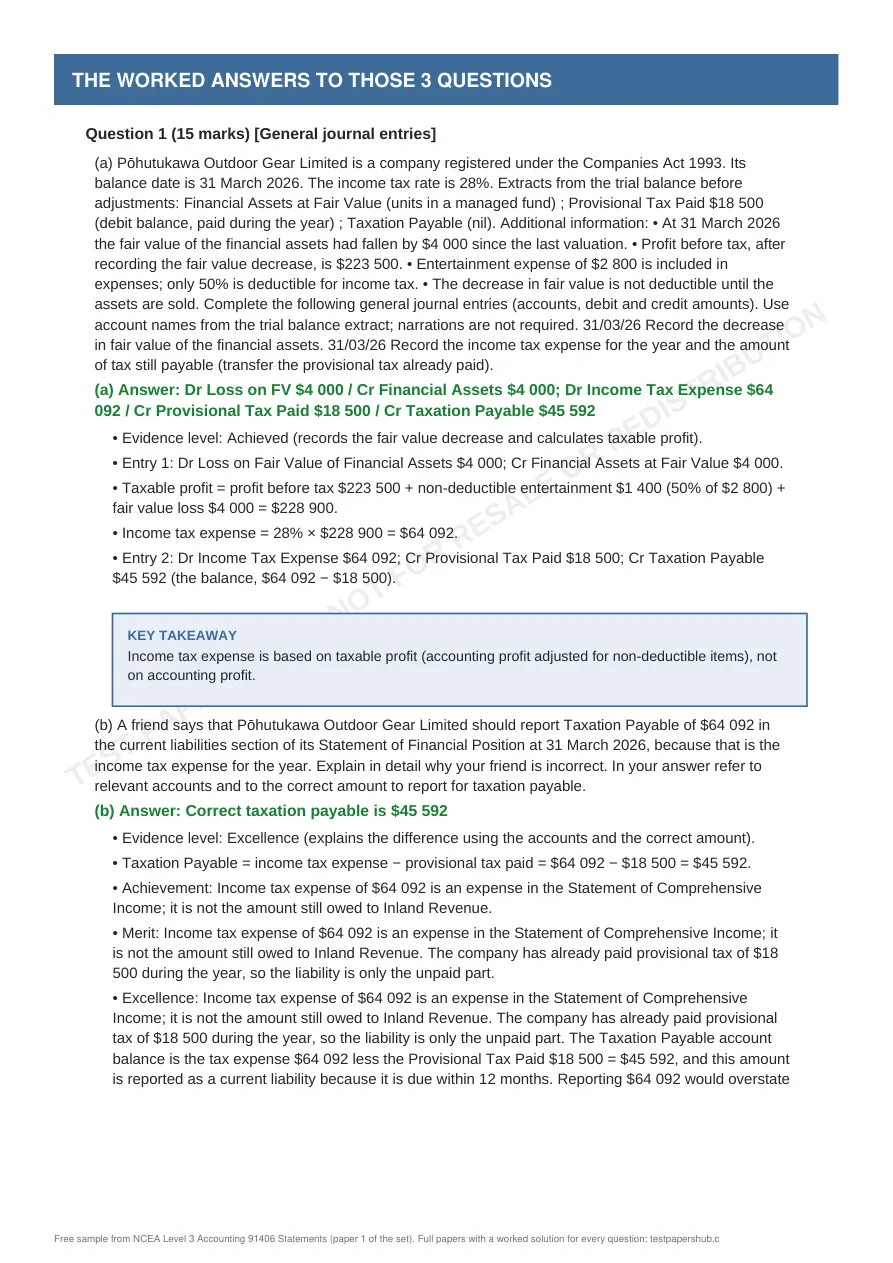
Question 1 (15 marks) [General journal entries]
(a) Pōhutukawa Outdoor Gear Limited is a company registered under the Companies Act 1993. Its balance date is 31 March 2026. The income tax rate is 28%. Extracts from the trial balance before adjustments: Financial Assets at Fair Value (units in a managed fund) ; Provisional Tax Paid $18 500 (debit balance, paid during the year) ; Taxation Payable (nil). Additional information: • At 31 March 2026 the fair value of the financial assets had fallen by $4 000 since the last valuation. • Profit before tax, after recording the fair value decrease, is $223 500. • Entertainment expense of $2 800 is included in expenses; only 50% is deductible for income tax. • The decrease in fair value is not deductible until the assets are sold. Complete the following general journal entries (accounts, debit and credit amounts). Use account names from the trial balance extract; narrations are not required. 31/03/26 Record the decrease in fair value of the financial assets. 31/03/26 Record the income tax expense for the year and the amount of tax still payable (transfer the provisional tax already paid).
(a) Answer: Dr Loss on FV $4 000 / Cr Financial Assets $4 000; Dr Income Tax Expense $64 092 / Cr Provisional Tax Paid $18 500 / Cr Taxation Payable $45 592
• Evidence level: Achieved (records the fair value decrease and calculates taxable profit).
• Entry 1: Dr Loss on Fair Value of Financial Assets $4 000; Cr Financial Assets at Fair Value $4 000.
• Taxable profit = profit before tax $223 500 + non-deductible entertainment $1 400 (50% of $2 800) + fair value loss $4 000 = $228 900.
• Income tax expense = 28% × $228 900 = $64 092.
• Entry 2: Dr Income Tax Expense $64 092; Cr Provisional Tax Paid $18 500; Cr Taxation Payable $45 592 (the balance, $64 092 − $18 500).
(b) A friend says that Pōhutukawa Outdoor Gear Limited should report Taxation Payable of $64 092 in the current liabilities section of its Statement of Financial Position at 31 March 2026, because that is the income tax expense for the year. Explain in detail why your friend is incorrect. In your answer refer to relevant accounts and to the correct amount to report for taxation payable.
(b) Answer: Correct taxation payable is $45 592
• Evidence level: Excellence (explains the difference using the accounts and the correct amount).
• Taxation Payable = income tax expense − provisional tax paid = $64 092 − $18 500 = $45 592.
• Achievement: Income tax expense of $64 092 is an expense in the Statement of Comprehensive Income; it is not the amount still owed to Inland Revenue.
• Merit: Income tax expense of $64 092 is an expense in the Statement of Comprehensive Income; it is not the amount still owed to Inland Revenue. The company has already paid provisional tax of $18 500 during the year, so the liability is only the unpaid part.
Your sample is downloading. Liked it? NCEA Level 3 Accounting 91406 Statements Paper 1 is the full paper: three written questions on company financial statements: journal entries, tax and GST, the Statement of Comprehensive Income, the Statement of Financial Position and the Statement of Cash Flows, with worked solutions showing Achieved, Merit and Excellence answers, with a worked solution for every question.
Get Paper 1 for A$11.99See all 20 papers from A$11.99More free NCEA (New Zealand) samples
Questions about this sample
What is in the NCEA Level 3 Accounting 91406 Statements free sample?
The first 3 questions from paper 1 of the set, in the real exam layout, followed by the step-by-step worked answers. It is a 6-page PDF; this page shows the opening pages.
How many full NCEA Level 3 Accounting 91406 Statements papers are there?
20 original papers for New Zealand Level 3 students preparing for NCEA external standard 91406. Each is three written questions on company financial statements: journal entries, tax and GST, the Statement of Comprehensive Income, the Statement of Financial Position and the Statement of Cash Flows, with worked solutions showing Achieved, Merit and Excellence answers, with a worked solution for every question. Papers start at A$11.99 and download instantly as a PDF.
Are these official past papers?
No. The sample is taken from our own original practice paper and is not an official past paper or affiliated with any exam authority.