NCEA Level 3 Biology 91603 Responses free practice questions with answers
Read the opening questions and their worked answers from paper 1 of our 20-paper NCEA Level 3 Biology 91603 Responses set, then download the 4-page PDF. These are original practice questions, not official past papers. Page updated 3 November 2026.

Topics: Biological clocks and behaviour (91603).
- Biological clocks: in constant conditions the rhythm free-runs with a period close to, but not exactly, 24 h (so activity onset drifts each day); light (the zeitgeber) entrains the clock to 24 h.
- Behaviour: a kinesis changes the rate of movement or turning with the stimulus intensity (no direction); a taxis is movement towards or away from a stimulus; both help animals end up in favourable conditions.
Read the text of this sample
Question One (14 marks)
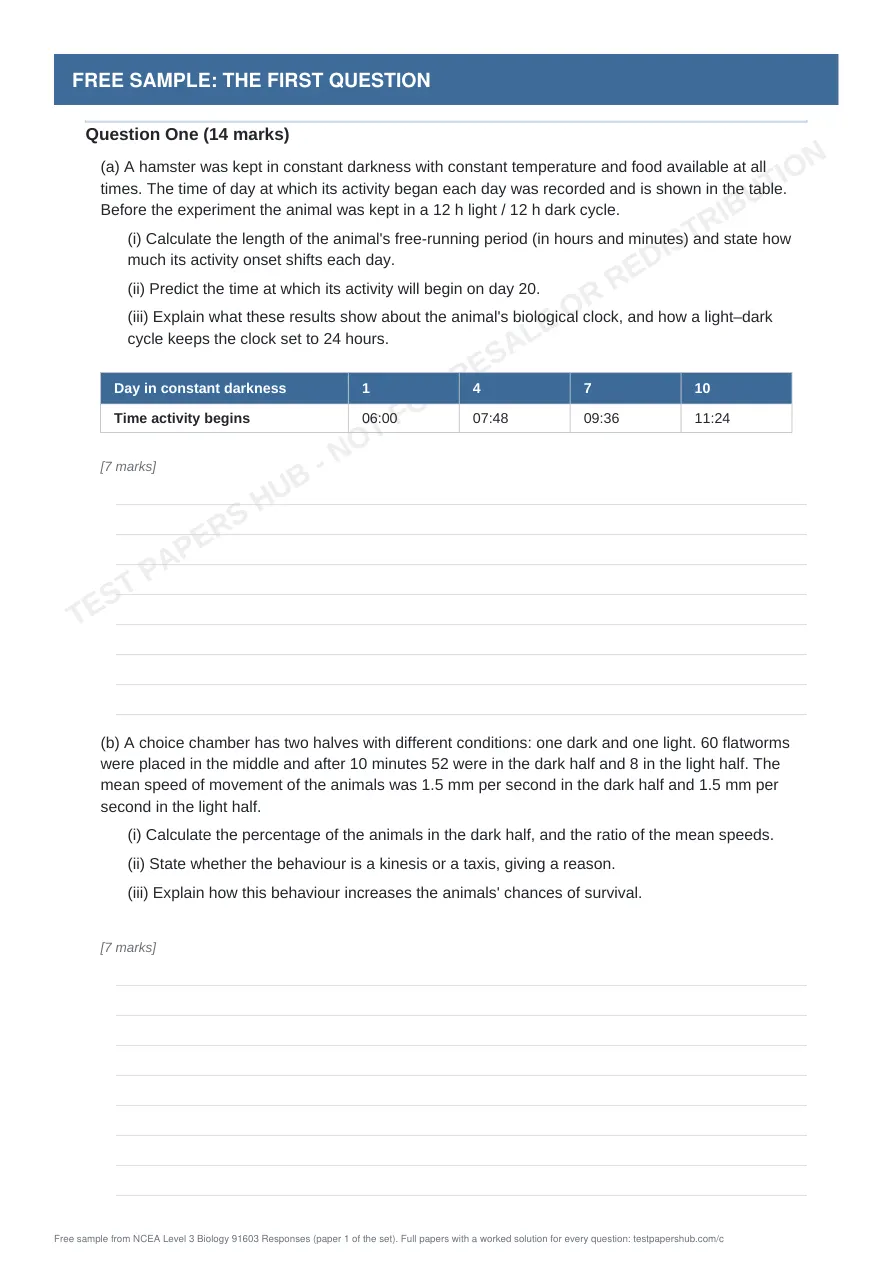
(a) A hamster was kept in constant darkness with constant temperature and food available at all times. The time of day at which its activity began each day was recorded and is shown in the table. Before the experiment the animal was kept in a 12 h light / 12 h dark cycle.
(i) Calculate the length of the animal's free-running period (in hours and minutes) and state how much its activity onset shifts each day.
(ii) Predict the time at which its activity will begin on day 20.
(iii) Explain what these results show about the animal's biological clock, and how a light–dark cycle keeps the clock set to 24 hours. Day in constant darkness 1 4 7 10 Time activity begins 06:00 07:48 09:36 11:24
[7 marks]
(b) A choice chamber has two halves with different conditions: one dark and one light. 60 flatworms were placed in the middle and after 10 minutes 52 were in the dark half and 8 in the light half. The mean speed of movement of the animals was 1.5 mm per second in the dark half and 1.5 mm per second in the light half.
(i) Calculate the percentage of the animals in the dark half, and the ratio of the mean speeds.
(ii) State whether the behaviour is a kinesis or a taxis, giving a reason.
(iii) Explain how this behaviour increases the animals' chances of survival.
[7 marks]
Question 1 (14 marks) [Biological clocks and behaviour]
(a) A hamster was kept in constant darkness with constant temperature and food available at all times. The time of day at which its activity began each day was recorded and is shown in the table. Before the experiment the animal was kept in a 12 h light / 12 h dark cycle. (i) Calculate the length of the animal's free-running period (in hours and minutes) and state how much its activity onset shifts each day. (ii) Predict the time at which its activity will begin on day 20. (iii) Explain what these results show about the animal's biological clock, and how a light–dark cycle keeps the clock set to 24 hours.
(a) Answer: (i) 24 h 36 min, shift 36 min per day; (ii) 17:24; (iii) endogenous clock reset by light
• Evidence level: Excellence (free-running period = 24 h + daily drift in activity onset; predict by adding the drift for each further day).
• (i) Between day 1 and day 10 (9 days) the onset moved from 06:00 to 11:24, a shift of 36 min per day, so the free-running period = 24 h + 36 min = 24 h 36 min.
• (ii) Onset on day 20 = onset on day 1 + 19 × 36 min = 17:24.
• Achievement: (iii) States that the rhythm continues without light cues, so it is endogenous.
• Merit: Links to the clock: the period is close to but not exactly 24 hours, so the cycle is free-running, and light resets it.
• Excellence: Full explanation: the activity rhythm continued in constant conditions with a period (24 h 36 min) that was not exactly 24 hours, showing that an internal (endogenous) biological clock – in mammals the suprachiasmatic nucleus – generates the rhythm; in a normal light–dark cycle, light (the zeitgeber) is detected by the retina and resets the clock each day (entrainment), so the 24-hour environmental cycle makes the rhythm exactly 24 hours.
(b) A choice chamber has two halves with different conditions: one dark and one light. 60 flatworms were placed in the middle and after 10 minutes 52 were in the dark half and 8 in the light half. The mean speed of movement of the animals was 1.5 mm per second in the dark half and 1.5 mm per second in the light
half. (i) Calculate the percentage of the animals in the dark half, and the ratio of the mean speeds. (ii) State whether the behaviour is a kinesis or a taxis, giving a reason. (iii) Explain how this behaviour increases the animals' chances of survival.
(b) Answer: (i) 86.7% in the dark half, speed ratio 1.00 : 1; (ii) taxis; (iii) survival value
• Evidence level: Excellence (percentage = number ÷ total × 100; kinesis changes the speed or turning rate without direction; taxis is directed movement).
• (i) 52 ÷ 60 × 100 = 86.7% in the dark half; speed ratio (1.5 : 1.5) = 1.00 : 1.
• (ii) It is a taxis: the animals moved directly away from the stimulus at the same speed (a directed movement in response to the direction of the stimulus).
• Achievement: (iii) States that the animals end up in a better place.
• Merit: Links to survival: the behaviour keeps them where they lose less water or avoid predators.
Your sample is downloading. Liked it? NCEA Level 3 Biology 91603 Responses Paper 1 is the full paper: three questions made of several multi-part problems answered in writing (constructed response, no multiple choice), with a worked solution for every part that shows whether it is aimed at Achieved, Merit or Excellence, with a worked solution for every question.
Get Paper 1 for A$11.99See all 20 papers from A$11.99More free NCEA (New Zealand) samples
Questions about this sample
What is in the NCEA Level 3 Biology 91603 Responses free sample?
The first 3 questions from paper 1 of the set, in the real exam layout, followed by the step-by-step worked answers. It is a 4-page PDF; this page shows the opening pages.
How many full NCEA Level 3 Biology 91603 Responses papers are there?
20 original papers for New Zealand Level 3 students preparing for NCEA external standard 91603. Each is three questions made of several multi-part problems answered in writing (constructed response, no multiple choice), with a worked solution for every part that shows whether it is aimed at Achieved, Merit or Excellence, with a worked solution for every question. Papers start at A$11.99 and download instantly as a PDF.
Are these official past papers?
No. The sample is taken from our own original practice paper and is not an official past paper or affiliated with any exam authority.