NCEA Level 3 Chemistry 91390 Thermochem free practice questions with answers
Read the opening questions and their worked answers from paper 1 of our 20-paper NCEA Level 3 Chemistry 91390 Thermochem set, then download the 4-page PDF. These are original practice questions, not official past papers. Page updated 3 November 2026.

Topics: Atoms, electron configurations and periodic trends (91390).
- Electron configurations: fill 1s, 2s, 2p, 3s, 3p, 4s, 3d, 4p; Cr and Cu are 4s¹ 3d⁵ and 4s¹ 3d¹⁰; remove 4s before 3d from cations; count unpaired electrons using Hund's rule.
- Exceptions to the trend: Be→B and Mg→Al (the p electron is higher in energy than the s electron) and N→O and P→S (electron–electron repulsion in a paired p orbital).
- Successive ionisation energies: a big jump marks the move to a new, inner energy level; the number of electrons removed before the jump equals the number of outer electrons.
Read the text of this sample
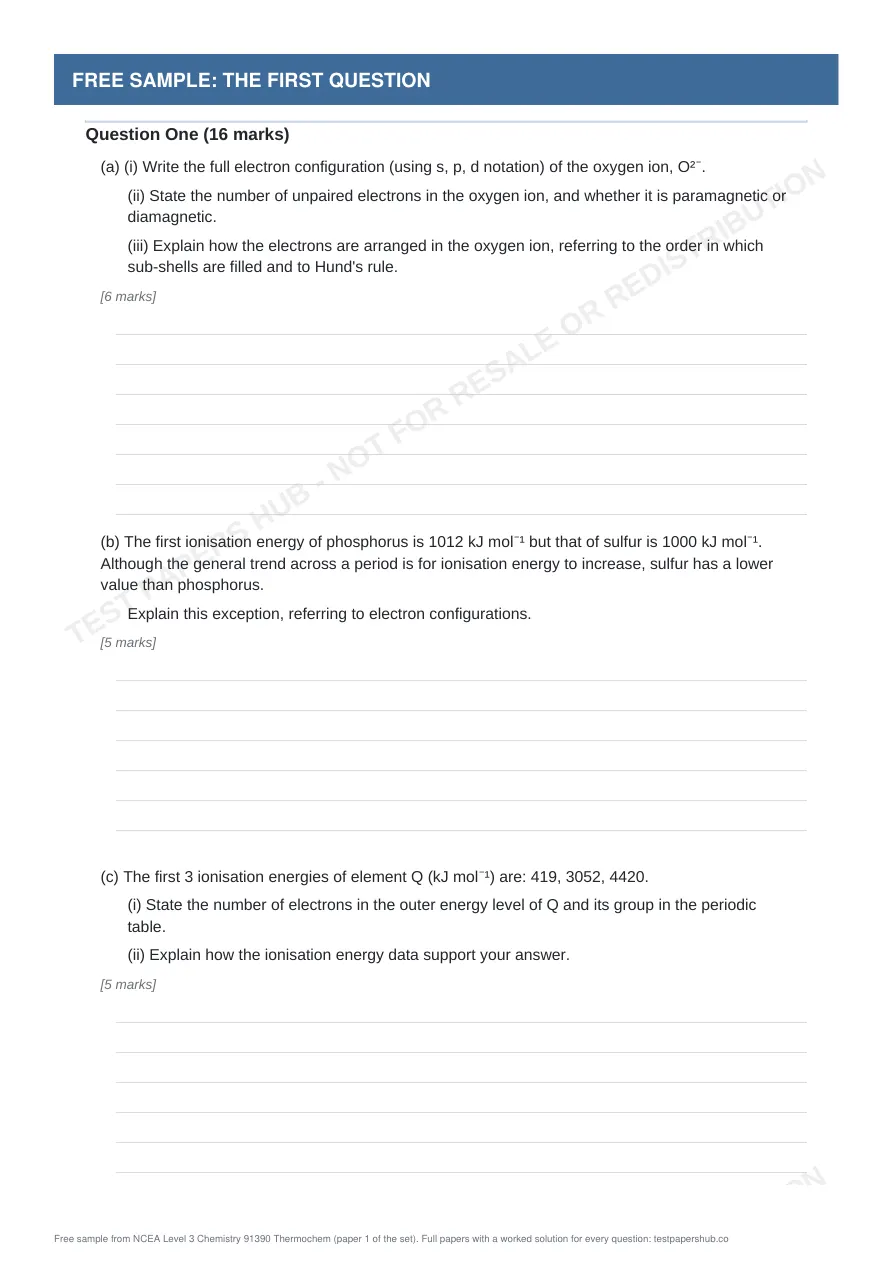
Question One (16 marks)
(a) (i) Write the full electron configuration (using s, p, d notation) of the oxygen ion, O²⁻.
(ii) State the number of unpaired electrons in the oxygen ion, and whether it is paramagnetic or diamagnetic.
(iii) Explain how the electrons are arranged in the oxygen ion, referring to the order in which sub-shells are filled and to Hund's rule.
[6 marks]
(b) The first ionisation energy of phosphorus is 1012 kJ mol⁻¹ but that of sulfur is 1000 kJ mol⁻¹. Although the general trend across a period is for ionisation energy to increase, sulfur has a lower value than phosphorus. Explain this exception, referring to electron configurations.
[5 marks]
ON
(c) The first 3 ionisation energies of element Q (kJ mol⁻¹) are: 419, 3052, 4420.
(i) State the number of electrons in the outer energy level of Q and its group in the periodic table.
(ii) Explain how the ionisation energy data support your answer.
[5 marks]
Question 1 (16 marks) [Atoms, electron configurations and periodic trends]
(a) (i) Write the full electron configuration (using s, p, d notation) of the oxygen ion, O²⁻. (ii) State the number of unpaired electrons in the oxygen ion, and whether it is paramagnetic or diamagnetic. (iii) Explain how the electrons are arranged in the oxygen ion, referring to the order in which sub-shells are filled and to Hund's rule.
(a) Answer: (i) 1s² 2s² 2p⁶; (ii) 0 unpaired, diamagnetic
• Evidence level: Excellence (fill the sub-shells in order of increasing energy, apply Hund's rule, and adjust for ions and for half-full and full d sub-shells).
• (i) 1s² 2s² 2p⁶.
• (ii) The oxygen ion has 0 unpaired electron(s) (electrons occupy separate orbitals of a sub-shell with parallel spins before pairing, Hund's rule), so it is diamagnetic.
• Achievement: (iii) States the order of filling.
• Merit: Links to energy: electrons enter the lowest-energy sub-shell available first (1s, 2s, 2p, 3s, 3p, 4s, 3d, 4p).
• Excellence: Full explanation: the 10 electrons are placed in sub-shells in order of increasing energy, each holding at most 2 (s), 6 (p) or 10 (d) electrons; where a sub-shell has several orbitals, electrons occupy them singly with parallel spins before pairing (Hund's rule); the anion gains electrons into the next available sub-shell, reaching a stable full outer shell.
(b) The first ionisation energy of phosphorus is 1012 kJ mol⁻¹ but that of sulfur is 1000 kJ mol⁻¹. Although the general trend across a period is for ionisation energy to increase, sulfur has a lower value than phosphorus. Explain this exception, referring to electron configurations.
(b) Answer: Exception explained by the electron configurations: sulfur's 3p⁴ configuration has a pair of electrons in one 3p orbital; the repulsion between the paired electrons makes it easier to remove an electron than from phosphorus's 3p³ half-filled sub-shell
• Evidence level: Excellence (use the electron configurations to explain the exception).
• Achievement: Writes the electron configurations of both atoms.
• Merit: Links the configuration to the energy of the electron removed.
• Excellence: Full explanation: sulfur's 3p⁴ configuration has a pair of electrons in one 3p orbital; the repulsion between the paired electrons makes it easier to remove an electron than from phosphorus's 3p³ half-filled sub-shell.
(c) The first 3 ionisation energies of element Q (kJ mol⁻¹) are: 419, 3052, 4420. (i) State the number of electrons in the outer energy level of Q and its group in the periodic table. (ii) Explain how the ionisation energy data support your answer.
(c) Answer: (i) 1 outer electrons, group 1; (ii) a large jump after the 1st ionisation energy as an inner-shell electron is removed
• Evidence level: Excellence (find the large jump in successive ionisation energies, which marks the start of a closer, inner energy level).
• (i) The ratios of successive values are 7.28, 1.45; the biggest jump is after the 1st ionisation energy (419 → 3052 kJ mol⁻¹), so Q has 1 outer electrons and is in group 1.
• Achievement: (ii) States that there is a big increase after the 1st ionisation energy.
Your sample is downloading. Liked it? NCEA Level 3 Chemistry 91390 Thermochem Paper 1 is the full paper: three questions made of several multi-part problems answered in writing (constructed response, no multiple choice), with a worked solution for every part that shows whether it is aimed at Achieved, Merit or Excellence, with a worked solution for every question.
Get Paper 1 for A$11.99See all 20 papers from A$11.99More free NCEA (New Zealand) samples
Questions about this sample
What is in the NCEA Level 3 Chemistry 91390 Thermochem free sample?
The first 3 questions from paper 1 of the set, in the real exam layout, followed by the step-by-step worked answers. It is a 4-page PDF; this page shows the opening pages.
How many full NCEA Level 3 Chemistry 91390 Thermochem papers are there?
20 original papers for New Zealand Level 3 students preparing for NCEA external standard 91390. Each is three questions made of several multi-part problems answered in writing (constructed response, no multiple choice), with a worked solution for every part that shows whether it is aimed at Achieved, Merit or Excellence, with a worked solution for every question. Papers start at A$11.99 and download instantly as a PDF.
Are these official past papers?
No. The sample is taken from our own original practice paper and is not an official past paper or affiliated with any exam authority.