NCEA Level 3 Biology 91605 Speciation free practice questions with answers
Read the opening questions and their worked answers from paper 1 of our 20-paper NCEA Level 3 Biology 91605 Speciation set, then download the 4-page PDF. These are original practice questions, not official past papers. Page updated 3 November 2026.

Topics: Allele frequencies and selection (91605).
- Hardy–Weinberg: p + q = 1 and p² + 2pq + q² = 1; q = √(frequency of the recessive phenotype); selection against a genotype lowers its alleles' frequency by an amount found from the mean fitness.
- Types of selection: directional (mean shifts), stabilising (extremes lost, mean unchanged), disruptive (extremes favoured, two peaks). Calculate the mean as Σ(number × value) ÷ total.
Read the text of this sample
Question One (15 marks)
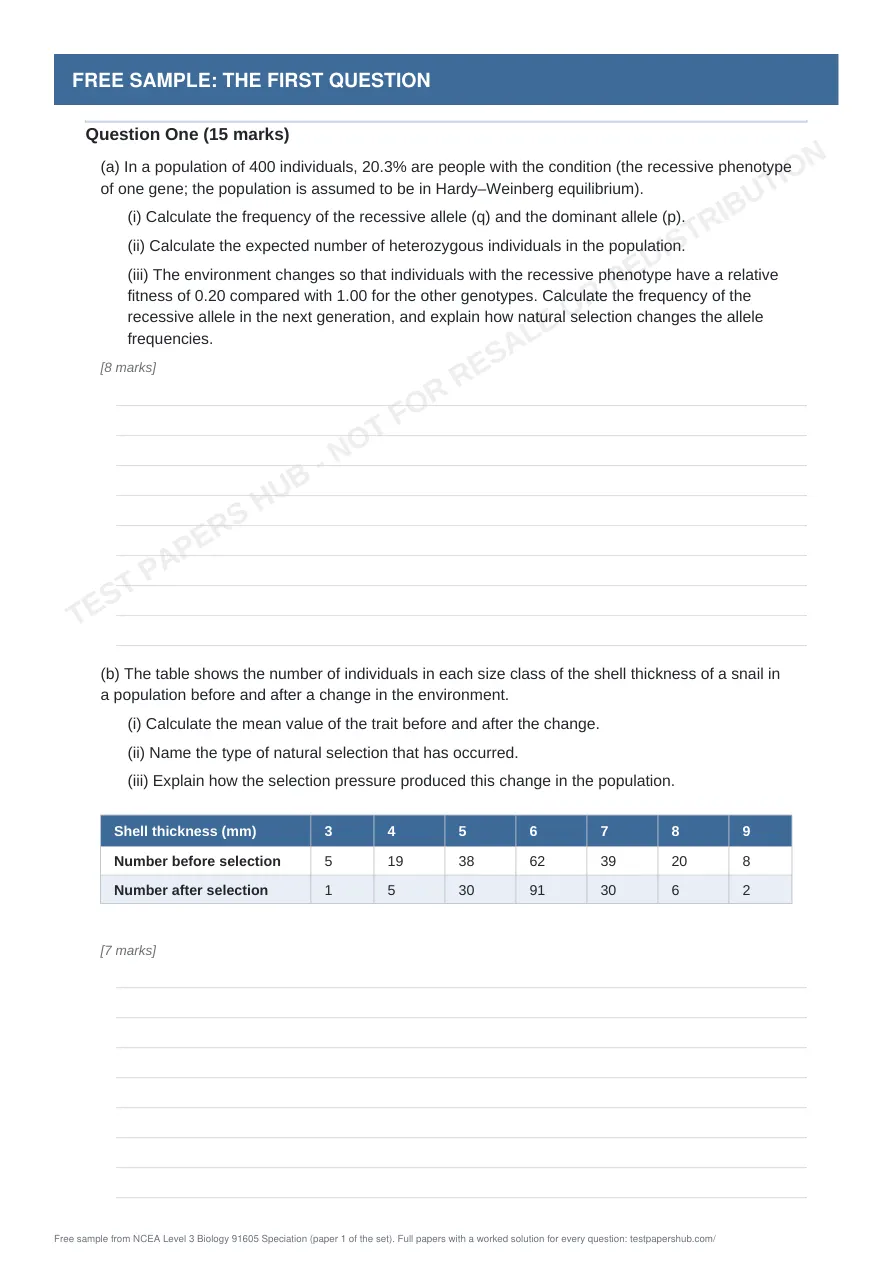
(a) In a population of 400 individuals, 20.3% are people with the condition (the recessive phenotype of one gene; the population is assumed to be in Hardy–Weinberg equilibrium).
(i) Calculate the frequency of the recessive allele (q) and the dominant allele (p).
(ii) Calculate the expected number of heterozygous individuals in the population.
(iii) The environment changes so that individuals with the recessive phenotype have a relative fitness of 0.20 compared with 1.00 for the other genotypes. Calculate the frequency of the recessive allele in the next generation, and explain how natural selection changes the allele frequencies.
[8 marks]
(b) The table shows the number of individuals in each size class of the shell thickness of a snail in a population before and after a change in the environment.
(i) Calculate the mean value of the trait before and after the change.
(ii) Name the type of natural selection that has occurred.
(iii) Explain how the selection pressure produced this change in the population. Shell thickness (mm) 3 4 5 6 7 8 9 Number before selection 5 19 38 62 39 20 8 Number after selection 1 5 30 91 30 6 2
[7 marks]
Question 1 (15 marks) [Allele frequencies and selection]
(a) In a population of 400 individuals, 20.3% are people with the condition (the recessive phenotype of one gene; the population is assumed to be in Hardy–Weinberg equilibrium). (i) Calculate the frequency of the recessive allele (q) and the dominant allele (p). (ii) Calculate the expected number of heterozygous individuals in the population. (iii) The environment changes so that individuals with the recessive phenotype have a relative fitness of 0.20 compared with 1.00 for the other genotypes. Calculate the frequency of the recessive allele in the next generation, and explain how natural selection changes the allele frequencies.
(a) Answer: (i) q = 0.450, p = 0.550; (ii) 198 heterozygotes; (iii) new q = 0.344
• Evidence level: Excellence (q² = frequency of the recessive phenotype; p + q = 1; 2pq = heterozygotes; selection changes the gene pool).
• (i) q² = 0.203, so q = √0.203 = 0.450 and p = 1 − 0.450 = 0.550.
• (ii) 2pq = 2 × 0.550 × 0.450 = 0.495, so the number of heterozygotes = 0.495 × 400 = 198.
• (iii) After selection, the mean fitness = 1 − q²(1 − w) = 1 − 0.203 × 0.80 = 0.8380. New q = (pq + q²w) ÷ mean fitness = (0.248 + 0.0405) ÷ 0.8380 = 0.344 (a fall from 0.450).
• Achievement: States that selection reduces the recessive allele frequency.
• Merit: Links to survival and reproduction: individuals with the recessive phenotype have a lower chance of surviving and reproducing, so fewer recessive alleles are passed on.
• Excellence: Full explanation: the phenotype of the recessive homozygotes reduces their fitness, so they contribute fewer offspring to the next generation; the proportion of recessive alleles in the gene pool falls (from 0.450 to 0.344), though not to zero because recessive alleles carried in heterozygotes are hidden from selection; this is natural selection changing allele frequencies, the basis of evolution.
(b) The table shows the number of individuals in each size class of the shell thickness of a snail in a population before and after a change in the environment. (i) Calculate the mean value of the trait before and after the change. (ii) Name the type of natural selection that has occurred. (iii) Explain how the selection pressure produced this change in the population.
(b) Answer: (i) 6.06 and 6.03 mm; (ii) stabilising selection
• Evidence level: Excellence (compare the means and the spread (standard deviation) before and after).
• (i) Mean before = 6.06 mm; mean after = 6.03 mm. (Spread: standard deviation 1.35 then 0.891.)
• (ii) Stabilising selection: the mean is unchanged but the spread has decreased (the extremes have been lost).
• Achievement: (iii) States which phenotypes survived and reproduced.
• Merit: Links to inheritance: the favoured individuals pass their alleles to the next generation in greater numbers.
• Excellence: Full explanation: individuals with intermediate values had the highest fitness, while extremes were less likely to survive or reproduce, so alleles for extreme phenotypes were selected against and the population became more uniform around the mean
Your sample is downloading. Liked it? NCEA Level 3 Biology 91605 Speciation Paper 1 is the full paper: three questions made of several multi-part problems answered in writing (constructed response, no multiple choice), with a worked solution for every part that shows whether it is aimed at Achieved, Merit or Excellence, with a worked solution for every question.
Get Paper 1 for A$11.99See all 20 papers from A$11.99More free NCEA (New Zealand) samples
Questions about this sample
What is in the NCEA Level 3 Biology 91605 Speciation free sample?
The first 3 questions from paper 1 of the set, in the real exam layout, followed by the step-by-step worked answers. It is a 4-page PDF; this page shows the opening pages.
How many full NCEA Level 3 Biology 91605 Speciation papers are there?
20 original papers for New Zealand Level 3 students preparing for NCEA external standard 91605. Each is three questions made of several multi-part problems answered in writing (constructed response, no multiple choice), with a worked solution for every part that shows whether it is aimed at Achieved, Merit or Excellence, with a worked solution for every question. Papers start at A$11.99 and download instantly as a PDF.
Are these official past papers?
No. The sample is taken from our own original practice paper and is not an official past paper or affiliated with any exam authority.