NCEA Level 3 Chemistry 91391 Organic free practice questions with answers
Read the opening questions and their worked answers from paper 1 of our 20-paper NCEA Level 3 Chemistry 91391 Organic set, then download the 5-page PDF. These are original practice questions, not official past papers. Page updated 3 November 2026.

Topics: Functional groups and isomers (91391).
- Functional groups: name by the longest chain and suffix; isomers share a molecular formula but not a structure. Hydrogen bonding needs an H bonded to O or N, so acids and alcohols boil higher than their isomers.
- Isomers: same molecular formula, different structure. Work systematically: first the unbranched chain with the group at each position, then the branched chains; check each is different before counting.
- Optical isomerism: a carbon bonded to four different groups is chiral; enantiomers are non-superimposable mirror images that rotate polarised light equally in opposite directions; n chiral centres give up to 2^n stereoisomers (fewer with a meso form).
Read the text of this sample
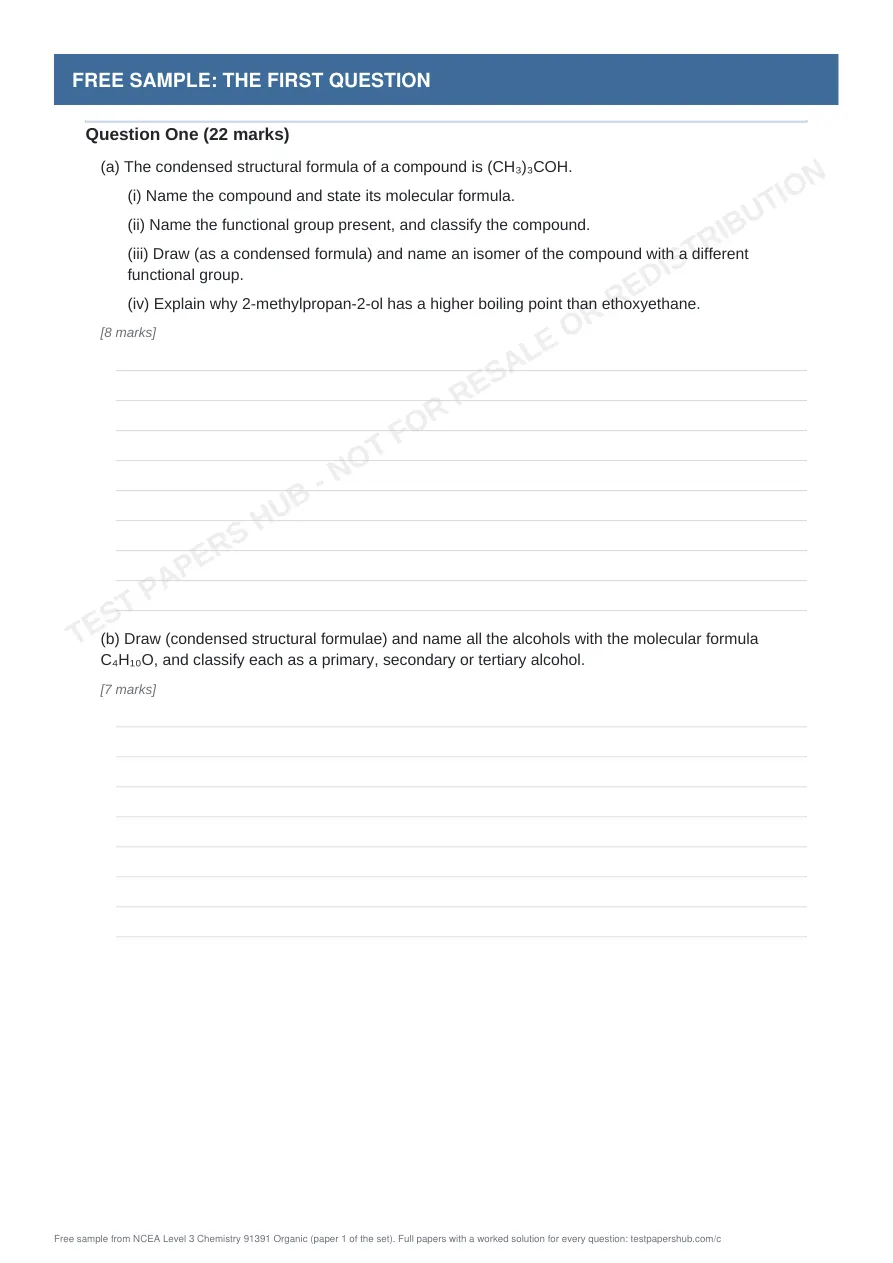
Question One (22 marks)
(a) The condensed structural formula of a compound is (CH₃)₃COH.
(i) Name the compound and state its molecular formula.
(ii) Name the functional group present, and classify the compound.
(iii) Draw (as a condensed formula) and name an isomer of the compound with a different functional group.
(iv) Explain why 2-methylpropan-2-ol has a higher boiling point than ethoxyethane.
[8 marks]
(b) Draw (condensed structural formulae) and name all the alcohols with the molecular formula C₄H₁₀O, and classify each as a primary, secondary or tertiary alcohol.
[7 marks]
(c) Consider the compound butane-2,3-diol.
(i) Identify the chiral carbon atom(s) in butane-2,3-diol, and explain what makes a carbon atom chiral.
(ii) Explain what is meant by ‘optical isomers’ (enantiomers) and describe how two optical isomers of this compound differ in their effect on plane-polarised light.
(iii) State the total number of stereoisomers of butane-2,3-diol and explain why it is not optically active as a whole.
[7 marks]
Question 1 (22 marks) [Functional groups and isomers]
(a) The condensed structural formula of a compound is (CH₃)₃COH. (i) Name the compound and state its molecular formula. (ii) Name the functional group present, and classify the compound. (iii) Draw (as a condensed formula) and name an isomer of the compound with a different functional group. (iv) Explain why 2-methylpropan-2-ol has a higher boiling point than ethoxyethane.
(a) Answer: (i) 2-methylpropan-2-ol, C4H10O; (ii) alcohol; (iii) ethoxyethane, CH₃CH₂OCH₂CH₃; (iv) the alcohol has the stronger intermolecular forces (hydrogen bonding)
• Evidence level: Excellence (identify the functional group from the arrangement of atoms, then use the structure to explain the properties).
• (i) The compound is 2-methylpropan-2-ol; its molecular formula is C4H10O.
• (ii) It is an alcohol: the hydroxyl group –OH; the carbon bonded to OH is attached to three other carbon(s), so it is a tertiary alcohol.
• (iii) An isomer with a different functional group is ethoxyethane, CH₃CH₂OCH₂CH₃ (ether), which has the same molecular formula C4H10O.
• Achievement: The alcohol has a higher boiling point than its ether isomer.
• Merit: Links to the forces: the alcohol contains an O–H group so can form hydrogen bonds between molecules; the ether cannot.
• Excellence: Full explanation: alcohol molecules form strong hydrogen bonds between the O–H of one molecule and the lone pair on the O of another; ethers have polar C–O bonds but no hydrogen attached to oxygen, so they have only weaker dipole–dipole and dispersion forces. More energy is needed to overcome hydrogen bonds, so the alcohol has the higher boiling point.
(b) Draw (condensed structural formulae) and name all the alcohols with the molecular formula C₄H₁₀O, and classify each as a primary, secondary or tertiary alcohol.
(b) Answer: 7 isomers (butan-1-ol; butan-2-ol; 2-methylpropan-1-ol; 2-methylpropan-2-ol; ethoxyethane; 1-methoxypropane; 2-methoxypropane)
• Evidence level: Excellence (work systematically through the carbon skeletons and positions of the functional group, avoiding repeats).
• The 4 alcohols are: butan-1-ol (CH₃CH₂CH₂CH₂OH); butan-2-ol (CH₃CH₂CH(OH)CH₃); 2-methylpropan-1-ol ((CH₃)₂CHCH₂OH); 2-methylpropan-2-ol ((CH₃)₃COH).
• The 3 ethers are: ethoxyethane (CH₃CH₂OCH₂CH₃); 1-methoxypropane (CH₃OCH₂CH₂CH₃); 2-methoxypropane (CH₃OCH(CH₃)₂).
• Classification: butan-1-ol – primary; butan-2-ol – secondary; 2-methylpropan-1-ol – primary; 2-methylpropan-2-ol – tertiary.
• Achievement: Defines structural isomers as compounds with the same molecular formula but different structural formulae.
• Merit: Gives an example from the answer.
• Excellence: Full answer: structural isomers have the same molecular formula but different arrangements of atoms – the atoms are bonded together in a different order (different carbon chain, different position of the functional group, or a different functional group); chain, position and functional-group isomers appear above.
Your sample is downloading. Liked it? NCEA Level 3 Chemistry 91391 Organic Paper 1 is the full paper: three questions made of several multi-part problems answered in writing (constructed response, no multiple choice), with a worked solution for every part that shows whether it is aimed at Achieved, Merit or Excellence, with a worked solution for every question.
Get Paper 1 for A$11.99See all 20 papers from A$11.99More free NCEA (New Zealand) samples
Questions about this sample
What is in the NCEA Level 3 Chemistry 91391 Organic free sample?
The first 3 questions from paper 1 of the set, in the real exam layout, followed by the step-by-step worked answers. It is a 5-page PDF; this page shows the opening pages.
How many full NCEA Level 3 Chemistry 91391 Organic papers are there?
20 original papers for New Zealand Level 3 students preparing for NCEA external standard 91391. Each is three questions made of several multi-part problems answered in writing (constructed response, no multiple choice), with a worked solution for every part that shows whether it is aimed at Achieved, Merit or Excellence, with a worked solution for every question. Papers start at A$11.99 and download instantly as a PDF.
Are these official past papers?
No. The sample is taken from our own original practice paper and is not an official past paper or affiliated with any exam authority.