NCEA Level 3 Chemistry 91392 Equilibrium free practice questions with answers
Read the opening questions and their worked answers from paper 1 of our 20-paper NCEA Level 3 Chemistry 91392 Equilibrium set, then download the 5-page PDF. These are original practice questions, not official past papers. Page updated 3 November 2026.

Topics: Sparingly soluble salts (91392).
- Ks and solubility: write Ks from the dissolving equation, put each ion concentration in terms of s (AB: s²; AB₂ or A₂B: 4s³), and solve; multiply by M to convert to g L⁻¹.
- Common ion effect: the existing ion raises the ion concentration, so (since Ks is constant) the solubility falls; in the Ks expression use the common ion's total concentration (initial + dissolved), and neglect s when it is tiny.
- Precipitation: dilute both ions in the combined volume, calculate the ion product Q in the same form as Ks; Q > Ks gives a precipitate, Q < Ks does not.
Read the text of this sample
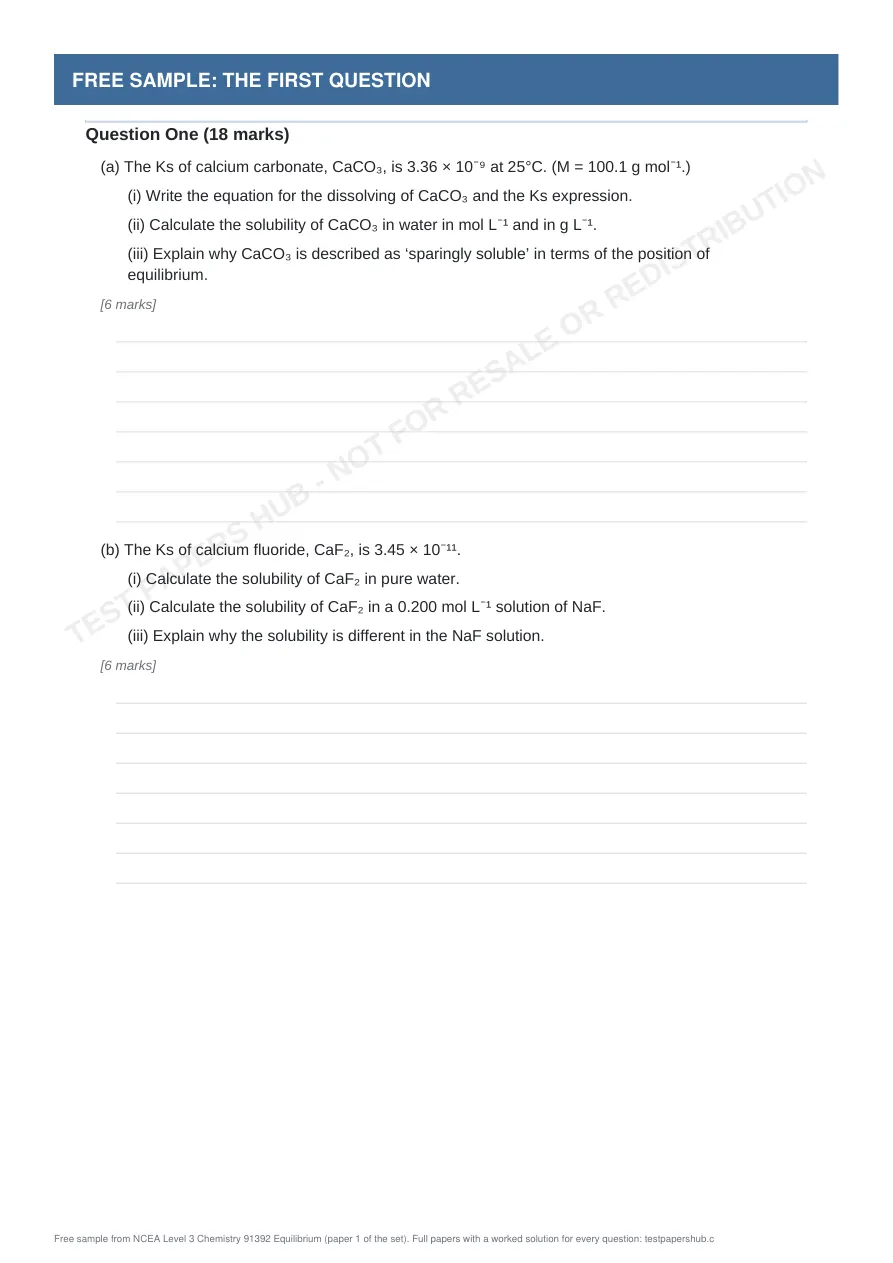
Question One (18 marks)
(a) The Ks of calcium carbonate, CaCO₃, is 3.36 × 10⁻⁹ at 25°C. (M = 100.1 g mol⁻¹.)
(i) Write the equation for the dissolving of CaCO₃ and the Ks expression.
(ii) Calculate the solubility of CaCO₃ in water in mol L⁻¹ and in g L⁻¹.
(iii) Explain why CaCO₃ is described as ‘sparingly soluble’ in terms of the position of equilibrium.
[6 marks]
(b) The Ks of calcium fluoride, CaF₂, is 3.45 × 10⁻¹¹.
(i) Calculate the solubility of CaF₂ in pure water.
(ii) Calculate the solubility of CaF₂ in a 0.200 mol L⁻¹ solution of NaF.
(iii) Explain why the solubility is different in the NaF solution.
[6 marks]
(c) 50.0 mL of a 0.000100 mol L⁻¹ solution of a soluble salt containing Ba²⁺ is mixed with 100 mL of a 0.0000150 mol L⁻¹ solution of a soluble salt containing SO₄²⁻. The Ks of BaSO₄ is 1.08 × 10⁻¹⁰.
(i) Calculate the concentration of each ion immediately after mixing, before any reaction.
(ii) Decide whether a precipitate of BaSO₄ forms, showing your calculation of the ion product.
(iii) Explain how the ion product and Ks are used to make this prediction.
[6 marks]
Question 1 (18 marks) [Sparingly soluble salts]
(a) The Ks of calcium carbonate, CaCO₃, is 3.36 × 10⁻⁹ at 25°C. (M = 100.1 g mol⁻¹.) (i) Write the equation for the dissolving of CaCO₃ and the Ks expression. (ii) Calculate the solubility of CaCO₃ in water in mol L⁻¹ and in g L⁻¹. (iii) Explain why CaCO₃ is described as ‘sparingly soluble’ in terms of the position of equilibrium. = 5.80 × 10⁻³ g L⁻¹; (iii) Ks is tiny so the equilibrium lies far towards the solid
• Evidence level: Excellence (write the Ks expression, express ion concentrations with the solubility s, and solve).
• (ii) Let the solubility be s mol L⁻¹: Ks = [Ca²⁺][CO₃²⁻] = 3.36 × 10⁻⁹ so s² = 3.36 × 10⁻⁹ and s = 5.80 × 10⁻⁵ mol L⁻¹.
• Solubility in g L⁻¹ = s × M = 5.80 × 10⁻⁵ × 100.1 = 5.80 × 10⁻³ g L⁻¹.
• Achievement: (iii) States that very little of the solid dissolves.
• Merit: Links to the equilibrium: Ks is very small, so the equilibrium lies far to the left (towards the solid).
• Excellence: Full explanation: Ks = 3.36 × 10⁻⁹ is very small, so at equilibrium the concentrations of strongly on the side of the undissolved solid, so only a very small amount dissolves.
(b) The Ks of calcium fluoride, CaF₂, is 3.45 × 10⁻¹¹. (i) Calculate the solubility of CaF₂ in pure water. (ii) Calculate the solubility of CaF₂ in a 0.200 mol L⁻¹ solution of NaF. (iii) Explain why the solubility is different in the NaF solution.
(b) Answer: (i) 2.05 × 10⁻⁴ mol L⁻¹; (ii) 8.62 × 10⁻¹⁰ mol L⁻¹; (iii) the common ion shifts the equilibrium towards the solid
• Evidence level: Excellence (solve for the solubility in water and again with a common ion, then explain with Le Chatelier's principle).
• (i) In water: Ks = [Ca²⁺][F⁻]² gives s = 2.05 × 10⁻⁴ mol L⁻¹.
• (ii) The common ion from NaF has concentration 0.200 mol L⁻¹, so Ks = [Ca²⁺][F⁻]² = 3.45 × 10⁻¹¹ with the extra ion; because s is very small compared with the common ion, the approximation gives s = 8.62 × 10⁻¹⁰ mol L⁻¹.
• Achievement: (iii) States that the solubility is lower because of the common ion. reducing the amount that dissolves.
• Excellence: Full explanation: the NaF solution already contains 0.200 mol L⁻¹ of the F⁻ ion; by Le Chatelier's principle the equilibrium shifts towards the solid to oppose the increase in the ion concentration, so less solid dissolves (the solubility falls from 2.05 × 10⁻⁴ to 8.62 × 10⁻¹⁰ mol L⁻¹), although Ks is unchanged.
(c) 50.0 mL of a 0.000100 mol L⁻¹ solution of a soluble salt containing Ba²⁺ is mixed with 100 mL of a 0.0000150 mol L⁻¹ solution of a soluble salt containing SO₄²⁻. The Ks of BaSO₄ is 1.08 × 10⁻¹⁰. (i) Calculate the concentration of each ion immediately after mixing, before any reaction. (ii) Decide whether a precipitate of BaSO₄ forms, showing your calculation of the ion product. (iii) Explain how the ion product and Ks are used to make this prediction.
(c) Answer: (i) [Ba²⁺] = 3.33 × 10⁻⁵, [SO₄²⁻] = 1.00 × 10⁻⁵ mol L⁻¹; (ii) Q = 3.33 × 10⁻¹⁰, so a precipitate forms; (iii) Q > Ks means a precipitate forms
• Evidence level: Excellence (dilute each ion on mixing, calculate the ion product Q, and compare with Ks).
Your sample is downloading. Liked it? NCEA Level 3 Chemistry 91392 Equilibrium Paper 1 is the full paper: three questions made of several multi-part problems answered in writing (constructed response, no multiple choice), with a worked solution for every part that shows whether it is aimed at Achieved, Merit or Excellence, with a worked solution for every question.
Get Paper 1 for A$11.99See all 20 papers from A$11.99More free NCEA (New Zealand) samples
Questions about this sample
What is in the NCEA Level 3 Chemistry 91392 Equilibrium free sample?
The first 3 questions from paper 1 of the set, in the real exam layout, followed by the step-by-step worked answers. It is a 5-page PDF; this page shows the opening pages.
How many full NCEA Level 3 Chemistry 91392 Equilibrium papers are there?
20 original papers for New Zealand Level 3 students preparing for NCEA external standard 91392. Each is three questions made of several multi-part problems answered in writing (constructed response, no multiple choice), with a worked solution for every part that shows whether it is aimed at Achieved, Merit or Excellence, with a worked solution for every question. Papers start at A$11.99 and download instantly as a PDF.
Are these official past papers?
No. The sample is taken from our own original practice paper and is not an official past paper or affiliated with any exam authority.