NCEA Level 3 Economics 91399 Efficiency free practice questions with answers
Read the opening questions and their worked answers from paper 1 of our 20-paper NCEA Level 3 Economics 91399 Efficiency set, then download the 6-page PDF. These are original practice questions, not official past papers. Page updated 3 November 2026.

Topics: Market equilibrium and efficiency (91399).
- Consumer surplus is the triangle between the demand curve and the price; producer surplus is the triangle between the price and the supply curve; their sum is total surplus.
- Allocative efficiency means total surplus is as large as it can be, which happens where marginal benefit equals marginal cost; any other quantity leaves a deadweight loss.
- At a price below equilibrium buyers want more than sellers supply (a shortage); above equilibrium sellers supply more than buyers want (a surplus).
- Market forces restore equilibrium by price changes: competition among buyers (shortage) or sellers (surplus) moves the price until quantity demanded equals quantity supplied.
Read the text of this sample
Question One (15 marks)
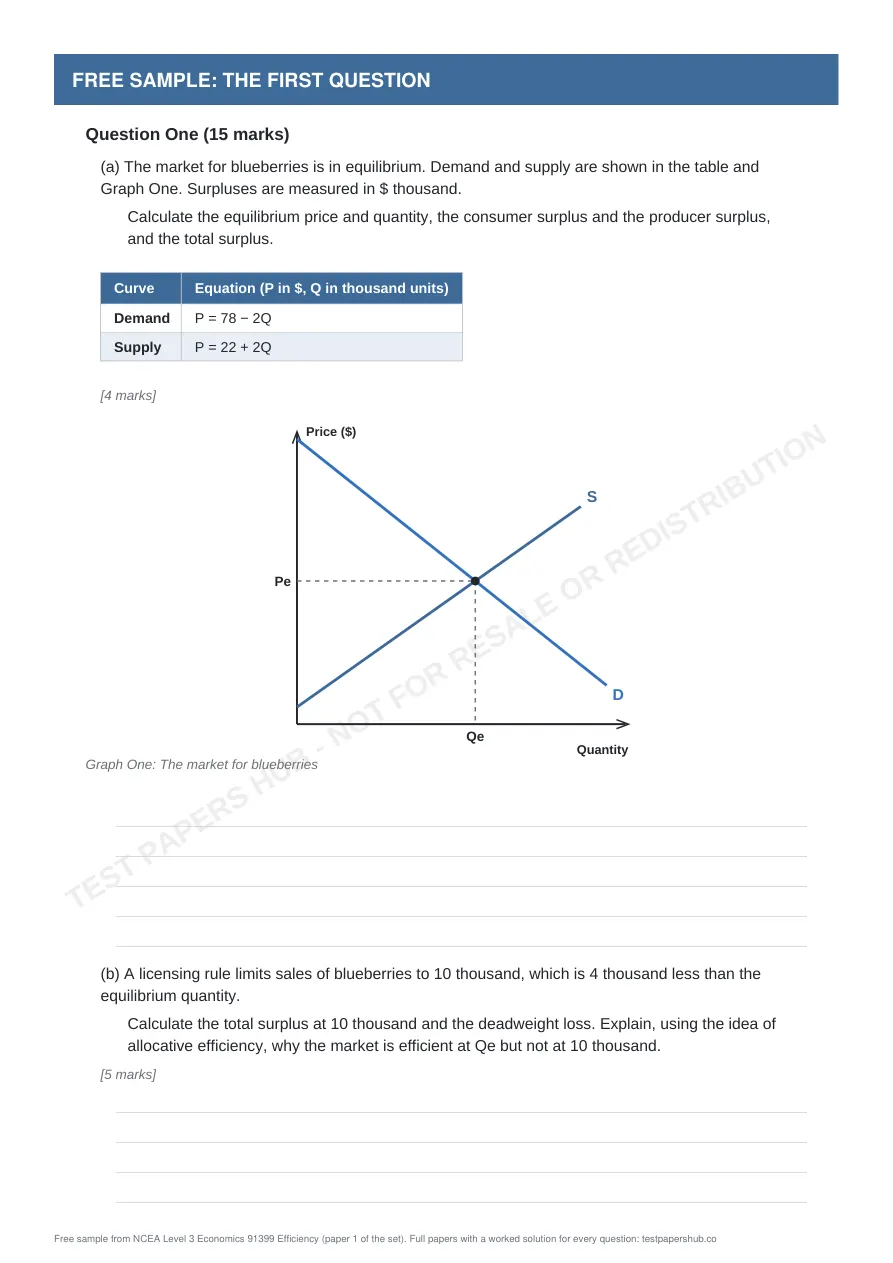
(a) The market for blueberries is in equilibrium. Demand and supply are shown in the table and Graph One. Surpluses are measured in $ thousand. Calculate the equilibrium price and quantity, the consumer surplus and the producer surplus, and the total surplus. Curve Equation (P in $, Q in thousand units) Demand P = 78 − 2Q Supply P = 22 + 2Q
[4 marks]
Price ($) Quantity D S Qe Pe Graph One: The market for blueberries
(b) A licensing rule limits sales of blueberries to 10 thousand, which is 4 thousand less than the equilibrium quantity. Calculate the total surplus at 10 thousand and the deadweight loss. Explain, using the idea of allocative efficiency, why the market is efficient at Qe but not at 10 thousand.
[5 marks]
(c) The price of ski lift passes is set at P₁, shown on Graph Two, by a pricing rule that applies for one week. On Graph Two, use dotted lines to show the resulting surplus at P₁. Label the surplus and the quantities demanded (Qd) and supplied (Qs). Curve Equation (P in $, Q in thousand units) Demand P = 62 − Q Supply P = 26 + Q Price P₁ $45
[2 marks]
Price ($) Quantity D S P₁ Qe Pe Graph Two: The market for ski lift passes
(d) Explain how the market would restore equilibrium from P₁ if the price were free to change. Refer to the labels on Graph Two, including Pe, Qe, Qd and Qs.
[4 marks]
Question 1 (15 marks) [Market equilibrium and efficiency]
(a) The market for blueberries is in equilibrium. Demand and supply are shown in the table and Graph One. Surpluses are measured in $ thousand. Calculate the equilibrium price and quantity, the consumer surplus and the producer surplus, and the total surplus. Price ($) Quantity D S Qe Pe Graph One: The market for blueberries
(a) Answer: Qe = 14 thousand, Pe = $50; CS = $196 thousand, PS = $196 thousand, total = $392 thousand
• Evidence level: Merit (solves for equilibrium and finds both surpluses as triangles).
• Set demand equal to supply: 78 − 2Q = 22 + 2Q, so 4Q = 56 and Q = 14 thousand.
• P = 78 − 2 × 14 = $50.
• Consumer surplus = ½ × base × height = ½ × 14 × (78 − 50) = $196 thousand.
• Producer surplus = ½ × 14 × (50 − 22) = $196 thousand.
• Total surplus = 196 + 196 = $392 thousand.
(b) A licensing rule limits sales of blueberries to 10 thousand, which is 4 thousand less than the equilibrium quantity. Calculate the total surplus at 10 thousand and the deadweight loss. Explain, using the idea of allocative efficiency, why the market is efficient at Qe but not at 10 thousand.
(b) Answer: Total surplus $360 thousand; deadweight loss $32 thousand
• Evidence level: Excellence (calculates the loss and links marginal benefit and marginal cost to allocative efficiency).
• Achievement: Total surplus is $360 thousand, so the deadweight loss is $32 thousand; allocative efficiency is where total surplus is greatest, at Qe.
• Merit: At 10 thousand units, the value to buyers is shown by demand at P = 78 − 2 × 10 = $58 and the cost to sellers by supply at P = 22 + 2 × 10 = $42. Total surplus = (78 − 22) × 10 − ½ × 4 × 10² = $360 thousand, which is $32 thousand below the maximum of $392 thousand.
• Excellence: At 10 thousand units, the value to buyers is shown by demand at P = 78 − 2 × 10 = $58 and the cost to sellers by supply at P = 22 + 2 × 10 = $42. Total surplus = (78 − 22) × 10 − ½ × 4 × 10² = $360 thousand, which is $32 thousand below the maximum of $392 thousand. Deadweight loss = ½ × (58 − 42) × 4 = $32 thousand. Every unit between 10 and 14 thousand is valued by buyers by more than it costs sellers to produce (marginal benefit > marginal cost), so trades that would make both sides better off do not happen. At Qe, marginal benefit equals marginal cost, there are no such trades left, and total surplus (consumer plus producer surplus) is as large as it can be: the market is allocatively efficient. Below Qe the deadweight loss shows that resources are not used to produce the most valuable combination of goods.
(c) The price of ski lift passes is set at P₁, shown on Graph Two, by a pricing rule that applies for one
week. On Graph Two, use dotted lines to show the resulting surplus at P₁. Label the surplus and the quantities demanded (Qd) and supplied (Qs). Price ($) Quantity D S P₁ Qe Pe Graph Two: The market for ski lift passes
(c) Answer: At P₁ Qd = 17 thousand and Qs = 19 thousand: a surplus of 2 thousand
• Evidence level: Achieved (draws and labels the dotted lines from P₁ to the curves).
• Draw a horizontal line at P₁ and mark where it meets the demand curve (Qd) and the supply curve (Qs).
Your sample is downloading. Liked it? NCEA Level 3 Economics 91399 Efficiency Paper 1 is the full paper: three written questions on market efficiency: surpluses, deadweight loss, taxes, subsidies, price controls, tariffs and quotas, with worked solutions showing Achieved, Merit and Excellence answers, with a worked solution for every question.
Get Paper 1 for A$11.99See all 20 papers from A$11.99More free NCEA (New Zealand) samples
Questions about this sample
What is in the NCEA Level 3 Economics 91399 Efficiency free sample?
The first 3 questions from paper 1 of the set, in the real exam layout, followed by the step-by-step worked answers. It is a 6-page PDF; this page shows the opening pages.
How many full NCEA Level 3 Economics 91399 Efficiency papers are there?
20 original papers for New Zealand Level 3 students preparing for NCEA external standard 91399. Each is three written questions on market efficiency: surpluses, deadweight loss, taxes, subsidies, price controls, tariffs and quotas, with worked solutions showing Achieved, Merit and Excellence answers, with a worked solution for every question. Papers start at A$11.99 and download instantly as a PDF.
Are these official past papers?
No. The sample is taken from our own original practice paper and is not an official past paper or affiliated with any exam authority.