NCEA Level 3 Economics 91403 Macro free practice questions with answers
Read the opening questions and their worked answers from paper 1 of our 20-paper NCEA Level 3 Economics 91403 Macro set, then download the 6-page PDF. These are original practice questions, not official past papers. Page updated 3 November 2026.

Topics: External influences on the economy (91403).
- Terms of trade = export price index ÷ import price index × 100; a rise means each unit of exports buys more imports.
- Better terms of trade raise real national income and export receipts; worse terms of trade do the opposite, and the exchange rate partly reverses the current account effect.
- Decide whether the event raises or lowers aggregate demand; the new equilibrium and the gap Yf − Y follow from the new AD curve.
- A change in aggregate demand with spare capacity changes output and employment by more than it changes the price level.
Read the text of this sample
Question One (15 marks)
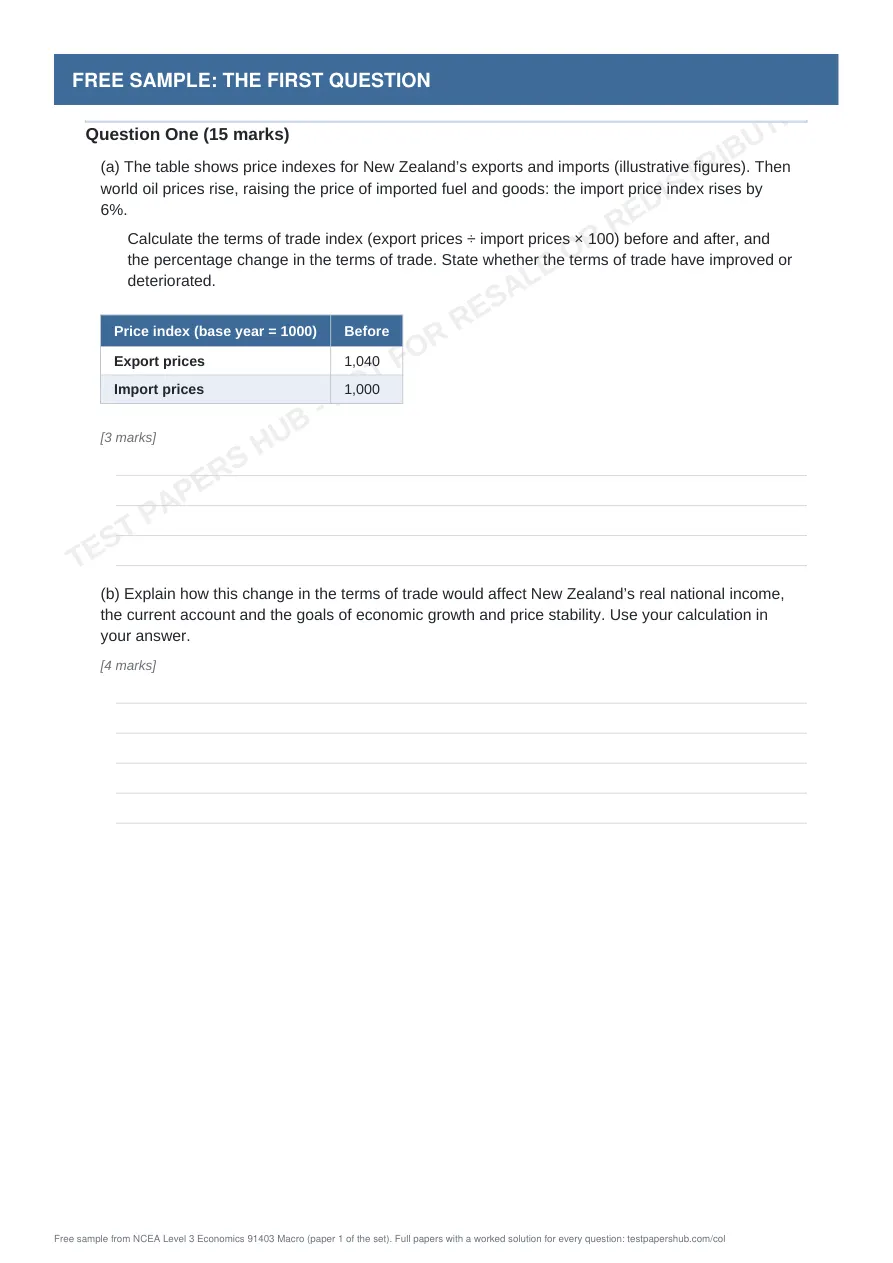
(a) The table shows price indexes for New Zealand’s exports and imports (illustrative figures). Then world oil prices rise, raising the price of imported fuel and goods: the import price index rises by 6%. Calculate the terms of trade index (export prices ÷ import prices × 100) before and after, and the percentage change in the terms of trade. State whether the terms of trade have improved or deteriorated. Price index (base year = 1000) Before Export prices 1,040 Import prices 1,000
[3 marks]
(b) Explain how this change in the terms of trade would affect New Zealand’s real national income, the current account and the goals of economic growth and price stability. Use your calculation in your answer.
[4 marks]
(c) New Zealand’s real GDP (Y) is below the full-employment level of real GDP (Yf), so there is a recessionary gap, as shown on Graph One. Then a recession in China and Australia reduces demand for New Zealand exports. On Graph One, show the effect on the economy: draw the new curve (label it AD₂), label the new real GDP (Y₂) and price level (PL₂), and label the change in the recessionary gap. State what happens to the size of the recessionary gap.
[3 marks]
Price level Real GDP AD AS Yf Y PL Graph One: The New Zealand economy with a recessionary gap
(d) Using your changes to Graph One, compare the effect of this event on the government’s goal of full employment with its effect on the goal of price stability.
[5 marks]
Question 1 (15 marks) [External influences on the economy]
(a) The table shows price indexes for New Zealand’s exports and imports (illustrative figures). Then world oil prices rise, raising the price of imported fuel and goods: the import price index rises by 6%. Calculate the terms of trade index (export prices ÷ import prices × 100) before and after, and the percentage change in the terms of trade. State whether the terms of trade have improved or deteriorated.
(a) Answer: Terms of trade 104 → 98.1 (−5.7%): deteriorated
• Evidence level: Merit (calculates both indexes and the percentage change).
• Before: 1,040 ÷ 1,000 × 100 = 104.
• After: the import index becomes 1,000 × 1.06 = 1,060, so the terms of trade = 1,040 ÷ 1,060 × 100 = 98.1.
• Percentage change = (98.1 − 104) ÷ 104 × 100 = −5.7%: the terms of trade have deteriorated.
(b) Explain how this change in the terms of trade would affect New Zealand’s real national income, the current account and the goals of economic growth and price stability. Use your calculation in your answer.
(b) Answer: Terms of trade deteriorate: income, AD and the current account move down; exchange rate offsets over time
• Evidence level: Excellence (links the terms of trade to income, AD, the exchange rate and two goals).
• Achievement: The terms of trade deteriorate (import prices rise, so New Zealand has to pay more for the goods it buys), so real national income falls and the current account worsens.
• Merit: The terms of trade deteriorate (import prices rise, so New Zealand has to pay more for the goods it buys), so real national income falls and the current account worsens. The terms of trade fell by 5.7%, so incomes (Y) and spending (C) fall, shifting aggregate demand left and lowering real GDP and employment.
• Excellence: The terms of trade deteriorate (import prices rise, so New Zealand has to pay more for the goods it buys), so real national income falls and the current account worsens. The terms of trade fell by 5.7%, so incomes (Y) and spending (C) fall, shifting aggregate demand left and lowering real GDP and employment. Lower demand reduces demand for the New Zealand dollar, so the exchange rate falls: exports become cheaper overseas and imports dearer, which offsets part of the damage to the current account over time, but dearer imports raise the price level. A fall in output together with rising import prices makes the goals of growth and price stability conflict.
(c) New Zealand’s real GDP (Y) is below the full-employment level of real GDP (Yf), so there is a recessionary gap, as shown on Graph One. Then a recession in China and Australia reduces demand for New Zealand exports. On Graph One, show the effect on the economy: draw the new curve (label it AD₂), label the new real GDP (Y₂) and price level (PL₂), and label the change in the recessionary gap. State what happens to the size of the recessionary gap. Price level Real GDP AD AS Yf Y PL Graph One: The New Zealand economy with a recessionary gap
(c) Answer: AD shifts left; Y₂ < Y₁; the recessionary gap widens
• Evidence level: Achieved (shifts AD the correct way and labels the new equilibrium and the gap).
Your sample is downloading. Liked it? NCEA Level 3 Economics 91403 Macro Paper 1 is the full paper: three written questions on macro-economic influences: the multiplier, terms of trade, the current account, fiscal and monetary policy, with worked solutions showing Achieved, Merit and Excellence answers, with a worked solution for every question.
Get Paper 1 for A$11.99See all 20 papers from A$11.99More free NCEA (New Zealand) samples
Questions about this sample
What is in the NCEA Level 3 Economics 91403 Macro free sample?
The first 3 questions from paper 1 of the set, in the real exam layout, followed by the step-by-step worked answers. It is a 6-page PDF; this page shows the opening pages.
How many full NCEA Level 3 Economics 91403 Macro papers are there?
20 original papers for New Zealand Level 3 students preparing for NCEA external standard 91403. Each is three written questions on macro-economic influences: the multiplier, terms of trade, the current account, fiscal and monetary policy, with worked solutions showing Achieved, Merit and Excellence answers, with a worked solution for every question. Papers start at A$11.99 and download instantly as a PDF.
Are these official past papers?
No. The sample is taken from our own original practice paper and is not an official past paper or affiliated with any exam authority.