NCEA Level 3 History 91436 91438 91439 free practice questions with answers
Read the opening questions and their worked answers from paper 1 of our 20-paper NCEA Level 3 History 91436 91438 91439 set, then download the 7-page PDF. These are original practice questions, not official past papers. Page updated 3 November 2026.
Topics: Analyse evidence relating to an historical event of significance to New Zealanders (91436).
- A cause-and-effect answer gives several causes, separates the trigger from the long-term background, and ties each cause to a specific piece of evidence.
- For continuity and change, compare the same thing at two dates, say what stayed the same and what changed, and judge how much real change took place.
- To judge significance, use the criteria (how many people, how deeply, for how long, how it is remembered) and say where the event was less significant.
Read the text of this sample
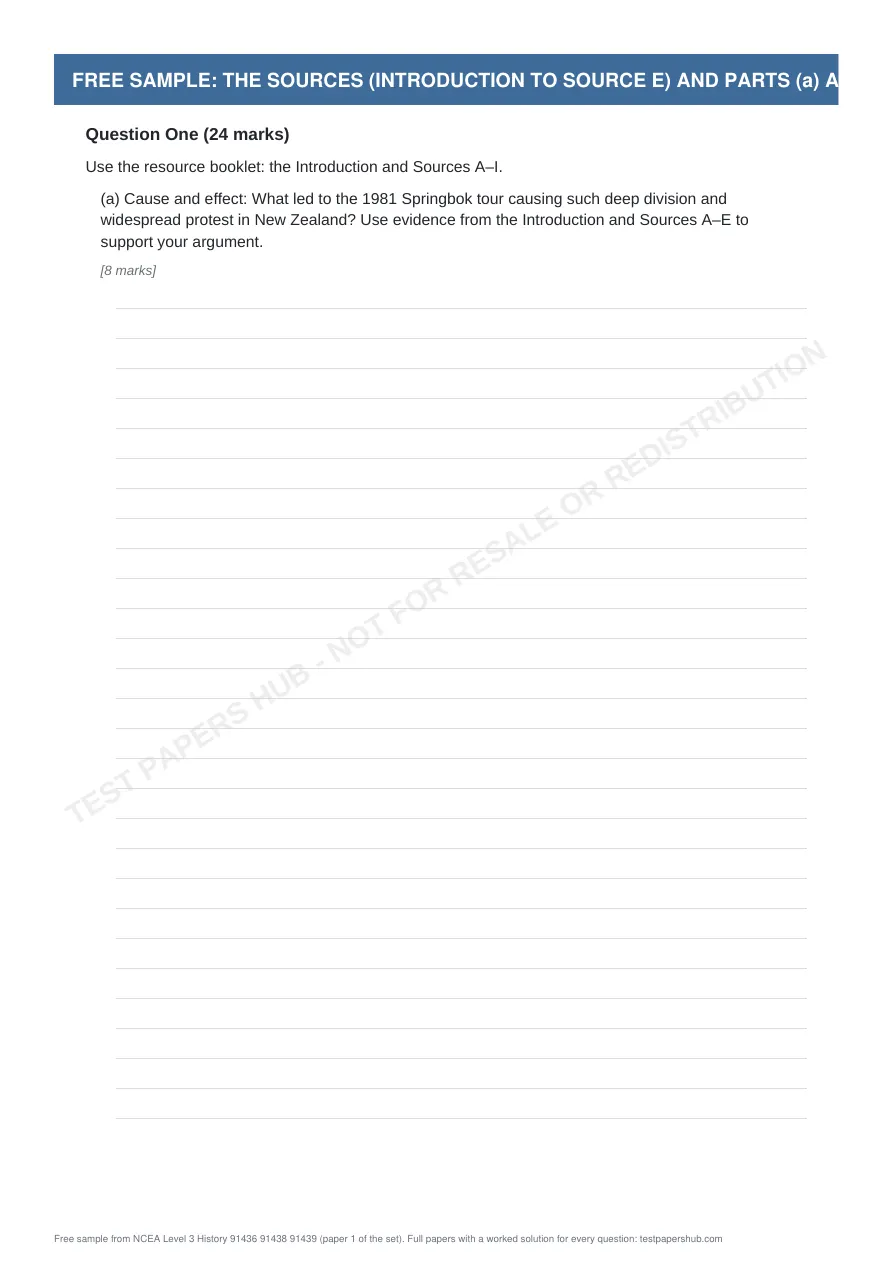
Question One (24 marks) Use the resource booklet: the Introduction and Sources A–I.
(a) Cause and effect: What led to the 1981 Springbok tour causing such deep division and widespread protest in New Zealand? Use evidence from the Introduction and Sources A–E to support your argument.
[8 marks]
(b) Continuity and change: In what ways do Sources A, B, E and I show continuity and change in New Zealanders' attitudes to race and sport between 1960 and 1985? You may use evidence from any of the other sources.
[8 marks]
(c) Significance: How do Sources F–I show the extent to which the 1981 Springbok tour is a significant event in New Zealand history? You may use evidence from any of the other sources.
[8 marks]
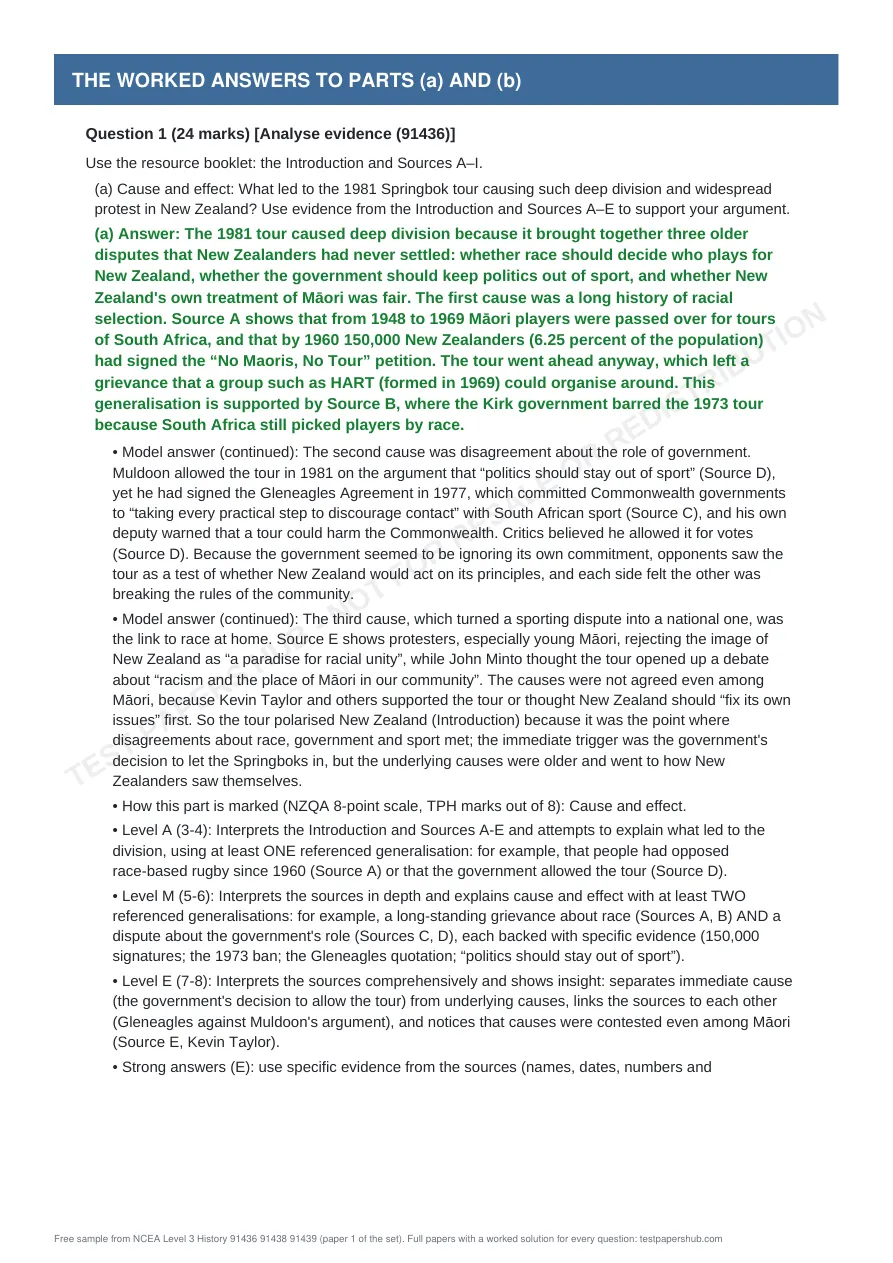
Question 1 (24 marks) [Analyse evidence (91436)]
Use the resource booklet: the Introduction and Sources A–I.
(a) Cause and effect: What led to the 1981 Springbok tour causing such deep division and widespread protest in New Zealand? Use evidence from the Introduction and Sources A–E to support your argument.
(a) Answer: The 1981 tour caused deep division because it brought together three older disputes that New Zealanders had never settled: whether race should decide who plays for New Zealand, whether the government should keep politics out of sport, and whether New Zealand's own treatment of Māori was fair. The first cause was a long history of racial selection. Source A shows that from 1948 to 1969 Māori players were passed over for tours of South Africa, and that by 1960 150,000 New Zealanders (6.25 percent of the population) had signed the “No Maoris, No Tour” petition. The tour went ahead anyway, which left a grievance that a group such as HART (formed in 1969) could organise around. This generalisation is supported by Source B, where the Kirk government barred the 1973 tour because South Africa still picked players by race.
• Model answer (continued): The second cause was disagreement about the role of government. Muldoon allowed the tour in 1981 on the argument that “politics should stay out of sport” (Source D), yet he had signed the Gleneagles Agreement in 1977, which committed Commonwealth governments to “taking every practical step to discourage contact” with South African sport (Source C), and his own deputy warned that a tour could harm the Commonwealth. Critics believed he allowed it for votes (Source D). Because the government seemed to be ignoring its own commitment, opponents saw the tour as a test of whether New Zealand would act on its principles, and each side felt the other was breaking the rules of the community.
• Model answer (continued): The third cause, which turned a sporting dispute into a national one, was the link to race at home. Source E shows protesters, especially young Māori, rejecting the image of New Zealand as “a paradise for racial unity”, while John Minto thought the tour opened up a debate about “racism and the place of Māori in our community”. The causes were not agreed even among Māori, because Kevin Taylor and others supported the tour or thought New Zealand should “fix its own issues” first. So the tour polarised New Zealand (Introduction) because it was the point where disagreements about race, government and sport met; the immediate trigger was the government's decision to let the Springboks in, but the underlying causes were older and went to how New Zealanders saw themselves.
• How this part is marked (NZQA 8-point scale, TPH marks out of 8): Cause and effect.
• Level A (3-4): Interprets the Introduction and Sources A-E and attempts to explain what led to the division, using at least ONE referenced generalisation: for example, that people had opposed race-based rugby since 1960 (Source A) or that the government allowed the tour (Source D).
Your sample is downloading. Liked it? NCEA Level 3 History 91436 91438 91439 Paper 1 is the full paper: a 40-mark paper: three 8-mark source questions on a ten-source booklet about a real New Zealand event, then two essays, with fact files and model answers at Achieved, Merit and Excellence, with a worked solution for every question.
Get Paper 1 for A$11.99See all 20 papers from A$11.99More free NCEA (New Zealand) samples
Questions about this sample
What is in the NCEA Level 3 History 91436 91438 91439 free sample?
The first 3 questions from paper 1 of the set, in the real exam layout, followed by the step-by-step worked answers. It is a 7-page PDF; this page shows the opening pages.
How many full NCEA Level 3 History 91436 91438 91439 papers are there?
20 original papers for New Zealand Level 3 students preparing for NCEA external standard 91436 and 91438 and 91439. Each is a 40-mark paper: three 8-mark source questions on a ten-source booklet about a real New Zealand event, then two essays, with fact files and model answers at Achieved, Merit and Excellence, with a worked solution for every question. Papers start at A$11.99 and download instantly as a PDF.
Are these official past papers?
No. The sample is taken from our own original practice paper and is not an official past paper or affiliated with any exam authority.