NCEA Level 3 Physics 91523 Wave Systems free practice questions with answers
Read the opening questions and their worked answers from paper 1 of our 20-paper NCEA Level 3 Physics 91523 Wave Systems set, then download the 4-page PDF. These are original practice questions, not official past papers. Page updated 3 November 2026.

Topics: Interference and gratings (91523).
- Diffraction grating: d sinθ = nλ with d = ≤ 1, so n ≤ d/λ.
- Double slit: fringe spacing x = λL/d — larger wavelength or screen distance spreads the fringes; larger slit separation brings them closer together. 1
- Multi-slit patterns: principal maxima are at d sinθ = nλ whatever the number of slits N; more slits sharpen them and put N − 2 weak secondary maxima between them.
Read the text of this sample
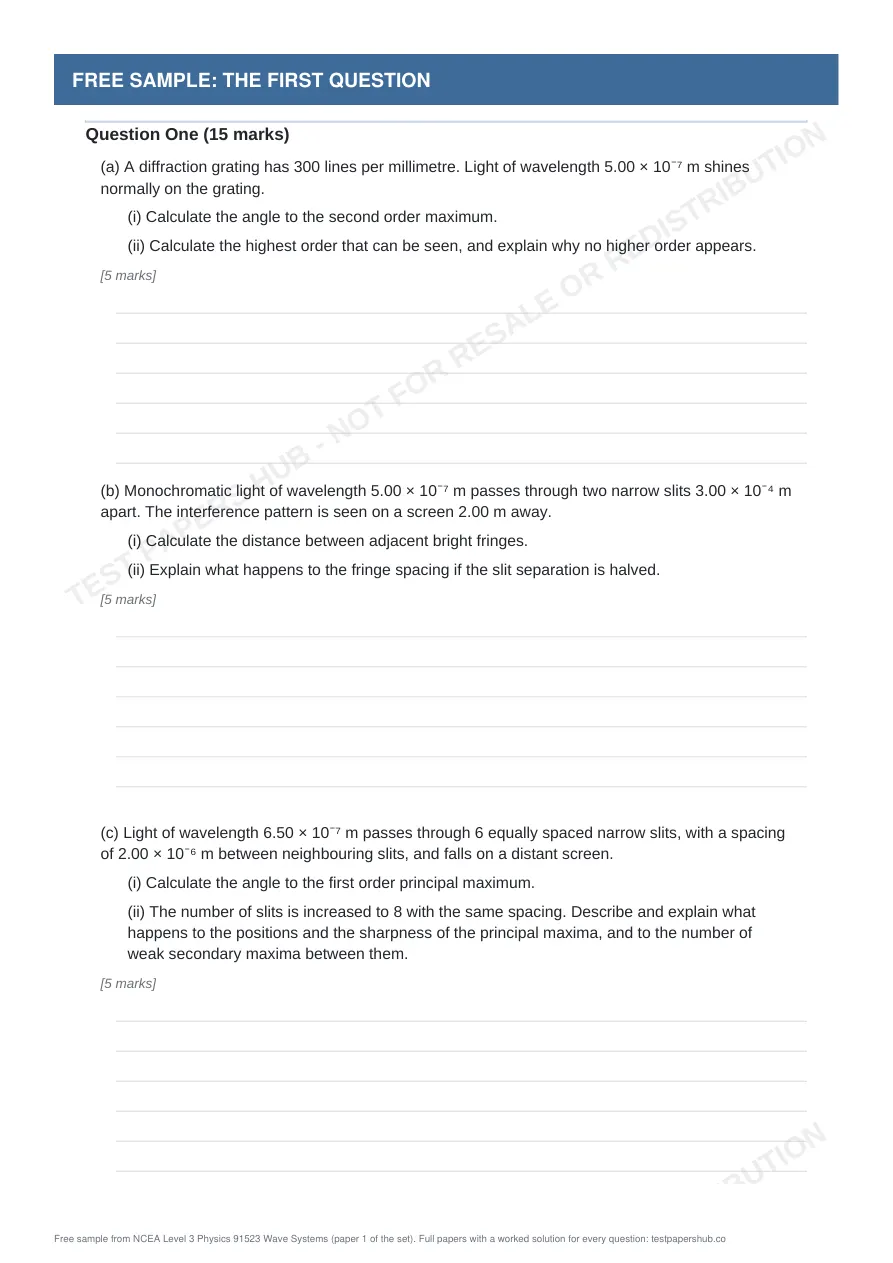
Question One (15 marks)
(a) A diffraction grating has 300 lines per millimetre. Light of wavelength 5.00 × 10⁻⁷ m shines normally on the grating.
(i) Calculate the angle to the second order maximum.
(ii) Calculate the highest order that can be seen, and explain why no higher order appears.
[5 marks]
(b) Monochromatic light of wavelength 5.00 × 10⁻⁷ m passes through two narrow slits 3.00 × 10⁻⁴ m apart. The interference pattern is seen on a screen 2.00 m away.
(i) Calculate the distance between adjacent bright fringes.
(ii) Explain what happens to the fringe spacing if the slit separation is halved.
[5 marks]
(c) Light of wavelength 6.50 × 10⁻⁷ m passes through 6 equally spaced narrow slits, with a spacing of 2.00 × 10⁻⁶ m between neighbouring slits, and falls on a distant screen.
(i) Calculate the angle to the first order principal maximum.
(ii) The number of slits is increased to 8 with the same spacing. Describe and explain what happens to the positions and the sharpness of the principal maxima, and to the number of weak secondary maxima between them.
[5 marks]
Question 1 (15 marks) [Interference and gratings]
(a) A diffraction grating has 300 lines per millimetre. Light of wavelength 5.00 × 10⁻⁷ m shines normally on the grating. (i) Calculate the angle to the second order maximum. (ii) Calculate the highest order that can be seen, and explain why no higher order appears.
(a) Answer: (i) 17.5°; (ii) highest order 6
• Evidence level: Excellence (find the grating spacing, apply d sin θ = nλ, and find the limit on n).
• (i) d = 1 ÷ (300 × 10³) = 3.33 × 10⁻⁶ m. sin θ = nλ/d = 2 × 5.00 × 10⁻⁷ ÷ 3.33 × 10⁻⁶ = 0.300, so θ = 17.5°.
• (ii) sin θ cannot exceed 1, so nλ/d ≤ 1 and n ≤ d/λ = 3.33 × 10⁻⁶ ÷ 5.00 × 10⁻⁷ = 6.67. The highest whole order is n = 6.
• Achievement: (ii) States that the maximum order is 6.
• Merit: Links to the relationship: nλ/d = sin θ must be less than or equal to 1.
• Excellence: Full explanation: the order nλ/d would need sin θ > 1 for n = 7, which is impossible, so the light for that order would have to travel along an angle beyond 90°; no such maximum can form.
(b) Monochromatic light of wavelength 5.00 × 10⁻⁷ m passes through two narrow slits 3.00 × 10⁻⁴ m apart. The interference pattern is seen on a screen 2.00 m away. (i) Calculate the distance between adjacent bright fringes. (ii) Explain what happens to the fringe spacing if the slit separation is halved.
(b) Answer: (i) 3.33 × 10⁻³ m; (ii) the spacing increases by a factor of 2.00
• Evidence level: Excellence (use the double-slit relationship dx/L = λ, and reason from the proportionality).
• (i) x = λL/d = (5.00 × 10⁻⁷ × 2.00) ÷ 3.00 × 10⁻⁴ = 3.33 × 10⁻³ m (3.33 mm).
• Achievement: (ii) States whether the fringes get closer together or further apart.
• Merit: States the change and links it to the relationship: x = λL/d, so x is proportional to L and λ and inversely proportional to d.
• Excellence: Full explanation: the slit separation is halved, so x changes by a factor of 2.00 (new spacing 6.67 × 10⁻³ m); a longer path from the slits lets the path difference between rays grow more slowly across the screen, or a different λ/d changes the angle θ at which each order of constructive interference occurs. lines per metre ; the number of orders is limited because sinθ
(c) Light of wavelength 6.50 × 10⁻⁷ m passes through 6 equally spaced narrow slits, with a spacing of 2.00 × 10⁻⁶ m between neighbouring slits, and falls on a distant screen. (i) Calculate the angle to the first order principal maximum. (ii) The number of slits is increased to 8 with the same spacing. Describe and explain what happens to the positions and the sharpness of the principal maxima, and to the number of weak secondary maxima between them.
(c) Answer: (i) 19.0°; (ii) same positions, narrower and brighter, 6 weak secondary maxima instead of 4
• Evidence level: Excellence (apply d sin θ = nλ and explain how more slits sharpen the pattern).
• (i) sin θ = λ/d = 6.50 × 10⁻⁷ ÷ 2.00 × 10⁻⁶ = 0.325, so θ = 19.0°.
• Achievement: (ii) States that the maxima stay in the same places but get sharper (narrower).
• Merit: Links to the cause: the positions depend only on d and λ (d sin θ = nλ), so they do not move; more slits make the maxima narrower and brighter.
Your sample is downloading. Liked it? NCEA Level 3 Physics 91523 Wave Systems Paper 1 is the full paper: three questions made of several multi-part problems answered in writing (constructed response, no multiple choice), with a worked solution for every part that shows whether it is aimed at Achieved, Merit or Excellence, with a worked solution for every question.
Get Paper 1 for A$11.99See all 20 papers from A$11.99More free NCEA (New Zealand) samples
Questions about this sample
What is in the NCEA Level 3 Physics 91523 Wave Systems free sample?
The first 3 questions from paper 1 of the set, in the real exam layout, followed by the step-by-step worked answers. It is a 4-page PDF; this page shows the opening pages.
How many full NCEA Level 3 Physics 91523 Wave Systems papers are there?
20 original papers for New Zealand Level 3 students preparing for NCEA external standard 91523. Each is three questions made of several multi-part problems answered in writing (constructed response, no multiple choice), with a worked solution for every part that shows whether it is aimed at Achieved, Merit or Excellence, with a worked solution for every question. Papers start at A$11.99 and download instantly as a PDF.
Are these official past papers?
No. The sample is taken from our own original practice paper and is not an official past paper or affiliated with any exam authority.