NCEA Level 3 Physics 91524 Mechanics free practice questions with answers
Read the opening questions and their worked answers from paper 1 of our 20-paper NCEA Level 3 Physics 91524 Mechanics set, then download the 4-page PDF. These are original practice questions, not official past papers. Page updated 3 November 2026.

Topics: Translational motion and gravity (91524).
- Glancing collisions: apply conservation of momentum along and perpendicular to the original line of motion; the perpendicular components must cancel.
- Centre of mass: each coordinate is the mass-weighted average, xcm = Σmx/Σm; removing a mass shifts it away from where that mass was.
- Gravitational field strength g = GM/r² with r measured from Earth's centre; in orbit everything is in free fall, so the contact force that we feel as weight is zero.
Read the text of this sample
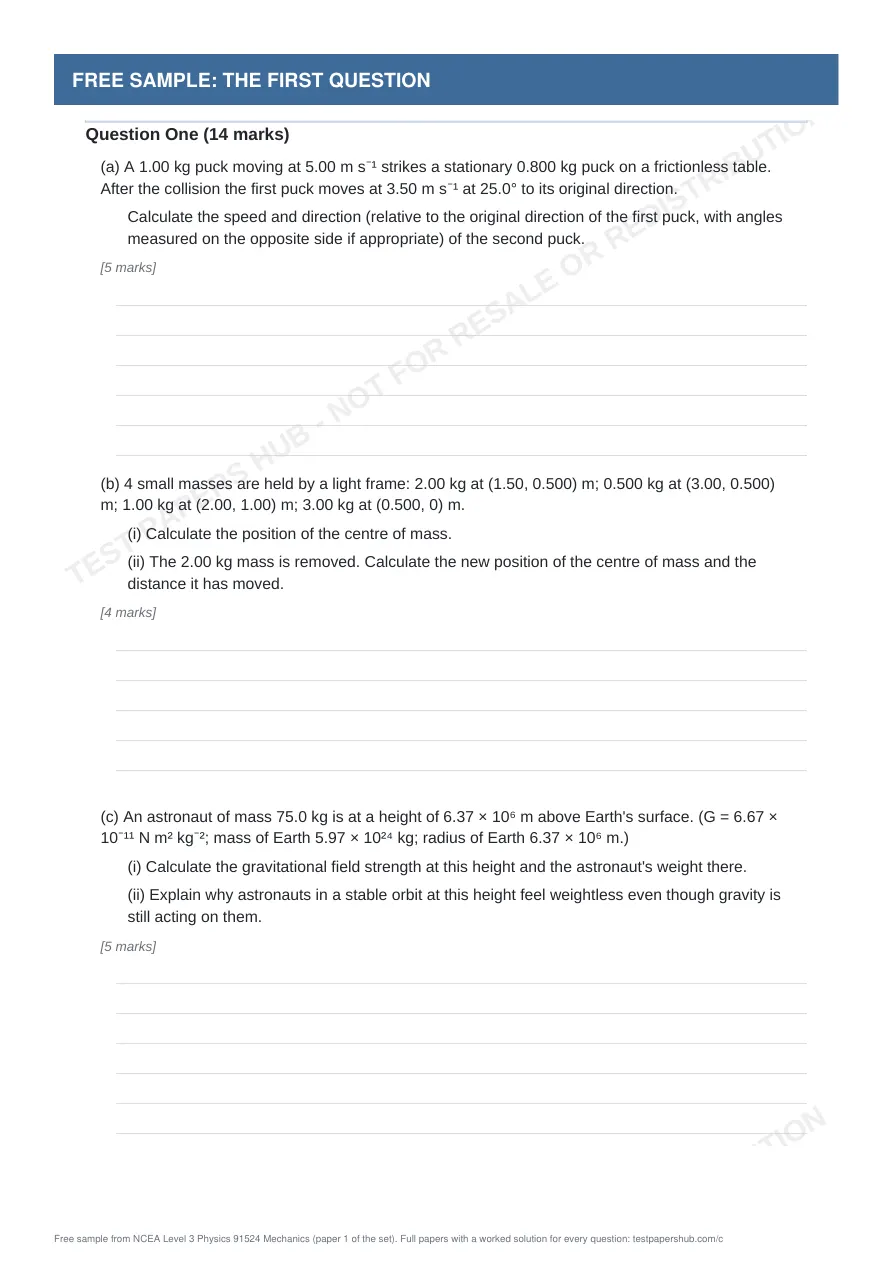
Question One (14 marks)
(a) A 1.00 kg puck moving at 5.00 m s⁻¹ strikes a stationary 0.800 kg puck on a frictionless table. After the collision the first puck moves at 3.50 m s⁻¹ at 25.0° to its original direction. Calculate the speed and direction (relative to the original direction of the first puck, with angles measured on the opposite side if appropriate) of the second puck.
[5 marks]
(b) 4 small masses are held by a light frame: 2.00 kg at (1.50, 0.500) m; 0.500 kg at (3.00, 0.500) m; 1.00 kg at (2.00, 1.00) m; 3.00 kg at (0.500, 0) m.
(i) Calculate the position of the centre of mass.
(ii) The 2.00 kg mass is removed. Calculate the new position of the centre of mass and the distance it has moved.
[4 marks]
(c) An astronaut of mass 75.0 kg is at a height of 6.37 × 10⁶ m above Earth's surface. (G = 6.67 × 10⁻¹¹ N m² kg⁻²; mass of Earth 5.97 × 10²⁴ kg; radius of Earth 6.37 × 10⁶ m.)
(i) Calculate the gravitational field strength at this height and the astronaut's weight there.
(ii) Explain why astronauts in a stable orbit at this height feel weightless even though gravity is still acting on them.
[5 marks]
Question 1 (14 marks) [Translational motion and gravity]
(a) A 1.00 kg puck moving at 5.00 m s⁻¹ strikes a stationary 0.800 kg puck on a frictionless table. After the collision the first puck moves at 3.50 m s⁻¹ at 25.0° to its original direction. Calculate the speed and direction (relative to the original direction of the first puck, with angles measured on the opposite side if appropriate) of the second puck.
(a) Answer: 2.94 m s⁻¹ at 39.0° on the opposite side of the original direction
• Evidence level: Excellence (resolve momentum parallel and perpendicular to the original direction).
• Along the original direction: 1.00 × 5.00 = 1.00 × 3.50 × cos 25.0° + 0.800 v₂x, so m₂v₂x = 1.83 kg m s⁻¹.
• Perpendicular: 0 = 1.00 × 3.50 × sin 25.0° + m₂v₂y, so m₂v₂y = −1.48 kg m s⁻¹ (opposite side).
• p₂ = √(1.83² + 1.48²) = 2.35 kg m s⁻¹, so v₂ = 2.35 ÷ 0.800 = 2.94 m s⁻¹ at 39.0° on the other side of the original line.
(b) 4 small masses are held by a light frame: 2.00 kg at (1.50, 0.500) m; 0.500 kg at (3.00, 0.500) m; 1.00 kg at (2.00, 1.00) m; 3.00 kg at (0.500, 0) m. (i) Calculate the position of the centre of mass. (ii) The 2.00 kg mass is removed. Calculate the new position of the centre of mass and the distance it has moved.
(b) Answer: (i) (1.23, 0.346) m; (ii) (1.11, 0.278) m, a shift of 0.138 m
• Evidence level: Merit (take moments about the axes to find the centre of mass).
• (i) xcm = Σmx/Σm = 8.00 ÷ 6.50 = 1.23 m; ycm = Σmy/Σm = 2.25 ÷ 6.50 = 0.346 m.
• (ii) Remaining mass = 4.50 kg, moments 5.00 and 1.25, so the new centre of mass is (1.11, 0.278) m.
• Distance moved = √((1.11 − 1.23)² + (0.278 − 0.346)²) = 0.138 m.
(c) An astronaut of mass 75.0 kg is at a height of 6.37 × 10⁶ m above Earth's surface. (G = 6.67 × 10⁻¹¹ N m² kg⁻²; mass of Earth 5.97 × 10²⁴ kg; radius of Earth 6.37 × 10⁶ m.) (i) Calculate the gravitational field strength at this height and the astronaut's weight there. (ii) Explain why astronauts in a stable orbit at this height feel weightless even though gravity is still acting on them.
(c) Answer: (i) 2.45 N kg⁻¹ and 184 N; (ii) both are in free fall, so there is no contact force
• Evidence level: Excellence (use Newton's law of gravitation and explain apparent weightlessness).
• (i) g = GM/r² with r = 6.37 × 10⁶ + 6.37 × 10⁶ = 1.27 × 10⁷ m: g = 3.98 × 10¹⁴ ÷ 1.27 × 10⁷² = 2.45 N kg⁻¹.
• Weight = mg = 75.0 × 2.45 = 184 N (compare 736 N at the surface).
• Achievement: (ii) States that the astronaut and the spacecraft are both falling together.
• Merit: Links to the force: gravity is the only force acting on both, so they have the same acceleration.
• Excellence: Full explanation: gravity still acts (weight 184 N), but the astronaut and spacecraft both accelerate at gh = 2.45 m s⁻² towards Earth as they orbit; there is no contact force from the floor (no 'normal reaction'), which is what we feel as weight, so the astronaut feels weightless.
Your sample is downloading. Liked it? NCEA Level 3 Physics 91524 Mechanics Paper 1 is the full paper: three questions made of several multi-part problems answered in writing (constructed response, no multiple choice), with a worked solution for every part that shows whether it is aimed at Achieved, Merit or Excellence, with a worked solution for every question.
Get Paper 1 for A$11.99See all 20 papers from A$11.99More free NCEA (New Zealand) samples
Questions about this sample
What is in the NCEA Level 3 Physics 91524 Mechanics free sample?
The first 3 questions from paper 1 of the set, in the real exam layout, followed by the step-by-step worked answers. It is a 4-page PDF; this page shows the opening pages.
How many full NCEA Level 3 Physics 91524 Mechanics papers are there?
20 original papers for New Zealand Level 3 students preparing for NCEA external standard 91524. Each is three questions made of several multi-part problems answered in writing (constructed response, no multiple choice), with a worked solution for every part that shows whether it is aimed at Achieved, Merit or Excellence, with a worked solution for every question. Papers start at A$11.99 and download instantly as a PDF.
Are these official past papers?
No. The sample is taken from our own original practice paper and is not an official past paper or affiliated with any exam authority.