NCEA Level 3 Physics 91526 Electricity free practice questions with answers
Read the opening questions and their worked answers from paper 1 of our 20-paper NCEA Level 3 Physics 91526 Electricity set, then download the 4-page PDF. These are original practice questions, not official past papers. Page updated 3 November 2026.

Topics: DC circuits (91526).
- Internal resistance: ε = I(R + r), V = ε − Ir; the 'lost volts' Ir are heated inside the battery, and the energy is shared between R and r in proportion to resistance.
- Kirchhoff: currents into a junction equal currents out, and the emfs round any loop equal the sum of the voltage drops; write one equation per loop plus the junction rule and solve.
- AC and rms: Vrms = Vmax/√2; the rms value gives the same average heating power in a resistor as the equivalent DC value.
Read the text of this sample
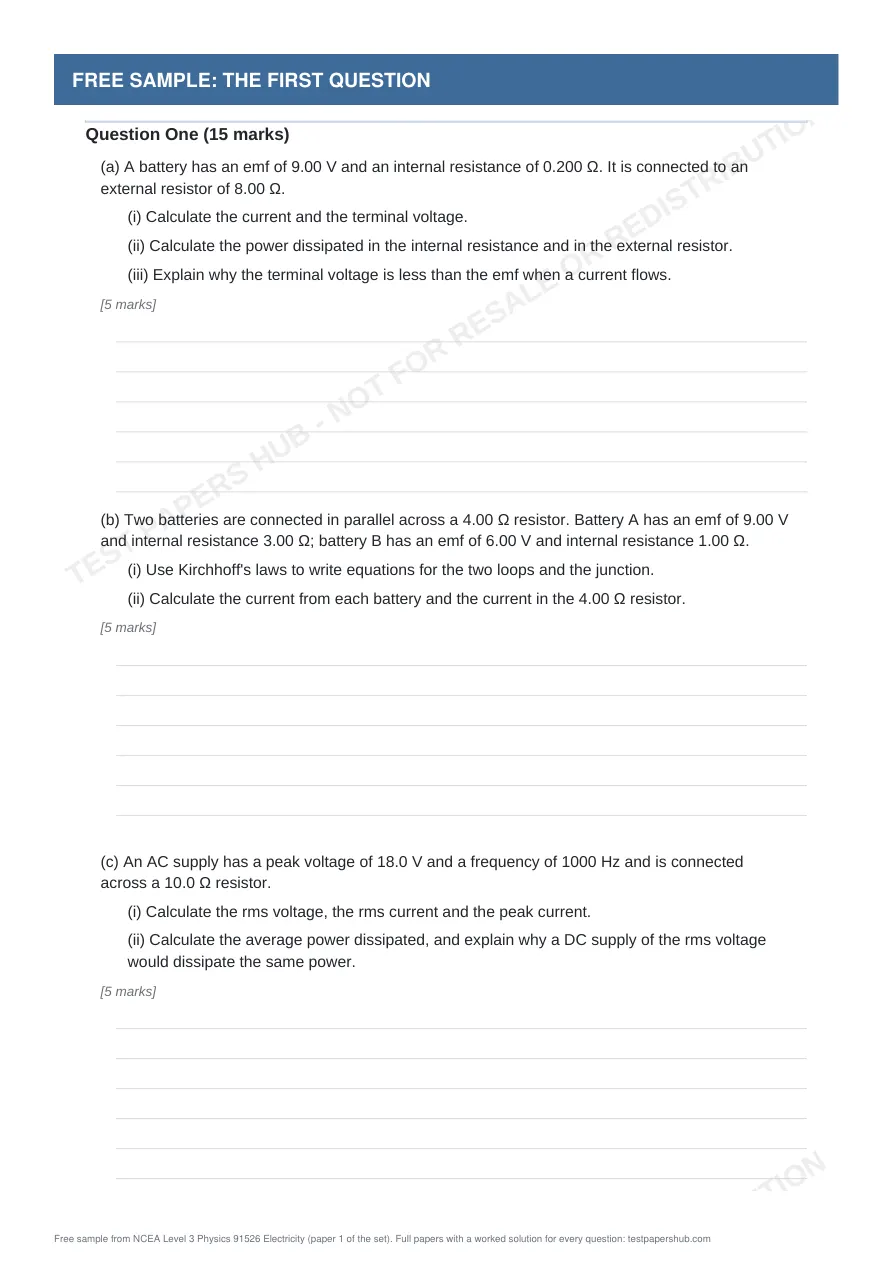
Question One (15 marks)
(a) A battery has an emf of 9.00 V and an internal resistance of 0.200 Ω. It is connected to an external resistor of 8.00 Ω.
(i) Calculate the current and the terminal voltage.
(ii) Calculate the power dissipated in the internal resistance and in the external resistor.
(iii) Explain why the terminal voltage is less than the emf when a current flows.
[5 marks]
(b) Two batteries are connected in parallel across a 4.00 Ω resistor. Battery A has an emf of 9.00 V and internal resistance 3.00 Ω; battery B has an emf of 6.00 V and internal resistance 1.00 Ω.
(i) Use Kirchhoff's laws to write equations for the two loops and the junction.
(ii) Calculate the current from each battery and the current in the 4.00 Ω resistor.
[5 marks]
(c) An AC supply has a peak voltage of 18.0 V and a frequency of 1000 Hz and is connected across a 10.0 Ω resistor.
(i) Calculate the rms voltage, the rms current and the peak current.
(ii) Calculate the average power dissipated, and explain why a DC supply of the rms voltage would dissipate the same power.
[5 marks]
Question 1 (15 marks) [DC circuits]
(a) A battery has an emf of 9.00 V and an internal resistance of 0.200 Ω. It is connected to an external resistor of 8.00 Ω. (i) Calculate the current and the terminal voltage. (ii) Calculate the power dissipated in the internal resistance and in the external resistor. (iii) Explain why the terminal voltage is less than the emf when a current flows.
(a) Answer: (i) 1.10 A and 8.78 V; (ii) 0.241 W and 9.64 W; (iii) the lost volts Ir across the internal resistance reduce the terminal voltage
• Evidence level: Excellence (treat the internal resistance as a resistor in series, then explain the lost volts).
• (i) I = ε/(R + r) = 9.00 ÷ (8.00 + 0.200) = 1.10 A. Terminal voltage V = IR = 1.10 × 8.00 = 8.78 V.
• (ii) Pint = I²r = 1.10² × 0.200 = 0.241 W; Ploaᵈ = I²R = 9.64 W.
• Achievement: (iii) States that some of the emf is lost across the internal resistance.
• Merit: Links to the cause: the battery's internal resistance has a voltage Ir across it when a current flows, so V = ε − Ir.
• Excellence: Full explanation: the emf is the total energy per coulomb supplied by the chemical reactions; some of it (the lost volts Ir = 0.220 V) is transformed to heat in the battery's own internal resistance, leaving 8.78 V across the terminals. The larger the current, the larger the lost volts.
(b) Two batteries are connected in parallel across a 4.00 Ω resistor. Battery A has an emf of 9.00 V and internal resistance 3.00 Ω; battery B has an emf of 6.00 V and internal resistance 1.00 Ω. (i) Use Kirchhoff's laws to write equations for the two loops and the junction. (ii) Calculate the current from each battery and the current in the 4.00 Ω resistor.
(b) Answer: (ii) I₁ = 1.11 A, I₂ = 0.316 A, I₃ = 1.42 A
• Evidence level: Excellence (write junction and loop equations and solve them simultaneously).
• (i) Junction: I₃ = I₁ + I₂. Loop A: 9.00 − 3.00I₁ − 4.00I₃ = 0. Loop B: 6.00 − 1.00I₂ − 4.00I₃ = 0.
• (ii) Substitute I₃ = I₁ + I₂: 7.00I₁ + 4.00I₂ = 9.00... solving the pair gives I₁ = 1.11 A and I₂ = 0.316 A.
• The current in the common resistor is I₃ = 1.11 + 0.316 = 1.42 A.
(c) An AC supply has a peak voltage of 18.0 V and a frequency of 1000 Hz and is connected across a 10.0 Ω resistor. (i) Calculate the rms voltage, the rms current and the peak current. (ii) Calculate the average power dissipated, and explain why a DC supply of the rms voltage would dissipate the same power.
(c) Answer: (i) 12.7 V, 1.27 A, 1.80 A; (ii) 16.2 W, the same as DC at the rms voltage
• Evidence level: Merit (use Vrms = Vmax/√2 and compare with DC).
• (i) Vrms = 18.0 ÷ √2 = 12.7 V. Irms = Vrms/R = 1.27 A. Imax = Vmax/R = 1.80 A.
• (ii) P = VrmsIrms = 12.7 × 1.27 = 16.2 W.
• Achievement: States that the rms value is the DC value that gives the same power.
• Merit: Links to heating: the power in a resistor is proportional to V², whose average over a cycle is Vmax²/2.
• Excellence: Full explanation: the instantaneous power V²/R varies between 0 and Vmax²/R, averaging to Vmax²/2R; a DC voltage Vrms = Vmax/√2 gives Vrms²/R = Vmax²/2R, the same average power.
Your sample is downloading. Liked it? NCEA Level 3 Physics 91526 Electricity Paper 1 is the full paper: three questions made of several multi-part problems answered in writing (constructed response, no multiple choice), with a worked solution for every part that shows whether it is aimed at Achieved, Merit or Excellence, with a worked solution for every question.
Get Paper 1 for A$11.99See all 20 papers from A$11.99More free NCEA (New Zealand) samples
Questions about this sample
What is in the NCEA Level 3 Physics 91526 Electricity free sample?
The first 3 questions from paper 1 of the set, in the real exam layout, followed by the step-by-step worked answers. It is a 4-page PDF; this page shows the opening pages.
How many full NCEA Level 3 Physics 91526 Electricity papers are there?
20 original papers for New Zealand Level 3 students preparing for NCEA external standard 91526. Each is three questions made of several multi-part problems answered in writing (constructed response, no multiple choice), with a worked solution for every part that shows whether it is aimed at Achieved, Merit or Excellence, with a worked solution for every question. Papers start at A$11.99 and download instantly as a PDF.
Are these official past papers?
No. The sample is taken from our own original practice paper and is not an official past paper or affiliated with any exam authority.