NCEA Level 3 Statistics 91584 Reports free practice questions with answers
Read the opening questions and their worked answers from paper 1 of our 20-paper NCEA Level 3 Statistics 91584 Reports set, then download the 4-page PDF. These are original practice questions, not official past papers. Page updated 3 November 2026.

Topics: Surveys and polls (91584).
- Polls: margin of error ≈ 1/√n (as a proportion); an interval is estimate ± margin of error; overlapping intervals mean no clear difference; the margin of error does not account for bias; n = (1/MOE)².
- Survey bias: voluntary response, selection, non-response, leading questions, response and measurement bias; a bigger sample does not remove bias, only random selection and good design do.
Read the text of this sample
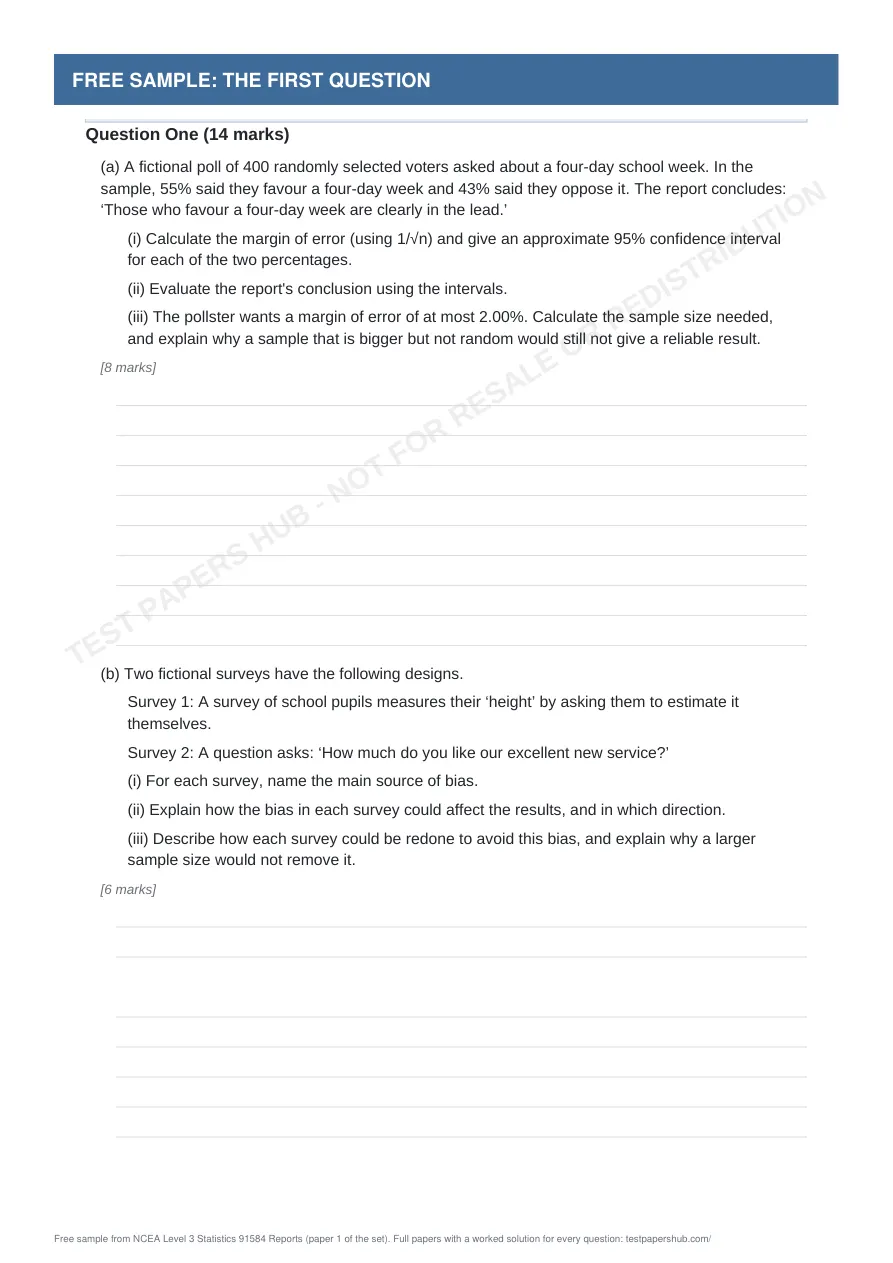
Question One (14 marks)
(a) A fictional poll of 400 randomly selected voters asked about a four-day school week. In the sample, 55% said they favour a four-day week and 43% said they oppose it. The report concludes:
‘Those who favour a four-day week are clearly in the lead.’
(i) Calculate the margin of error (using 1/√n) and give an approximate 95% confidence interval for each of the two percentages.
(ii) Evaluate the report's conclusion using the intervals.
(iii) The pollster wants a margin of error of at most 2.00%. Calculate the sample size needed, and explain why a sample that is bigger but not random would still not give a reliable result.
[8 marks]
(b) Two fictional surveys have the following designs. Survey 1: A survey of school pupils measures their ‘height’ by asking them to estimate it themselves. Survey 2: A question asks: ‘How much do you like our excellent new service?’
(i) For each survey, name the main source of bias.
(ii) Explain how the bias in each survey could affect the results, and in which direction.
(iii) Describe how each survey could be redone to avoid this bias, and explain why a larger sample size would not remove it.
[6 marks]
Question 1 (14 marks) [Surveys and polls]
(a) A fictional poll of 400 randomly selected voters asked about a four-day school week. In the sample, 55% said they favour a four-day week and 43% said they oppose it. The report concludes: ‘Those who favour a four-day week are clearly in the lead.’ (i) Calculate the margin of error (using 1/√n) and give an approximate 95% confidence interval for each of the two percentages. (ii) Evaluate the report's conclusion using the intervals. (iii) The pollster wants a margin of error of at most 2.00%. Calculate the sample size needed, and explain why a sample that is bigger but not random would still not give a reliable result.
(a) Answer: (i) MOE 5.00%; (ii) intervals do not overlap; (iii) n = 2500
• Evidence level: Merit (margin of error ≈ 1 ÷ √n; confidence interval = estimate ± margin of error).
• (i) Margin of error = 1 ÷ √400 = 0.0500, i.e. about ±5.00%. First group: 55% ± 5.00% = 50.0% to 60.0%; second group: 43% ± 5.00% = 38.0% to 48.0%.
• (ii) The intervals do not overlap, so the difference is greater than the sampling variation, and the conclusion that the first group leads is supported by the data (for these intervals).
• Achievement: (iii) Calculates the sample size.
• Merit: Links to the formula: n = (1 ÷ margin of error)².
• Excellence: Full answer: margin of error = 1 ÷ √n ≤ 2.00% = 0.0200, so n ≥ (1 ÷ 0.0200)² = 2500; the margin of error covers only sampling variation (random error), not bias; a larger voluntary or non-random sample (for example a call-in poll) can be biased because the people who respond differ from the population, so the estimate is still unreliable however large the sample.
(b) Two fictional surveys have the following designs. Survey 1: A survey of school pupils measures their ‘height’ by asking them to estimate it themselves. Survey 2: A question asks: ‘How much do you like our excellent new service?’ (i) For each survey, name the main source of bias. (ii) Explain how the bias in each survey could affect the results, and in which direction. (iii) Describe how each survey could be redone to avoid this bias, and explain why a larger sample size would not remove it.
(b) Answer: (i) measurement bias; leading (biased) question
• Evidence level: Merit (name the bias, then link it to the way people were selected or asked).
• (i) Survey 1: measurement bias; Survey 2: leading (biased) question.
• (ii) Survey 1: the measuring method gives readings that are systematically wrong, so the sample is not representative and the estimate is shifted from the population value (an over- or under-estimate depending on how the group differs). Survey 2: the word ‘excellent’ suggests the answer wanted, so the estimate is shifted from the population value in the same way.
• Achievement: (iii) States that a random sample or neutral wording is needed.
• Merit: Gives a design for each survey.
Your sample is downloading. Liked it? NCEA Level 3 Statistics 91584 Reports Paper 1 is the full paper: three questions made of several multi-part problems answered in writing (constructed response, no multiple choice), with a worked solution for every part that shows whether it is aimed at Achieved, Merit or Excellence, with a worked solution for every question.
Get Paper 1 for A$11.99See all 20 papers from A$11.99More free NCEA (New Zealand) samples
Questions about this sample
What is in the NCEA Level 3 Statistics 91584 Reports free sample?
The first 3 questions from paper 1 of the set, in the real exam layout, followed by the step-by-step worked answers. It is a 4-page PDF; this page shows the opening pages.
How many full NCEA Level 3 Statistics 91584 Reports papers are there?
20 original papers for New Zealand Level 3 students preparing for NCEA external standard 91584. Each is three questions made of several multi-part problems answered in writing (constructed response, no multiple choice), with a worked solution for every part that shows whether it is aimed at Achieved, Merit or Excellence, with a worked solution for every question. Papers start at A$11.99 and download instantly as a PDF.
Are these official past papers?
No. The sample is taken from our own original practice paper and is not an official past paper or affiliated with any exam authority.