NCEA Level 3 Statistics 91585 Probability free practice questions with answers
Read the opening questions and their worked answers from paper 1 of our 20-paper NCEA Level 3 Statistics 91585 Probability set, then download the 3-page PDF. These are original practice questions, not official past papers. Page updated 3 November 2026.

Topics: Two-way tables and Venn diagrams (91585).
- Two-way tables: P(A and B) = cell ÷ total; P(A | B) = cell ÷ column total; events are independent only if P(A | B) = P(A).
- Venn diagrams: P(A or B) = P(A) + P(B) − P(A and B); mutually exclusive means P(A and B) = 0; independent means P(A and B) = P(A) × P(B).
Read the text of this sample
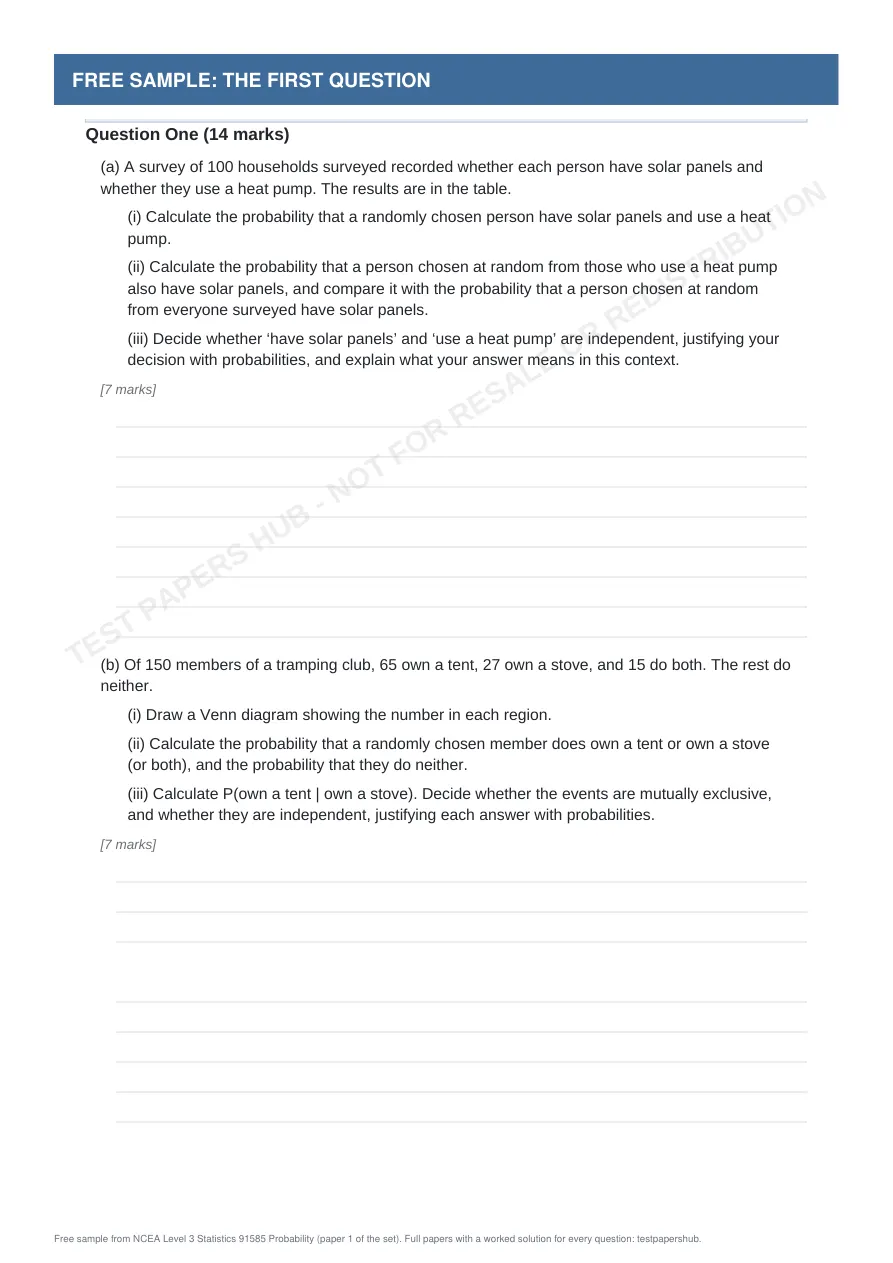
Question One (14 marks)
(a) A survey of 100 households surveyed recorded whether each person have solar panels and whether they use a heat pump. The results are in the table.
(i) Calculate the probability that a randomly chosen person have solar panels and use a heat pump.
(ii) Calculate the probability that a person chosen at random from those who use a heat pump also have solar panels, and compare it with the probability that a person chosen at random from everyone surveyed have solar panels.
(iii) Decide whether ‘have solar panels’ and ‘use a heat pump’ are independent, justifying your decision with probabilities, and explain what your answer means in this context.
[7 marks]
(b) Of 150 members of a tramping club, 65 own a tent, 27 own a stove, and 15 do both. The rest do neither.
(i) Draw a Venn diagram showing the number in each region.
(ii) Calculate the probability that a randomly chosen member does own a tent or own a stove (or both), and the probability that they do neither.
(iii) Calculate P(own a tent | own a stove). Decide whether the events are mutually exclusive, and whether they are independent, justifying each answer with probabilities.
[7 marks]
Question 1 (14 marks) [Two-way tables and Venn diagrams]
(a) A survey of 100 households surveyed recorded whether each person have solar panels and whether they use a heat pump. The results are in the table. (i) Calculate the probability that a randomly chosen person have solar panels and use a heat pump. (ii) Calculate the probability that a person chosen at random from those who use a heat pump also have solar panels, and compare it with the probability that a person chosen at random from everyone surveyed have solar panels. (iii) Decide whether ‘have solar panels’ and ‘use a heat pump’ are independent, justifying your decision with probabilities, and explain what your answer means in this context.
(a) Answer: (i)
• Evidence level: Merit (read the cells of the two-way table, then compare P(A | B) with P(A)).
• (i) P(have solar panels and use a heat pump) = 26 ÷ 100 =
• (ii) P(have solar panels | use a heat pump) = 26 ÷ 59 = 100 =
• Achievement: (iii) States whether the events are not independent.
• Merit: Links to the probabilities: independent events have P(A | B) = P(A); here they are different.
• Excellence: Full explanation: the events are not independent because P(have solar panels | use a heat pump) = is more likely to have solar panels than a person chosen from everyone (the events are associated).
(b) Of 150 members of a tramping club, 65 own a tent, 27 own a stove, and 15 do both. The rest do neither. (i) Draw a Venn diagram showing the number in each region. (ii) Calculate the probability that a randomly chosen member does own a tent or own a stove (or both), and the probability that they do neither. (iii) Calculate P(own a tent | own a stove). Decide whether the events are mutually exclusive, and whether they are independent, justifying each answer with probabilities.
(b) Answer: (ii)
• Evidence level: Merit (fill the Venn regions from the middle outwards; use P(A or B) = P(A) + P(B) − P(A and B)).
• (i) Both: 15; own a tent only: 65 − 15 = 50; own a stove only: 27 − 15 = 12; neither: 150 − 15 − 50 − 12 = 73.
• (ii) P(own a tent or own a stove) = (50 + 15 + 12) ÷ 150 = 77 ÷ 150 =
• (iii) P(own a tent | own a stove) = 15 ÷ 27 = Independent? P(own a tent) × P(own a stove) = are not independent. 13 50 ; (ii) 26 59 compared with 37 100 ; (iii) not independent 13 50 = 0.260. 26 59 = 0.441; P(have solar panels) = 37 ÷ 37 100 = 0.370. 26 59 ≠ P(have solar panels) = 37 100 ; this means that a person who use a heat pump 77 150 and 73 150 ; (iii) 5 9 ; not mutually exclusive; not independent 77 150 ; P(neither) = 73 ÷ 150 = 73 150 . 5 9 . Mutually exclusive? No: P(both) = 1 10 is not zero. 13 30 × 9 50 = 39 500 ≠ P(both) = 1 10 , so the events
Your sample is downloading. Liked it? NCEA Level 3 Statistics 91585 Probability Paper 1 is the full paper: three questions made of several multi-part problems answered in writing (constructed response, no multiple choice), with a worked solution for every part that shows whether it is aimed at Achieved, Merit or Excellence, with a worked solution for every question.
Get Paper 1 for A$11.99See all 20 papers from A$11.99More free NCEA (New Zealand) samples
Questions about this sample
What is in the NCEA Level 3 Statistics 91585 Probability free sample?
The first 3 questions from paper 1 of the set, in the real exam layout, followed by the step-by-step worked answers. It is a 3-page PDF; this page shows the opening pages.
How many full NCEA Level 3 Statistics 91585 Probability papers are there?
20 original papers for New Zealand Level 3 students preparing for NCEA external standard 91585. Each is three questions made of several multi-part problems answered in writing (constructed response, no multiple choice), with a worked solution for every part that shows whether it is aimed at Achieved, Merit or Excellence, with a worked solution for every question. Papers start at A$11.99 and download instantly as a PDF.
Are these official past papers?
No. The sample is taken from our own original practice paper and is not an official past paper or affiliated with any exam authority.