NCEA Level 1 Commerce 92030 and 92031 free practice questions with answers
Read the opening questions and their worked answers from paper 1 of our 20-paper NCEA Level 1 Commerce 92030 and 92031 set, then download the 5-page PDF. These are original practice questions, not official past papers. Page updated 3 November 2026.

Topics: Interdependent financial relationships and an event (92030).
- Insurance payout = share of the loss covered, less the excess.
- Workers’ income depends on how much work the employer has; an event that hurts the employer hurts the workers.
- Add income, take off costs, then check the loan repayments can still be met.
- Follow the money: who pays, who receives, who is left carrying the loss, and which relationship the figures show is most at risk.
Read the text of this sample
Question One (13 marks)
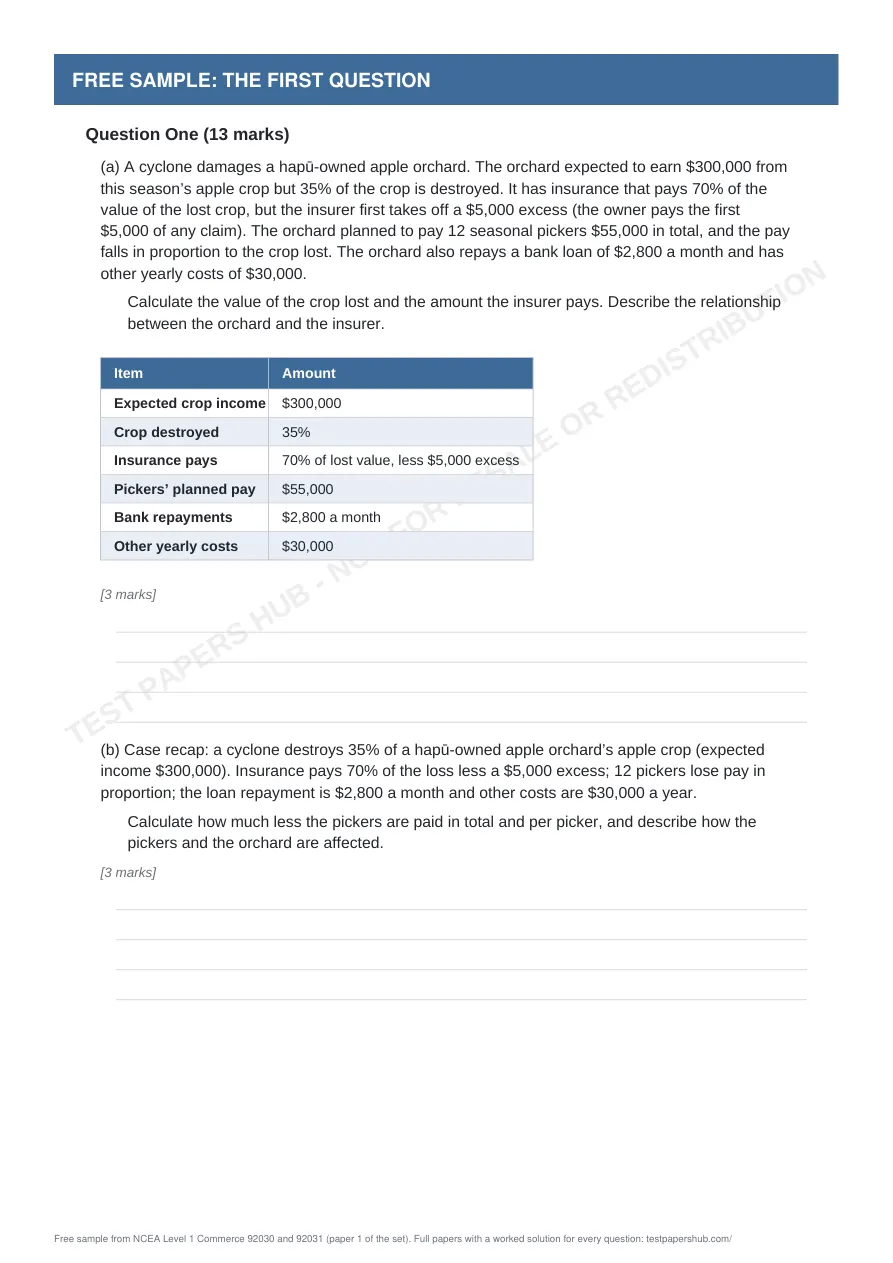
(a) A cyclone damages a hapū-owned apple orchard. The orchard expected to earn $300,000 from this season’s apple crop but 35% of the crop is destroyed. It has insurance that pays 70% of the value of the lost crop, but the insurer first takes off a $5,000 excess (the owner pays the first $5,000 of any claim). The orchard planned to pay 12 seasonal pickers $55,000 in total, and the pay falls in proportion to the crop lost. The orchard also repays a bank loan of $2,800 a month and has other yearly costs of $30,000. Calculate the value of the crop lost and the amount the insurer pays. Describe the relationship between the orchard and the insurer. Item Amount Expected crop income $300,000 Crop destroyed 35% Insurance pays 70% of lost value, less $5,000 excess Pickers’ planned pay $55,000 Bank repayments $2,800 a month Other yearly costs $30,000
[3 marks]
(b) Case recap: a cyclone destroys 35% of a hapū-owned apple orchard’s apple crop (expected income $300,000). Insurance pays 70% of the loss less a $5,000 excess; 12 pickers lose pay in proportion; the loan repayment is $2,800 a month and other costs are $30,000 a year. Calculate how much less the pickers are paid in total and per picker, and describe how the pickers and the orchard are affected.
[3 marks]
(c) Case recap: a cyclone destroys 35% of a hapū-owned apple orchard’s apple crop (expected income $300,000). Insurance pays 70% of the loss less a $5,000 excess; 12 pickers lose pay in proportion; the loan repayment is $2,800 a month and other costs are $30,000 a year. Work out the orchard’s income for the year after the cyclone and the insurance payout. After the pickers (who are still paid in proportion to the crop) and the other yearly costs are paid, and then the bank repayments, is there money left? Describe the relationship with the bank.
[3 marks]
(d) Case recap: a cyclone destroys 35% of a hapū-owned apple orchard’s apple crop (expected income $300,000). Insurance pays 70% of the loss less a $5,000 excess; 12 pickers lose pay in proportion; the loan repayment is $2,800 a month and other costs are $30,000 a year. Explain how the cyclone affects the orchard, the insurer, the pickers and the bank. Evaluate which relationship matters most for the orchard’s survival.
[4 marks]
Question 1 (13 marks) [Interdependent financial relationships and an event]
(a) A cyclone damages a hapū-owned apple orchard. The orchard expected to earn $300,000 from this season’s apple crop but 35% of the crop is destroyed. It has insurance that pays 70% of the value of the lost crop, but the insurer first takes off a $5,000 excess (the owner pays the first $5,000 of any claim). The orchard planned to pay 12 seasonal pickers $55,000 in total, and the pay falls in proportion to the crop lost. The orchard also repays a bank loan of $2,800 a month and has other yearly costs of $30,000. Calculate the value of the crop lost and the amount the insurer pays. Describe the relationship between the orchard and the insurer.
(a) Answer: Lost crop $105,000; the insurer pays $68,500.
• Evidence level: Achieved (finds the loss and the payout and says who pays whom).
• Value of crop lost = $300,000 × 35% = $105,000.
• Cover = $105,000 × 70% = $73,500; payout = $73,500 − $5,000 excess = $68,500.
• The orchard pays the insurer premiums and in return the insurer pays out when the event happens:
each depends on the other.
(b) Case recap: a cyclone destroys 35% of a hapū-owned apple orchard’s apple crop (expected income $300,000). Insurance pays 70% of the loss less a $5,000 excess; 12 pickers lose pay in proportion; the loan repayment is $2,800 a month and other costs are $30,000 a year. Calculate how much less the pickers are paid in total and per picker, and describe how the pickers and the orchard are affected.
(b) Answer: $19,250 less in total ($1,604 per picker).
• Evidence level: Merit (calculates the fall in pay and links it to both entities).
• Pay lost = $55,000 × 35% = $19,250.
• Per picker = $19,250 ÷ 12 = $1,604.
• The pickers lose income because the orchard has less fruit to pick; the orchard saves wages but loses far more in crop income.
(c) Case recap: a cyclone destroys 35% of a hapū-owned apple orchard’s apple crop (expected income $300,000). Insurance pays 70% of the loss less a $5,000 excess; 12 pickers lose pay in proportion; the loan repayment is $2,800 a month and other costs are $30,000 a year. Work out the orchard’s income for the year after the cyclone and the insurance payout. After the pickers (who are still paid in proportion to the crop) and the other yearly costs are paid, and then the bank repayments, is there money left? Describe the relationship with the bank.
(c) Answer: Income $263,500; after pickers’ pay and other costs $197,750, and $33,600 of repayments, the orchard is left with $164,150.
• Evidence level: Merit (puts income, costs and repayments together and links the result to the bank).
• Income after the cyclone = $195,000 remaining crop + $68,500 payout = $263,500.
• Pickers are still paid $55,000 − $19,250 = $35,750, so costs = $35,750 + $30,000 other costs = $65,750. Income − costs = $263,500 − $65,750 = $197,750. Bank repayments for the year = $2,800 × 12 = $33,600.
• Money after repayments = $197,750 − $33,600 = $164,150; the orchard can still pay the bank, so the bank relationship is not under immediate pressure.
Your sample is downloading. Liked it? NCEA Level 1 Commerce 92030 and 92031 Paper 1 is the full paper: two case-study questions: how an event affects financially interdependent relationships (92030) and the financial viability of an organisation (92031), with worked Achieved, Merit and Excellence answers, with a worked solution for every question.
Get Paper 1 for A$11.99See all 20 papers from A$11.99More free NCEA (New Zealand) samples
Questions about this sample
What is in the NCEA Level 1 Commerce 92030 and 92031 free sample?
The first 3 questions from paper 1 of the set, in the real exam layout, followed by the step-by-step worked answers. It is a 5-page PDF; this page shows the opening pages.
How many full NCEA Level 1 Commerce 92030 and 92031 papers are there?
20 original papers for New Zealand Level 1 students preparing for NCEA external standard 92030 and 92031. Each is two case-study questions: how an event affects financially interdependent relationships (92030) and the financial viability of an organisation (92031), with worked Achieved, Merit and Excellence answers, with a worked solution for every question. Papers start at A$11.99 and download instantly as a PDF.
Are these official past papers?
No. The sample is taken from our own original practice paper and is not an official past paper or affiliated with any exam authority.