NCEA Level 1 History 92026 92027 free practice questions with answers
Read the opening questions and their worked answers from paper 1 of our 20-paper NCEA Level 1 History 92026 92027 set, then download the 3-page PDF. These are original practice questions, not official past papers. Page updated 3 November 2026.
- Define the concept in your own words, then back it with a fact from the sources.
- Link every fact to the concept with a reason: say how each fact shows the concept and give the reason.
Read the text of this sample
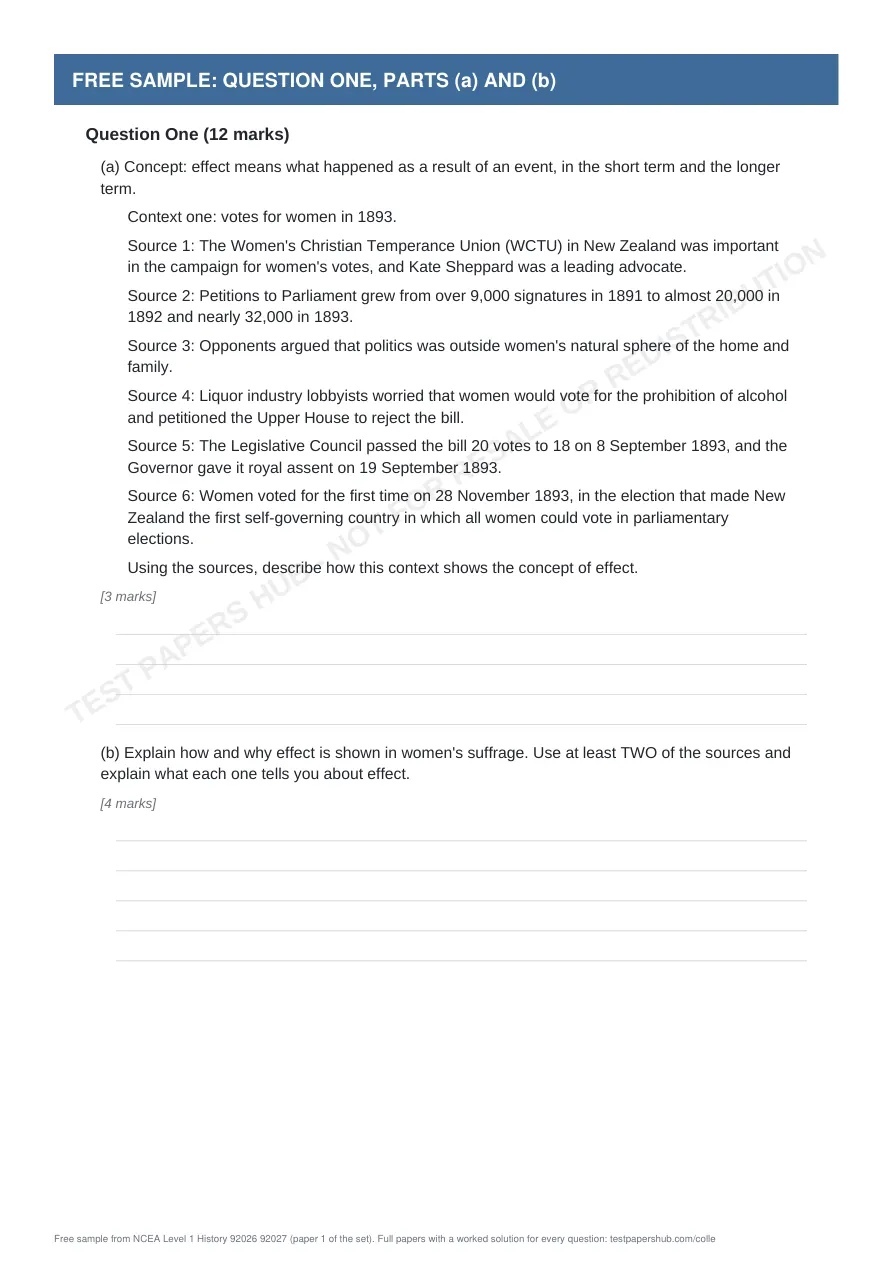
Question One (12 marks)
(a) Concept: effect means what happened as a result of an event, in the short term and the longer term. Context one: votes for women in 1893. Source 1: The Women's Christian Temperance Union (WCTU) in New Zealand was important in the campaign for women's votes, and Kate Sheppard was a leading advocate. Source 2: Petitions to Parliament grew from over 9,000 signatures in 1891 to almost 20,000 in 1892 and nearly 32,000 in 1893. Source 3: Opponents argued that politics was outside women's natural sphere of the home and family. Source 4: Liquor industry lobbyists worried that women would vote for the prohibition of alcohol and petitioned the Upper House to reject the bill. Source 5: The Legislative Council passed the bill 20 votes to 18 on 8 September 1893, and the Governor gave it royal assent on 19 September 1893. Source 6: Women voted for the first time on 28 November 1893, in the election that made New Zealand the first self-governing country in which all women could vote in parliamentary elections. Using the sources, describe how this context shows the concept of effect.
[3 marks]
(b) Explain how and why effect is shown in women's suffrage. Use at least TWO of the sources and explain what each one tells you about effect.
[4 marks]
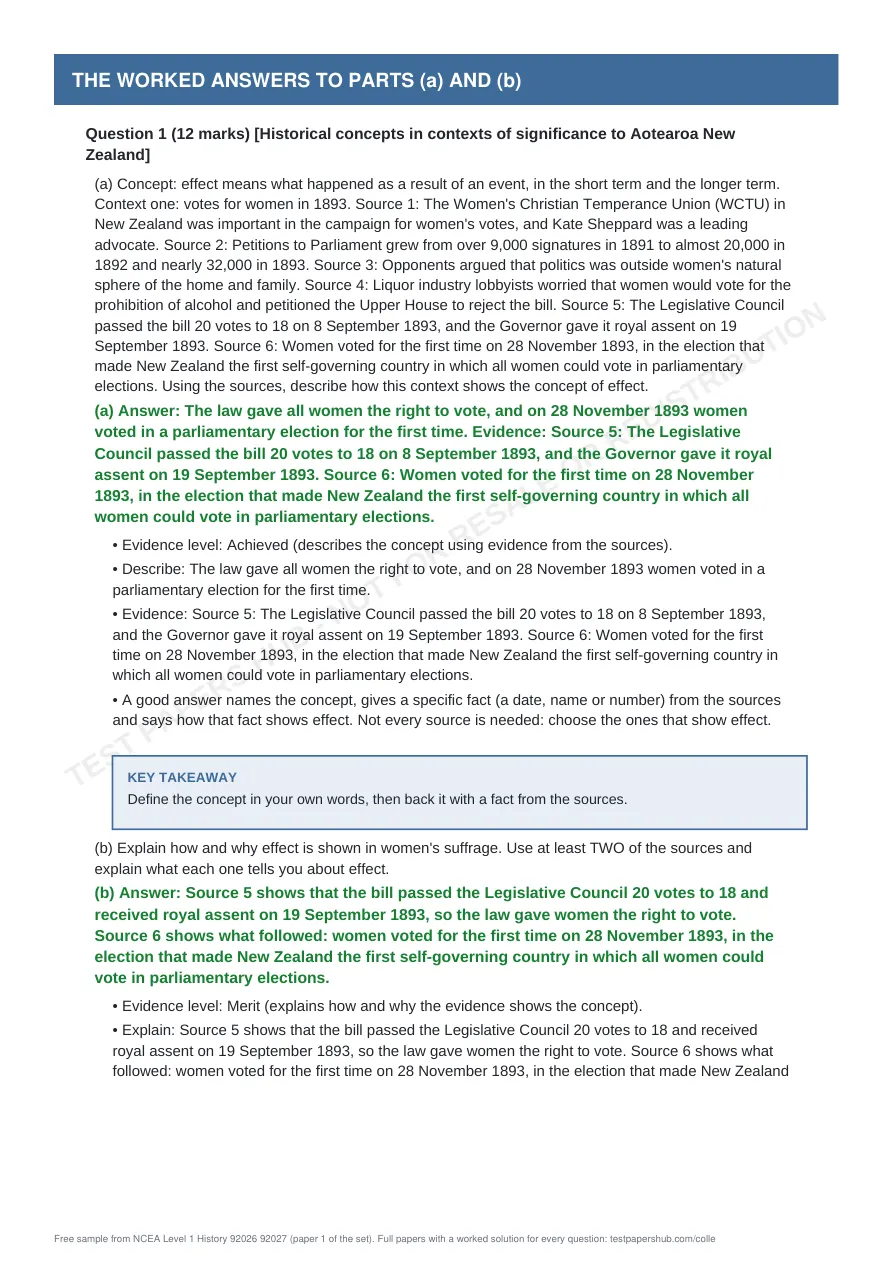
Question 1 (12 marks) [Historical concepts in contexts of significance to Aotearoa New Zealand]
(a) Concept: effect means what happened as a result of an event, in the short term and the longer term. Context one: votes for women in 1893. Source 1: The Women's Christian Temperance Union (WCTU) in New Zealand was important in the campaign for women's votes, and Kate Sheppard was a leading advocate. Source 2: Petitions to Parliament grew from over 9,000 signatures in 1891 to almost 20,000 in 1892 and nearly 32,000 in 1893. Source 3: Opponents argued that politics was outside women's natural sphere of the home and family. Source 4: Liquor industry lobbyists worried that women would vote for the prohibition of alcohol and petitioned the Upper House to reject the bill. Source 5: The Legislative Council passed the bill 20 votes to 18 on 8 September 1893, and the Governor gave it royal assent on 19 September 1893. Source 6: Women voted for the first time on 28 November 1893, in the election that made New Zealand the first self-governing country in which all women could vote in parliamentary elections. Using the sources, describe how this context shows the concept of effect.
(a) Answer: The law gave all women the right to vote, and on 28 November 1893 women voted in a parliamentary election for the first time. Evidence: Source 5: The Legislative Council passed the bill 20 votes to 18 on 8 September 1893, and the Governor gave it royal assent on 19 September 1893. Source 6: Women voted for the first time on 28 November 1893, in the election that made New Zealand the first self-governing country in which all women could vote in parliamentary elections.
• Evidence level: Achieved (describes the concept using evidence from the sources).
• Describe: The law gave all women the right to vote, and on 28 November 1893 women voted in a parliamentary election for the first time.
• Evidence: Source 5: The Legislative Council passed the bill 20 votes to 18 on 8 September 1893, and the Governor gave it royal assent on 19 September 1893. Source 6: Women voted for the first time on 28 November 1893, in the election that made New Zealand the first self-governing country in which all women could vote in parliamentary elections.
• A good answer names the concept, gives a specific fact (a date, name or number) from the sources and says how that fact shows effect. Not every source is needed: choose the ones that show effect.
(b) Explain how and why effect is shown in women's suffrage. Use at least TWO of the sources and explain what each one tells you about effect.
(b) Answer: Source 5 shows that the bill passed the Legislative Council 20 votes to 18 and received royal assent on 19 September 1893, so the law gave women the right to vote. Source 6 shows what followed: women voted for the first time on 28 November 1893, in the election that made New Zealand the first self-governing country in which all women could vote in parliamentary elections.
• Evidence level: Merit (explains how and why the evidence shows the concept).
Your sample is downloading. Liked it? NCEA Level 1 History 92026 92027 Paper 1 is the full paper: three questions made of several multi-part problems answered in writing (constructed response, no multiple choice), with a worked solution for every part that shows whether it is aimed at Achieved, Merit or Excellence, with a worked solution for every question.
Get Paper 1 for A$11.99See all 20 papers from A$11.99More free NCEA (New Zealand) samples
Questions about this sample
What is in the NCEA Level 1 History 92026 92027 free sample?
The first 3 questions from paper 1 of the set, in the real exam layout, followed by the step-by-step worked answers. It is a 3-page PDF; this page shows the opening pages.
How many full NCEA Level 1 History 92026 92027 papers are there?
20 original papers for New Zealand Level 1 students preparing for NCEA external standard 92026 and 92027. Each is three questions made of several multi-part problems answered in writing (constructed response, no multiple choice), with a worked solution for every part that shows whether it is aimed at Achieved, Merit or Excellence, with a worked solution for every question. Papers start at A$11.99 and download instantly as a PDF.
Are these official past papers?
No. The sample is taken from our own original practice paper and is not an official past paper or affiliated with any exam authority.