NCEA Scholarship Biology free practice questions with answers
Read the opening questions and their worked answers from paper 1 of our 20-paper NCEA Scholarship Biology set, then download the 5-page PDF. These are original practice questions, not official past papers. Page updated 3 November 2026.

Topics: Conservation biology: a bottlenecked island population (93101).
- Combine the growth curve (ecology) with heterozygosity and fitness data (genetics) to decide on conservation action, and always state a judgement with its limits.
Read the text of this sample
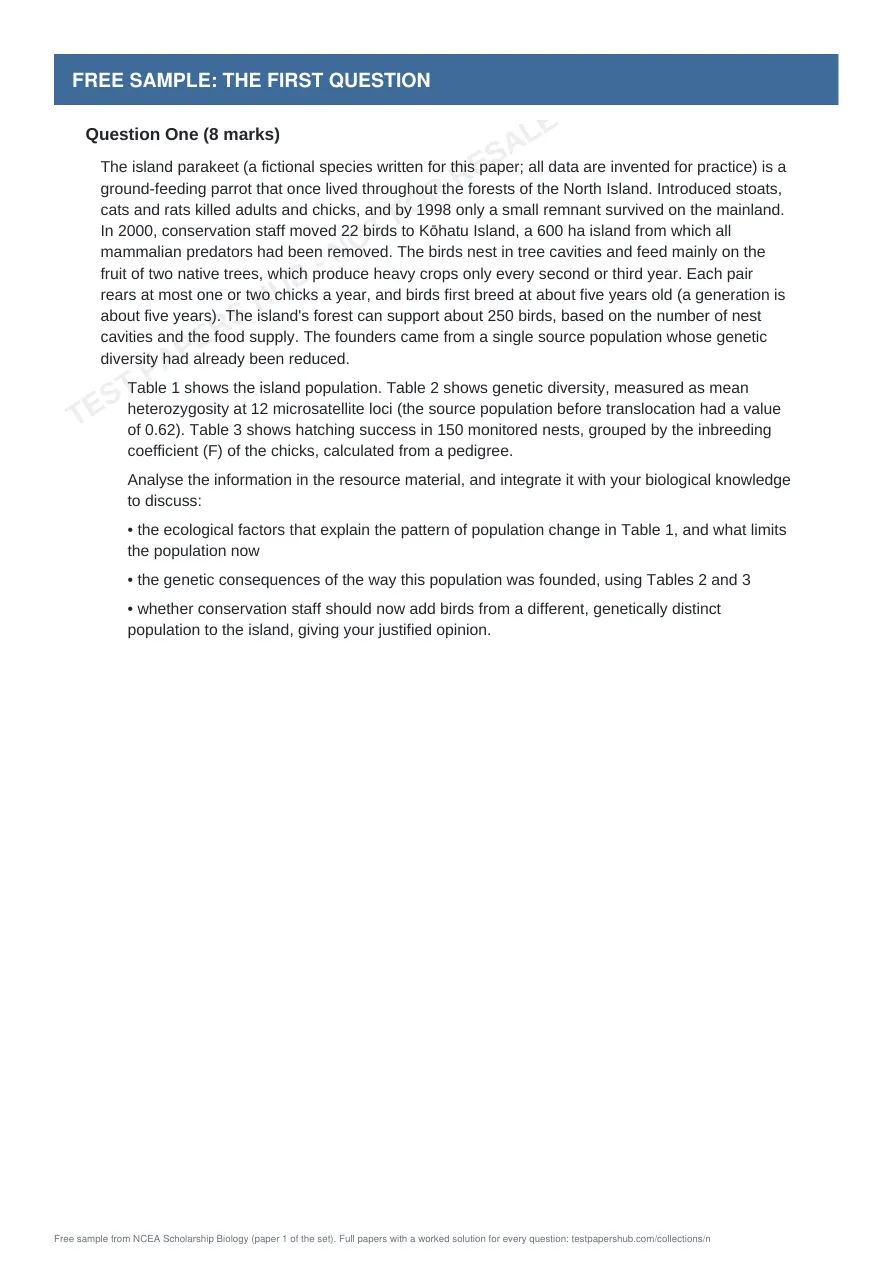
Question One (8 marks) The island parakeet (a fictional species written for this paper; all data are invented for practice) is a ground-feeding parrot that once lived throughout the forests of the North Island. Introduced stoats, cats and rats killed adults and chicks, and by 1998 only a small remnant survived on the mainland. In 2000, conservation staff moved 22 birds to Kōhatu Island, a 600 ha island from which all mammalian predators had been removed. The birds nest in tree cavities and feed mainly on the fruit of two native trees, which produce heavy crops only every second or third year. Each pair rears at most one or two chicks a year, and birds first breed at about five years old (a generation is about five years). The island's forest can support about 250 birds, based on the number of nest cavities and the food supply. The founders came from a single source population whose genetic diversity had already been reduced. Table 1 shows the island population. Table 2 shows genetic diversity, measured as mean heterozygosity at 12 microsatellite loci (the source population before translocation had a value of 0.62). Table 3 shows hatching success in 150 monitored nests, grouped by the inbreeding coefficient (F) of the chicks, calculated from a pedigree. Analyse the information in the resource material, and integrate it with your biological knowledge to discuss:
• the ecological factors that explain the pattern of population change in Table 1, and what limits the population now
• the genetic consequences of the way this population was founded, using Tables 2 and 3
• whether conservation staff should now add birds from a different, genetically distinct population to the island, giving your justified opinion. Table 1 Year 2000 2005 2010 2015 2020 2025 Birds on the island 22 41 87 160 231 248 Table 2 Year Mean heterozygosity 2000 0.55 2010 0.48 2025 0.41 Table 3 Inbreeding coefficient of chicks Hatching success (%)
F below 0.05 86
F 0.05 to 0.15 74
F above 0.15 52
[8 marks]
Question 1 (8 marks) [Conservation biology: a bottlenecked island population]
The island parakeet (a fictional species written for this paper; all data are invented for practice) is a ground-feeding parrot that once lived throughout the forests of the North Island. Introduced stoats, cats and rats killed adults and chicks, and by 1998 only a small remnant survived on the mainland. In 2000, conservation staff moved 22 birds to Kōhatu Island, a 600 ha island from which all mammalian predators had been removed. The birds nest in tree cavities and feed mainly on the fruit of two native trees, which produce heavy crops only every second or third year. Each pair rears at most one or two chicks a year, and birds first breed at about five years old (a generation is about five years). The island's forest can support about 250 birds, based on the number of nest cavities and the food supply. The founders came from a single source population whose genetic diversity had already been reduced. Table 1 shows the island population. Table 2 shows genetic diversity, measured as mean heterozygosity at 12 microsatellite loci (the source population before translocation had a value of 0.62). Table 3 shows hatching success in 150 monitored nests, grouped by the inbreeding coefficient (F) of the chicks, calculated from a pedigree. Analyse the information in the resource material, and integrate it with your biological knowledge to discuss:
• the ecological factors that explain the pattern of population change in Table 1, and what limits the population now • the genetic consequences of the way this population was founded, using Tables 2 and 3
• whether conservation staff should now add birds from a different, genetically distinct population to the island, giving your justified opinion. Answer: Integrated extended answer (8 marks); see the rubric and sample answers below.
• How the 8 marks are awarded (TPH rubric, 2 marks per row):
• Use of the resource data (accurate reading, calculation or comparison of the figures supplied). Reads Table 1 correctly (growth from 22 to 248 birds, fastest per bird in the early years and largest in absolute numbers between 2010 and 2020, then levelling near the carrying capacity of about 250) and quantifies it, for example r ≈ 0.137 per year in 2000–2010 against r ≈ 0.044 per year in 2015–2025. [2 marks]
• Accuracy and depth of biological knowledge (correct terms and mechanisms). Explains exponential then logistic growth, density-dependent limits (nest cavities, food), release from predators, the founder effect, a genetic bottleneck, genetic drift and inbreeding depression; mast-fruiting as a source of variation in breeding. [2 marks]
• Integration (links ecology, genetics and evolution and ties the data to the biology). Links ecology to genetics: a small founder number and slow breeding mean a small effective population size even when the census size is 248; the same low N that makes the population vulnerable to drift is reflected in Tables 2 and 3. [2 marks]
Your sample is downloading. Liked it? NCEA Scholarship Biology Paper 1 is the full paper: three extended-answer questions of 8 marks (24 in all) in three hours on ecology, genetics and evolution, each with a passage and data tables, a marking rubric, and Scholarship and Outstanding sample answers, with a worked solution for every question.
Get Paper 1 for A$11.99See all 20 papers from A$11.99More free NCEA (New Zealand) samples
Questions about this sample
What is in the NCEA Scholarship Biology free sample?
The first 3 questions from paper 1 of the set, in the real exam layout, followed by the step-by-step worked answers. It is a 5-page PDF; this page shows the opening pages.
How many full NCEA Scholarship Biology papers are there?
20 original papers for New Zealand Year 13 students preparing for NZ Scholarship Biology (standard 93202). Each is three extended-answer questions of 8 marks (24 in all) in three hours on ecology, genetics and evolution, each with a passage and data tables, a marking rubric, and Scholarship and Outstanding sample answers, with a worked solution for every question. Papers start at A$11.99 and download instantly as a PDF.
Are these official past papers?
No. The sample is taken from our own original practice paper and is not an official past paper or affiliated with any exam authority.