NCEA Scholarship Physics free practice questions with answers
Read the opening questions and their worked answers from paper 1 of our 20-paper NCEA Scholarship Physics set, then download the 2-page PDF. These are original practice questions, not official past papers. Page updated 3 November 2026.
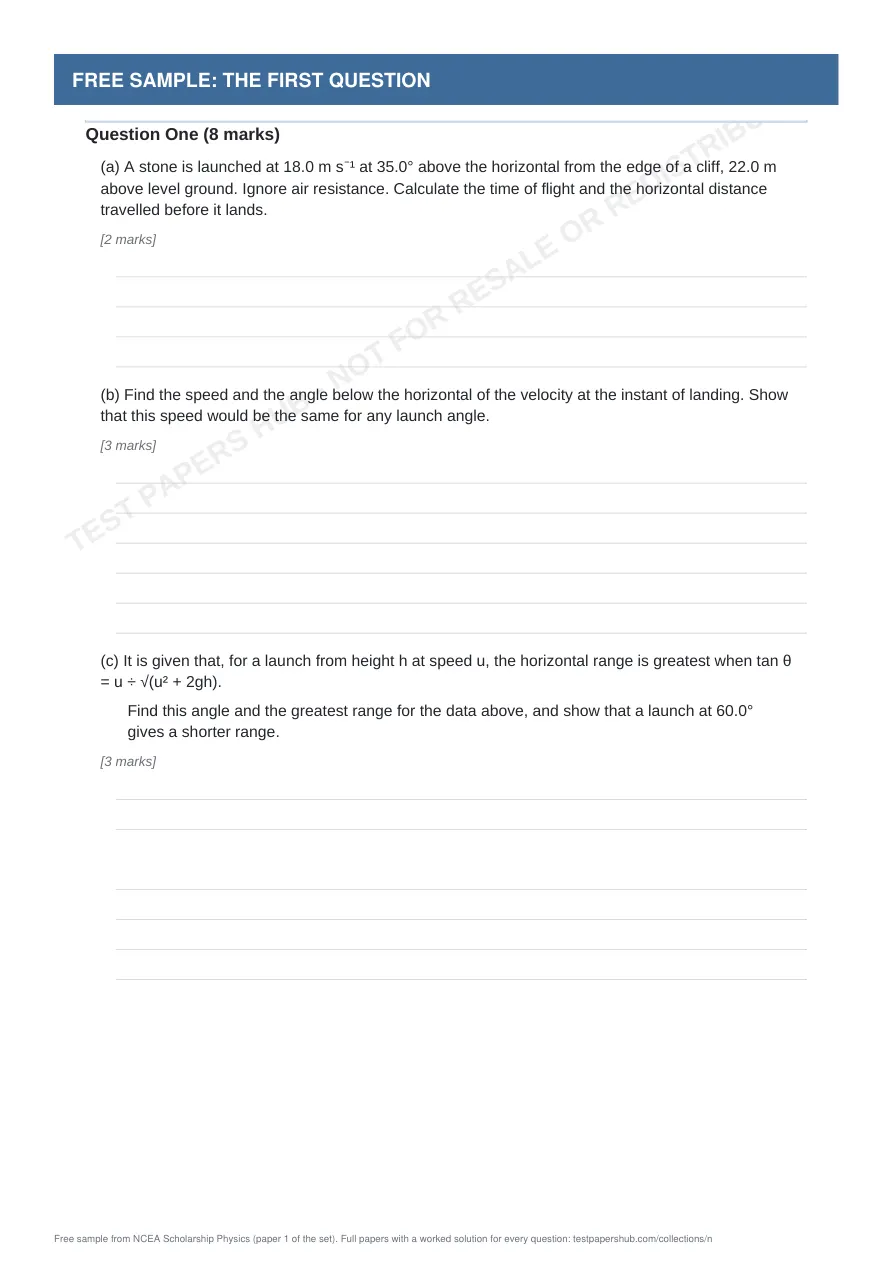

Topics: Projectile motion from a height (93103).
- Split the motion into independent vertical and horizontal parts; the landing condition gives a quadratic in time and only the positive root is physical.
- A conservative force changes speed by an amount that depends only on the height change, so the landing speed does not depend on the launch angle.
- For a launch from above the landing level the best angle is below 45°; a quick calculation at a second angle confirms the optimum is a maximum.
Read the text of this sample
Question One (8 marks)
(a) A stone is launched at 18.0 m s⁻¹ at 35.0° above the horizontal from the edge of a cliff, 22.0 m above level ground. Ignore air resistance. Calculate the time of flight and the horizontal distance travelled before it lands.
[2 marks]
(b) Find the speed and the angle below the horizontal of the velocity at the instant of landing. Show that this speed would be the same for any launch angle.
[3 marks]
(c) It is given that, for a launch from height h at speed u, the horizontal range is greatest when tan θ = u ÷ √(u² + 2gh). Find this angle and the greatest range for the data above, and show that a launch at 60.0° gives a shorter range.
[3 marks]
Question 1 (8 marks) [Projectile motion from a height]
(a) A stone is launched at 18.0 m s⁻¹ at 35.0° above the horizontal from the edge of a cliff, 22.0 m above level ground. Ignore air resistance. Calculate the time of flight and the horizontal distance travelled before it lands.
(a) Answer: T = 3.42 s; R = 50.4 m
• Entry step: worth marks in the 1-4 range of the 8-point question score.
• Take up as positive: initial vertical speed 18.0 sin 35.0° = 10.32 m s⁻¹ and horizontal speed 18.0 cos 35.0° = 14.74 m s⁻¹. Landing: −22.0 = 10.32 t − ½(9.81)t². [1 mark]
• Solve the quadratic and take the positive root: t = 3.417 s. Horizontal distance = 14.74 × 3.417 = 50.39 m. [1 mark]
(b) Find the speed and the angle below the horizontal of the velocity at the instant of landing. Show that this speed would be the same for any launch angle.
(b) Answer: v = 27.5 m s⁻¹ at 57.6° below the horizontal
• Scholarship band (5-6): the part needs your own method and accurate algebra.
• Vertical speed at landing = 10.32 − 9.81(3.417) = −23.20 m s⁻¹ (downwards). Speed = 27.49 m s⁻¹.
[1 mark]
• Angle = tan⁻¹(23.20 ÷ 14.74) = 57.56° below the horizontal. [1 mark]
• Energy conservation: ½mv² = ½mu² + mgh, so v = √(u² + 2gh) depends only on u and h, not on the launch angle. [1 mark]
(c) It is given that, for a launch from height h at speed u, the horizontal range is greatest when tan θ = u ÷ √(u² + 2gh). Find this angle and the greatest range for the data above, and show that a launch at 60.0° gives a shorter range.
(c) Answer: θ = 33.2°; Rmax = 50.4 m (at 60.0° the range is 38.1 m)
• Outstanding band (7-8): the part needs insight and a complete, efficient argument.
• tan θ = 18.0 ÷ 27.49 = 0.6548 so θ = 33.22°. [1 mark]
• At this angle, Rmax = u√(u² + 2gh) ÷ g = 18.0 × 27.49 ÷ 9.81 = 50.44 m. [1 mark]
• At 60.0°: T = 4.237 s and R = 18.0 × cos 60.0° × 4.237 = 38.13 m, which is less than 50.44 m. [1 mark]
Your sample is downloading. Liked it? NCEA Scholarship Physics Paper 1 is the full paper: four questions of 8 points (32 in all) in three hours on mechanics, rotation, waves, modern physics and electromagnetism, each with a formula page and a worked solution for every part showing the score band, with a worked solution for every question.
Get Paper 1 for A$11.99See all 20 papers from A$11.99More free NCEA (New Zealand) samples
Questions about this sample
What is in the NCEA Scholarship Physics free sample?
The first 3 questions from paper 1 of the set, in the real exam layout, followed by the step-by-step worked answers. It is a 2-page PDF; this page shows the opening pages.
How many full NCEA Scholarship Physics papers are there?
20 original papers for New Zealand Year 13 students preparing for NZ Scholarship Physics (standard 93103). Each is four questions of 8 points (32 in all) in three hours on mechanics, rotation, waves, modern physics and electromagnetism, each with a formula page and a worked solution for every part showing the score band, with a worked solution for every question. Papers start at A$11.99 and download instantly as a PDF.
Are these official past papers?
No. The sample is taken from our own original practice paper and is not an official past paper or affiliated with any exam authority.