NCEA Scholarship Chemistry free practice questions with answers
Read the opening questions and their worked answers from paper 1 of our 20-paper NCEA Scholarship Chemistry set, then download the 5-page PDF. These are original practice questions, not official past papers. Page updated 3 November 2026.
Topics: Thermochemistry, entropy and Gibbs energy (93102); Aqueous equilibria and titration (93102); Organic structure and spectroscopy (93102).
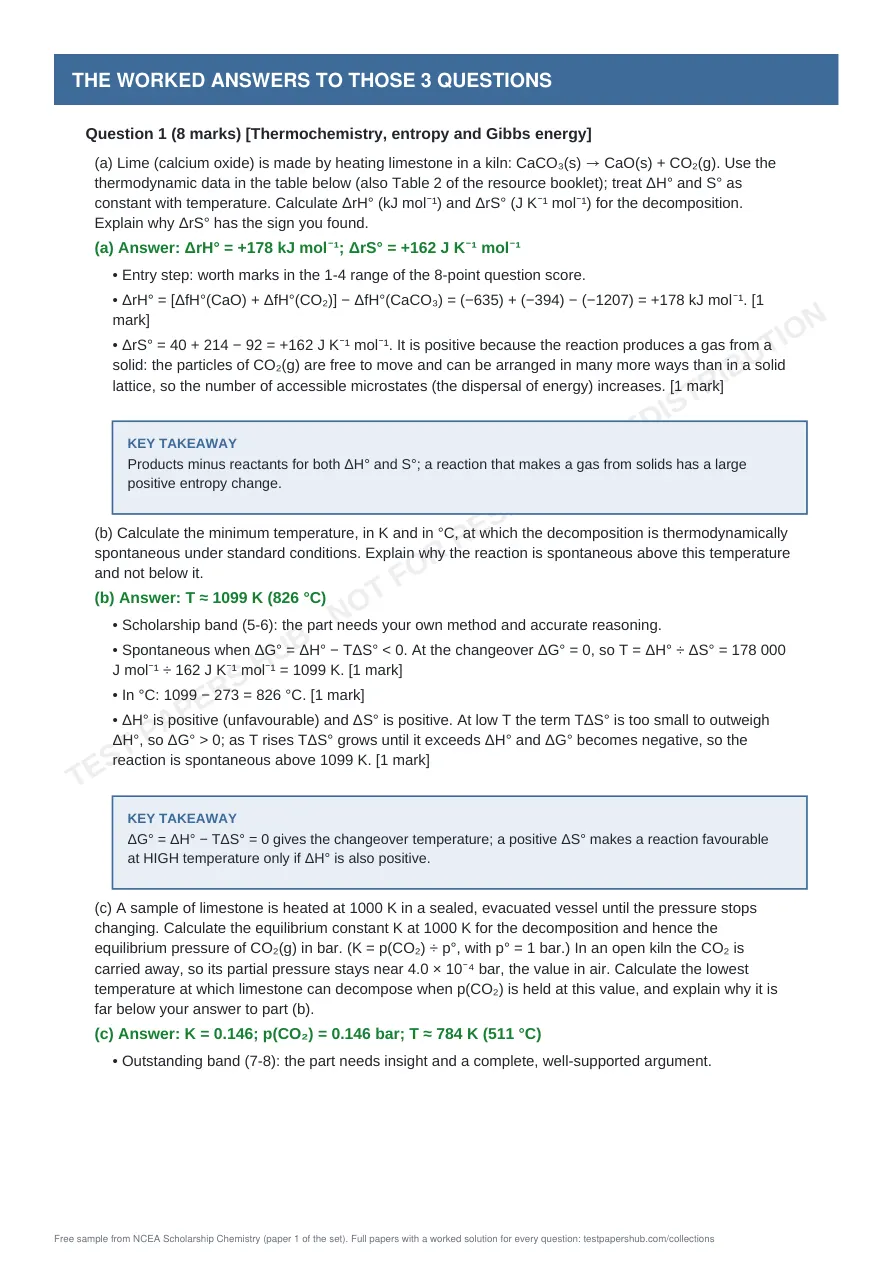
- Products minus reactants for both ΔH° and S°; a reaction that makes a gas from solids has a large positive entropy change.
- ΔG° = ΔH° − TΔS° = 0 gives the changeover temperature; a positive ΔS° makes a reaction favourable at HIGH temperature only if ΔH° is also positive.
- ΔG° tells you about standard conditions (1 bar); the real driving force is ΔG = ΔG° + RT ln Q, so removing a gaseous product lowers the temperature needed.
- For a weak acid use Ka = [H⁺]²/c; always check the approximation by comparing [H⁺] with c (under 5%).
Read the text of this sample
y ( ) (
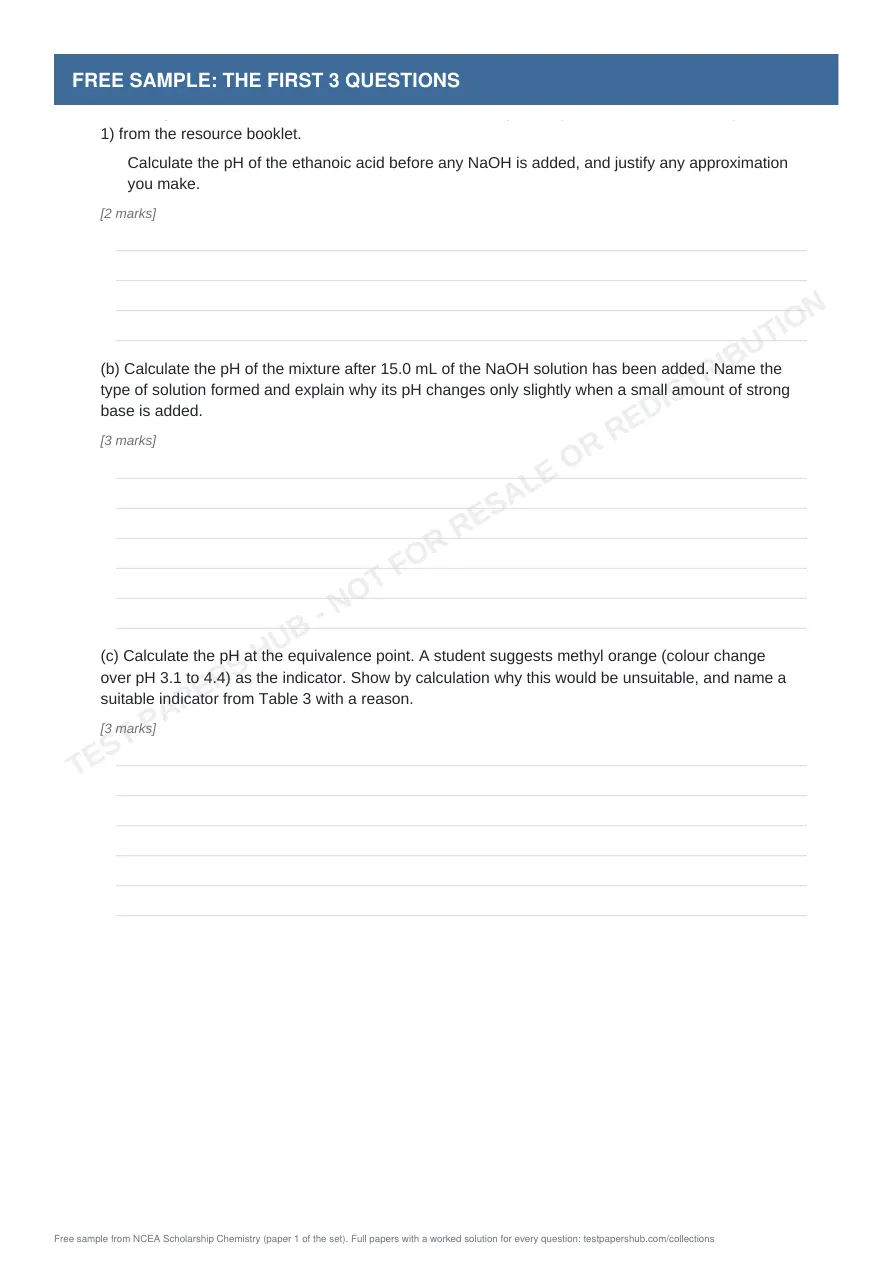
1) from the resource booklet. Calculate the pH of the ethanoic acid before any NaOH is added, and justify any approximation you make.
[2 marks]
(b) Calculate the pH of the mixture after 15.0 mL of the NaOH solution has been added. Name the type of solution formed and explain why its pH changes only slightly when a small amount of strong base is added.
[3 marks]
(c) Calculate the pH at the equivalence point. A student suggests methyl orange (colour change over pH 3.1 to 4.4) as the indicator. Show by calculation why this would be unsuitable, and name a suitable indicator from Table 3 with a reason.
[3 marks]
Question 1 (8 marks) [Thermochemistry, entropy and Gibbs energy]
(a) Lime (calcium oxide) is made by heating limestone in a kiln: CaCO₃(s) → CaO(s) + CO₂(g). Use the thermodynamic data in the table below (also Table 2 of the resource booklet); treat ΔH° and S° as constant with temperature. Calculate ΔrH° (kJ mol⁻¹) and ΔrS° (J K⁻¹ mol⁻¹) for the decomposition. Explain why ΔrS° has the sign you found.
(a) Answer: ΔrH° = +178 kJ mol⁻¹; ΔrS° = +162 J K⁻¹ mol⁻¹
• Entry step: worth marks in the 1-4 range of the 8-point question score.
• ΔrH° = [ΔfH°(CaO) + ΔfH°(CO₂)] − ΔfH°(CaCO₃) = (−635) + (−394) − (−1207) = +178 kJ mol⁻¹. [1 mark]
• ΔrS° = 40 + 214 − 92 = +162 J K⁻¹ mol⁻¹. It is positive because the reaction produces a gas from a solid: the particles of CO₂(g) are free to move and can be arranged in many more ways than in a solid lattice, so the number of accessible microstates (the dispersal of energy) increases. [1 mark]
(b) Calculate the minimum temperature, in K and in °C, at which the decomposition is thermodynamically spontaneous under standard conditions. Explain why the reaction is spontaneous above this temperature and not below it.
(b) Answer: T ≈ 1099 K (826 °C)
• Scholarship band (5-6): the part needs your own method and accurate reasoning.
• Spontaneous when ΔG° = ΔH° − TΔS° < 0. At the changeover ΔG° = 0, so T = ΔH° ÷ ΔS° = 178 000
J mol⁻¹ ÷ 162 J K⁻¹ mol⁻¹ = 1099 K. [1 mark]
• In °C: 1099 − 273 = 826 °C. [1 mark]
• ΔH° is positive (unfavourable) and ΔS° is positive. At low T the term TΔS° is too small to outweigh ΔH°, so ΔG° > 0; as T rises TΔS° grows until it exceeds ΔH° and ΔG° becomes negative, so the reaction is spontaneous above 1099 K. [1 mark]
(c) A sample of limestone is heated at 1000 K in a sealed, evacuated vessel until the pressure stops changing. Calculate the equilibrium constant K at 1000 K for the decomposition and hence the equilibrium pressure of CO₂(g) in bar. (K = p(CO₂) ÷ p°, with p° = 1 bar.) In an open kiln the CO₂ is carried away, so its partial pressure stays near 4.0 × 10⁻⁴ bar, the value in air. Calculate the lowest temperature at which limestone can decompose when p(CO₂) is held at this value, and explain why it is far below your answer to part (b).
(c) Answer: K = 0.146; p(CO₂) = 0.146 bar; T ≈ 784 K (511 °C)
• Outstanding band (7-8): the part needs insight and a complete, well-supported argument.
• ΔG° at 1000 K = 178 000 − 1000 × 162 = +16000 J mol⁻¹. K = e^(−ΔG°/RT) = e^(−16000 ÷ (8.314 × 1000)) = 0.1460, so p(CO₂) = 0.146 bar. [1 mark]
• Reaction is just possible when ΔG = 0 with Q = 4.0 × 10⁻⁴: ΔH° − TΔS° + RT ln(4.0 × 10⁻⁴) = 0, so T = ΔH° ÷ [ΔS° − R ln(4.0 × 10⁻⁴)] = 178 000 ÷ (162 + 65.05) = 784 K (511 °C). [1 mark]
• Part (b) assumes standard conditions (1 bar CO₂). In an open kiln the product gas is removed, so Q is tiny and ΔG = ΔG° + RT ln Q is much more negative than ΔG°; by Le Chatelier's principle removing CO₂ shifts the equilibrium to the right. The decomposition therefore starts at about 784 K, far below 1099 K, and is driven further by continuous removal of CO₂. [1 mark]
Question 2 (8 marks) [Aqueous equilibria and titration]
Your sample is downloading. Liked it? NCEA Scholarship Chemistry Paper 1 is the full paper: four questions of 8 points (32 in all) in three hours on thermochemistry, equilibrium and titrations, organic structure and spectroscopy, and electrochemistry, each with a data booklet and a worked solution for every part showing the score band, with a worked solution for every question.
Get Paper 1 for A$11.99See all 20 papers from A$11.99More free NCEA (New Zealand) samples
Questions about this sample
What is in the NCEA Scholarship Chemistry free sample?
The first 3 questions from paper 1 of the set, in the real exam layout, followed by the step-by-step worked answers. It is a 5-page PDF; this page shows the opening pages.
How many full NCEA Scholarship Chemistry papers are there?
20 original papers for New Zealand Year 13 students preparing for NZ Scholarship Chemistry (standard 93102). Each is four questions of 8 points (32 in all) in three hours on thermochemistry, equilibrium and titrations, organic structure and spectroscopy, and electrochemistry, each with a data booklet and a worked solution for every part showing the score band, with a worked solution for every question. Papers start at A$11.99 and download instantly as a PDF.
Are these official past papers?
No. The sample is taken from our own original practice paper and is not an official past paper or affiliated with any exam authority.