NCEA Scholarship Economics free practice questions with answers
Read the opening questions and their worked answers from paper 1 of our 20-paper NCEA Scholarship Economics set, then download the 5-page PDF. These are original practice questions, not official past papers. Page updated 3 November 2026.

Topics: Natural monopoly and regulation (93402).
- A natural monopoly has falling average cost over the market; any monopolist sets MR = MC and prices off the demand curve, so output is too low.
- A monopolist's profit-maximising output sets MR = MC; the DWL triangle has height P − MC at that output and base the shortfall from the P = MC output.
- Marginal-cost pricing is allocatively efficient but loses the fixed cost; average-cost pricing breaks even with a small deadweight loss; compare options by the output reached and who funds the shortfall.
- Regulating a natural monopoly is a trade-off between allocative efficiency, the funding of fixed costs and the incentive to control costs; a two-part tariff gets P = MC and covers the fixed cost.
Read the text of this sample
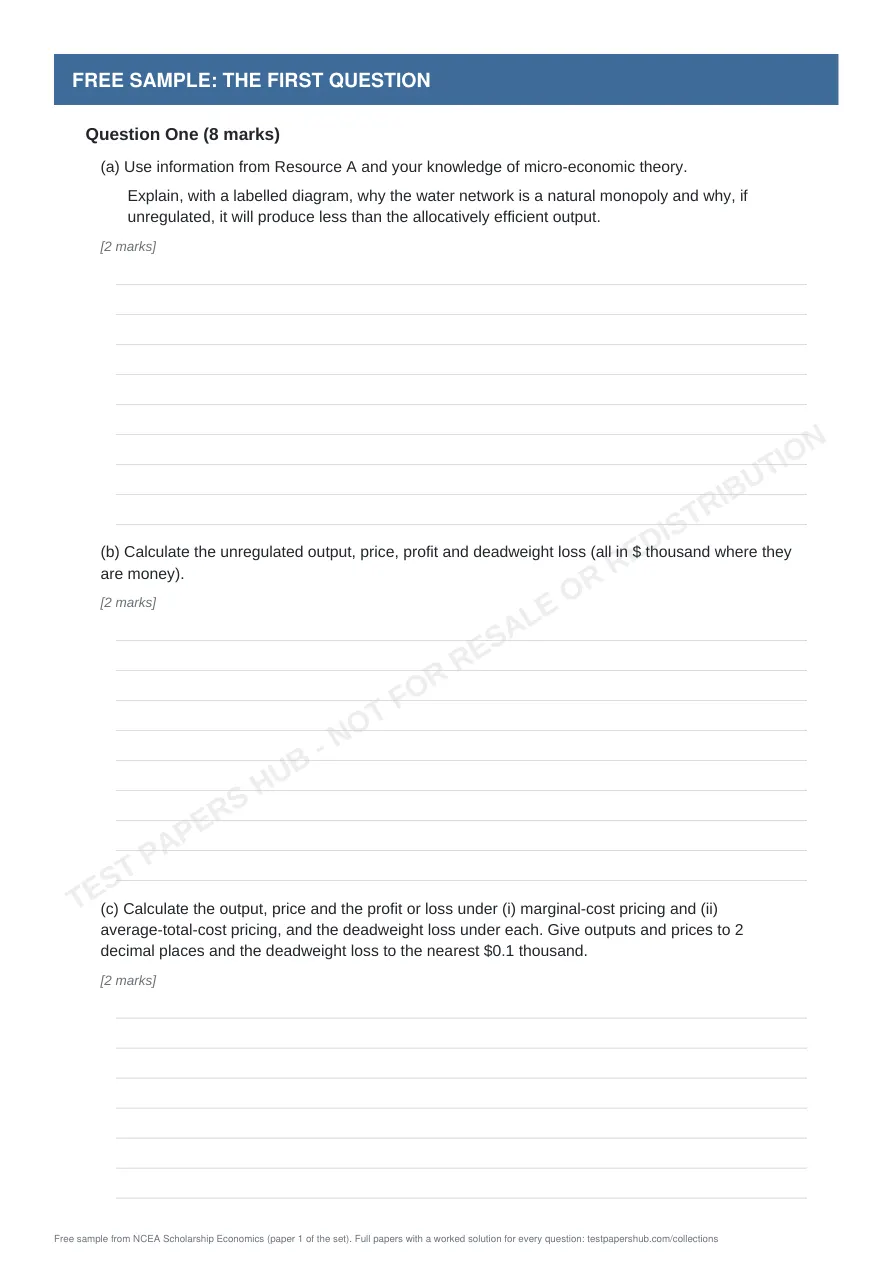
Question One (8 marks)
(a) Use information from Resource A and your knowledge of micro-economic theory. Explain, with a labelled diagram, why the water network is a natural monopoly and why, if unregulated, it will produce less than the allocatively efficient output.
[2 marks]
(b) Calculate the unregulated output, price, profit and deadweight loss (all in $ thousand where they are money).
[2 marks]
(c) Calculate the output, price and the profit or loss under (i) marginal-cost pricing and (ii) average-total-cost pricing, and the deadweight loss under each. Give outputs and prices to 2 decimal places and the deadweight loss to the nearest $0.1 thousand.
[2 marks]
(d) Evaluate the three options available to the council (leave it unregulated, marginal-cost pricing funded from rates, average-cost pricing). Recommend one, and say whether any other pricing scheme could do better.
[2 marks]
Question 1 (8 marks) [Natural monopoly and regulation]
(a) Use information from Resource A and your knowledge of micro-economic theory. Explain, with a labelled diagram, why the water network is a natural monopoly and why, if unregulated, it will produce less than the allocatively efficient output. Price ($ thousand) Quantity (thousand kilolitres) Q(m) P(m) Q(e) D MR MC ATC DWL Red triangle: deadweight loss from the monopoly output Q(m) instead of the efficient output Q(e), where P = MC.
(a) Answer: Falling average cost over the whole market; MR below price so the monopolist restricts output
• Entry step: worth marks in the 1-4 range of the 8-point question score.
• Fixed costs are large and marginal cost is constant, so average total cost = 400 ÷ Q + 10 falls as output rises and keeps falling over the whole range of demand. One firm can supply the market at lower cost than two, so competition is wasteful and a single seller emerges (a natural monopoly). [1 mark]
• A monopolist faces the downward-sloping market demand curve, so to sell more it must lower the price on every unit: marginal revenue lies below demand. It maximises profit where MR = MC, at Q = 40, and charges 50 from the demand curve. The allocatively efficient output is where price = MC (Q = 80); between the two outputs each unit is worth more to consumers than it costs to supply, so there is a deadweight loss. [1 mark]
(b) Calculate the unregulated output, price, profit and deadweight loss (all in $ thousand where they are money).
(b) Answer: Q = 40 thousand kL at P = 50; profit $1200 thousand; DWL $800 thousand
• Scholarship band (5-6): the part needs your own method and accurate reasoning.
• MR = 90 − 2Q; setting MR = MC = 10 gives Q = 40 and P = 90 − 40 = 50. ATC at that output = 400 ÷ 40 + 10 = 20, so profit = (50 − 20) × 40 = $1200 thousand. [1 mark]
• The efficient output has P = MC: 90 − Q = 10, so Q = 80. Deadweight loss = ½ × (P − MC) × (Q(e) − Q(m)) = ½ × (50 − 10) × (80 − 40) = $800 thousand. [1 mark]
(c) Calculate the output, price and the profit or loss under (i) marginal-cost pricing and (ii) average-total-cost pricing, and the deadweight loss under each. Give outputs and prices to 2 decimal places and the deadweight loss to the nearest $0.1 thousand.
(c) Answer: (i) Q = 80 at P = 10, loss $400 thousand, DWL 0; (ii) Q = 74.64 at P = 15.36, normal profit, DWL $14.4 thousand
• Scholarship band (5-6): the part needs your own method and accurate reasoning.
• (i) P = MC = 10 gives Q = 80. ATC = 400 ÷ 80 + 10 = 15 > P, so the loss is (15 − 10) × 80 = $400 thousand (exactly the fixed cost). Allocative efficiency is achieved: DWL = 0. [1 mark]
• (ii) P = ATC: 90 − Q = 400 ÷ Q + 10, so Q² − 80 Q + 400 = 0, giving Q = [80 + √(6400 − 1600)] ÷ 2 = 74.64 (the larger root, which gives the greater output with price still equal to ATC). P = 90 − 74.64 = 15.36, so profit is zero. DWL = ½ × (15.36 − 10) × (80 − 74.64) = $14.4 thousand. [1 mark]
(d) Evaluate the three options available to the council (leave it unregulated, marginal-cost pricing funded from rates, average-cost pricing). Recommend one, and say whether any other pricing scheme could do better.
Your sample is downloading. Liked it? NCEA Scholarship Economics Paper 1 is the full paper: three questions made of several multi-part problems answered in writing (constructed response, no multiple choice), with a worked solution for every part that shows whether it is aimed at Achieved, Merit or Excellence, with a worked solution for every question.
Get Paper 1 for A$11.99See all 20 papers from A$11.99More free NCEA (New Zealand) samples
Questions about this sample
What is in the NCEA Scholarship Economics free sample?
The first 3 questions from paper 1 of the set, in the real exam layout, followed by the step-by-step worked answers. It is a 5-page PDF; this page shows the opening pages.
How many full NCEA Scholarship Economics papers are there?
20 original papers for New Zealand Year 13 students preparing for NZ Scholarship Economics (standard 93402). Each is three questions made of several multi-part problems answered in writing (constructed response, no multiple choice), with a worked solution for every part that shows whether it is aimed at Achieved, Merit or Excellence, with a worked solution for every question. Papers start at A$11.99 and download instantly as a PDF.
Are these official past papers?
No. The sample is taken from our own original practice paper and is not an official past paper or affiliated with any exam authority.